Cehennemağzı Cave: Three Ancient Quarries and an Early Christian Church
Site at a Glance
- Rating
- 4.3
- Popularity
- Very High
- Country
- Turkey
- Primary era
- Classical
- Eras represented
- Classical
- Civilizations
- Roman
- Site type
- Economic
- Remains
- Quarry
On this page7 sections
History
Cehennemağzı Cave is an archaeological site comprising three former quarries in Karadeniz Ereğli, Zonguldak Province, northern Turkey. Quarrying had ended about 2,000 years ago, after which mineral formations called speleothems began developing in the excavations.
Ancient setting and traditions
In antiquity, the surrounding area was known as the Acheron Valley and associated with Ayazma, meaning “sacred spring.” The valley was regarded as one of antiquity’s two major centers of prophecy, alongside Delphi, the Greek sanctuary and oracle of Apollo. Greek myth identifies the caves as the place where Herakles descended to the land of the dead to seize Cerberus, the hound of Hades, ruler of the underworld and the dead. This was one of the twelve labors set for Herakles by King Eurystheus.
Early Christian reuse
In the early years of Christianity, the first quarry was adapted as a church and concealed place of worship. It is also known as Church Cave or Hercules Cave.
Remains
The three excavations lie side by side and were cut into limestone rather than formed as a natural cave system. Cehennemağzı Cave is described as 85 m long and 11 m deep, at an elevation of 24 m.
The first quarry
The first quarry has two sections. Its first section contains a floor mosaic with plant and geometric designs, along with columns, capitals (the upper parts of columns), and niches for oil lamps. In the second section, an apse, a recessed area commonly at a church’s end, survives in the eastern wall, with steps in front of it.
Koca Yusuf Cave
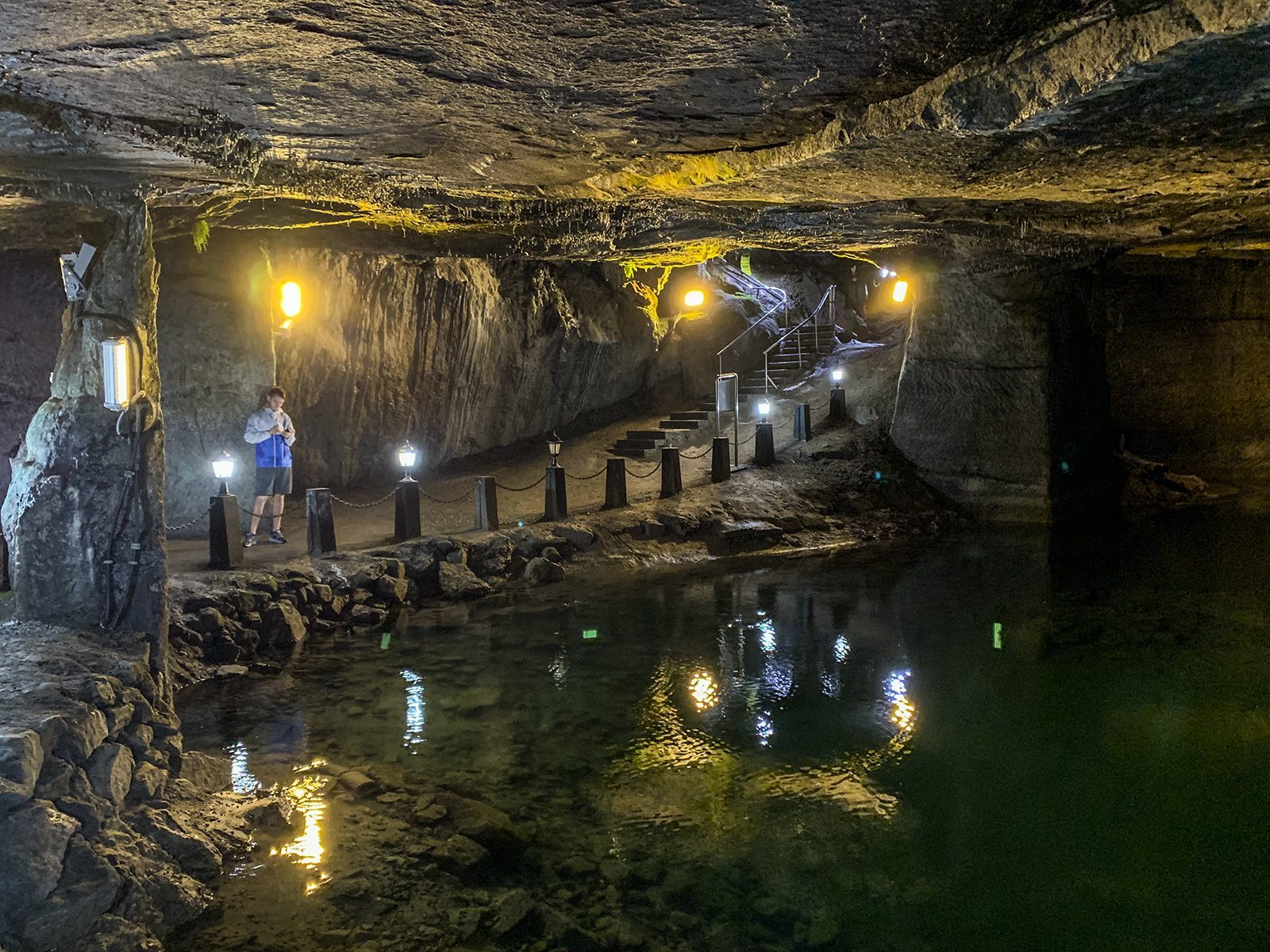
The second quarry, locally called Koca Yusuf Cave, occupies a slope about 10 to 12 m above the roadside. A narrow entrance and a vertical staircase of three steps lead inside. Its passage extends about 1.5 km into the mountain, but a rockfall around 1960 blocked the route, limiting access to a depth of about 350 m. The quarry covers about 400 m². Traces of stonework and two massive rectangular pillars indicate room-and-pillar mining, a method that leaves rock supports within the excavated space.
The third quarry
The third quarry is the largest by area. Groundwater covers its floor, and the artificial cavern served as a cistern and water source for the first and second quarries.