Cave of Altamira: A Prehistoric Painted Cave in Spain
Site at a Glance
- Popularity
- Very High
- Country
- Spain
- Primary era
- Stone Age
- Eras represented
- Stone Age
- Civilizations
- Unclassified
- Site type
- Civic
- Remains
- Rock Art
On this page16 sections
History
The Cave of Altamira is a natural limestone cave preserving Upper Paleolithic art and archaeological remains near Santillana del Mar in Cantabria, Spain. Evidence indicates human use over roughly 22,000 years, from about 36,000 to 13,000 years ago. The archaeological sequence is associated chiefly with the Aurignacian, Gravettian, Solutrean, and Magdalenian, cultural periods within the Upper Paleolithic, a later phase of the Stone Age. These period names describe material cultures, not necessarily the makers of particular images.
Prehistoric use and dating
Uranium-series analysis has dated a sign in the Great Hall to about 36,000 years ago, near the beginning of the Aurignacian. A red horse outlined with dots has been dated to about 22,110 years ago. These early dates have led to the possibility that Neanderthals made some of the art, but the artists’ identities remain uncertain.
Archaeological evidence places activity associated with the Solutrean at about 16,590 BCE and Magdalenian activity between about 14,530 and 11,180 BCE. Earlier estimates placed the Great Hall paintings between 15,000 and 12,000 BCE, while later estimates put the main group of multicolored images most probably around 13,540 BCE. A 2008 study concluded that the art may have been produced over a period as long as 20,000 years.
About 13,000 years ago, a rockfall at the end of the Magdalenian blocked the main entrance. Human access ended, helping to preserve the paintings, engravings, and deposits inside.
Discovery and recognition
Local hunter and tiler Modesto Cubillas found the entrance in 1868 while freeing his dog from rocks. Marcelino Sanz de Sautuola, a local landowner and amateur prehistorian, visited the cave by 1875 and probably returned in 1876. In 1879 he went back to excavate near the entrance. His daughter María, then about eight years old, noticed the ceiling paintings and called his attention to them.
In 1880, Sautuola published an argument that the paintings were prehistoric, supported by geologist Juan Vilanova y Piera. Many scholars rejected the claim, and some accused Sautuola of forgery. The discovery of comparable prehistoric art elsewhere in Europe helped establish that the paintings were authentic. Émile Cartailhac, who had been a prominent sceptic, visited Altamira and publicly acknowledged his error in 1902. Henri Breuil’s research on prehistoric cave art also helped shift scholarly opinion.
Research, conservation, and heritage
Excavation and study continued after Sautuola’s work. In 1902, archaeologist Hermilio Alcalde del Río investigated layers associated with the Magdalenian and Solutrean and recovered three kilograms of hematite, an iron-oxide mineral used for red pigment. Cartailhac and Breuil surveyed the cave from 1902 to 1904. Hugo Obermaier and Breuil worked there in 1924, and Obermaier continued in 1925. Joaquín González Echegaray and Leslie Freeman excavated the Magdalenian layer in 1980 and 1981. Earlier excavation results were reassessed in 2004, and uranium-thorium sampling in 2012 provided further dates for the art.
A conservation committee was formed in 1910, and another was appointed in 1925 to improve preservation. The Altamira Cave Board, the body responsible for oversight, began operating in 1940. Heavy visitation threatened the cave’s microclimate and paintings; visitor numbers reached 174,000 in 1973. The cave closed in 1977, reopened under restrictions in 1982, and closed again in 2002 while the effects of access were studied. An experimental program in 2014 limited visits to five people a day and 37 minutes per visit to assess their impact.
Altamira received Spain’s Historic-Artistic Monument designation in 1924 and became a UNESCO World Heritage Site in 1985. In 2008, the listed property was extended to include 17 other caves in Cantabria, Asturias, and the Basque Country. A National Museum and Research Center of Altamira, with a replica intended to reduce pressure to enter the original cave, was established beside it. Reproductions were also made in the 1960s for the National Archaeological Museum in Madrid and the Deutsches Museum in Munich. Close comparison of the museum replica and the original helped identify additional paintings and engravings.
The purpose of the art remains uncertain. Suggested explanations include religious or fertility rites, hunting ceremonies, images intended to influence real events, social or sexual symbolism, conflict between groups, and art made for its own sake. Prehistorian André Leroi-Gourhan proposed that caves could serve as shared ritual places with more restricted inner areas, and interpreted Altamira’s Great Hall as a temple. This is a scholarly interpretation, not a proven account of prehistoric practice.
Remains
Setting and spatial plan
Natural setting and cave course
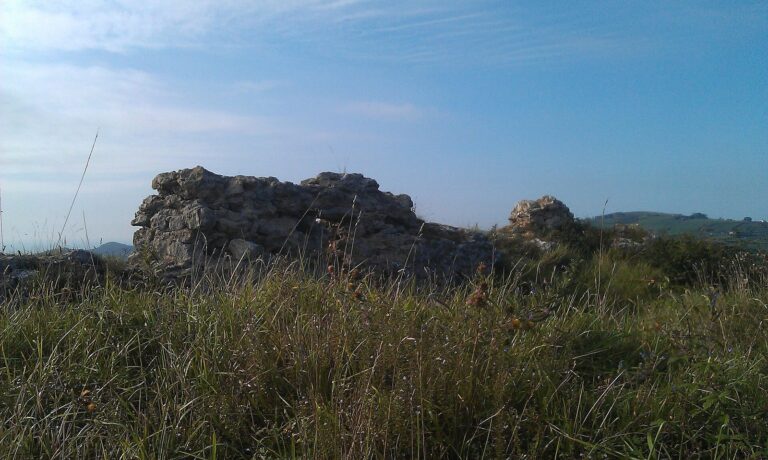
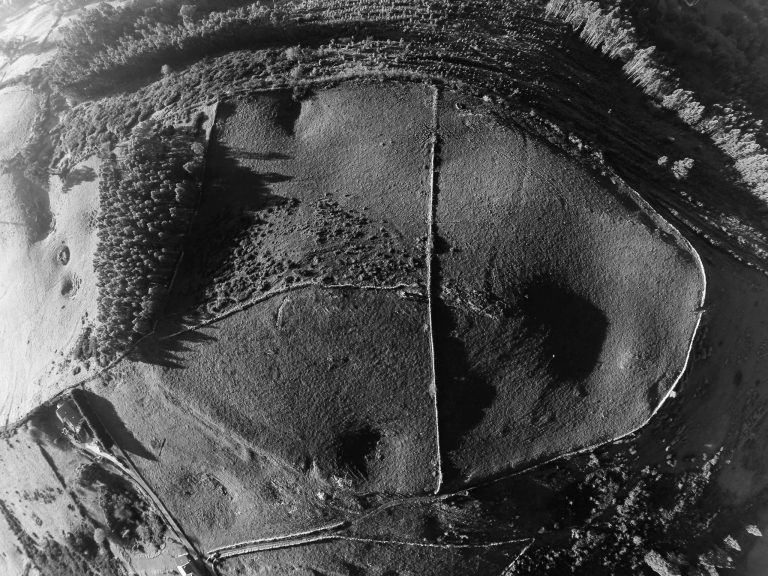
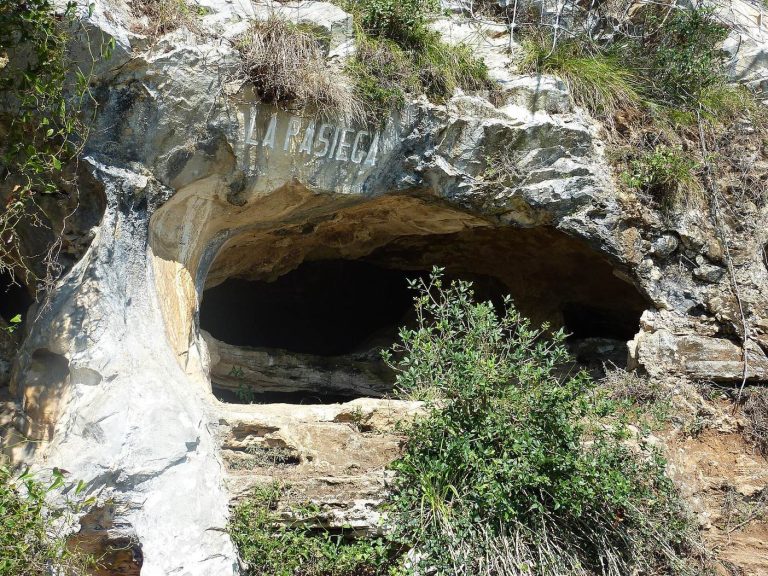
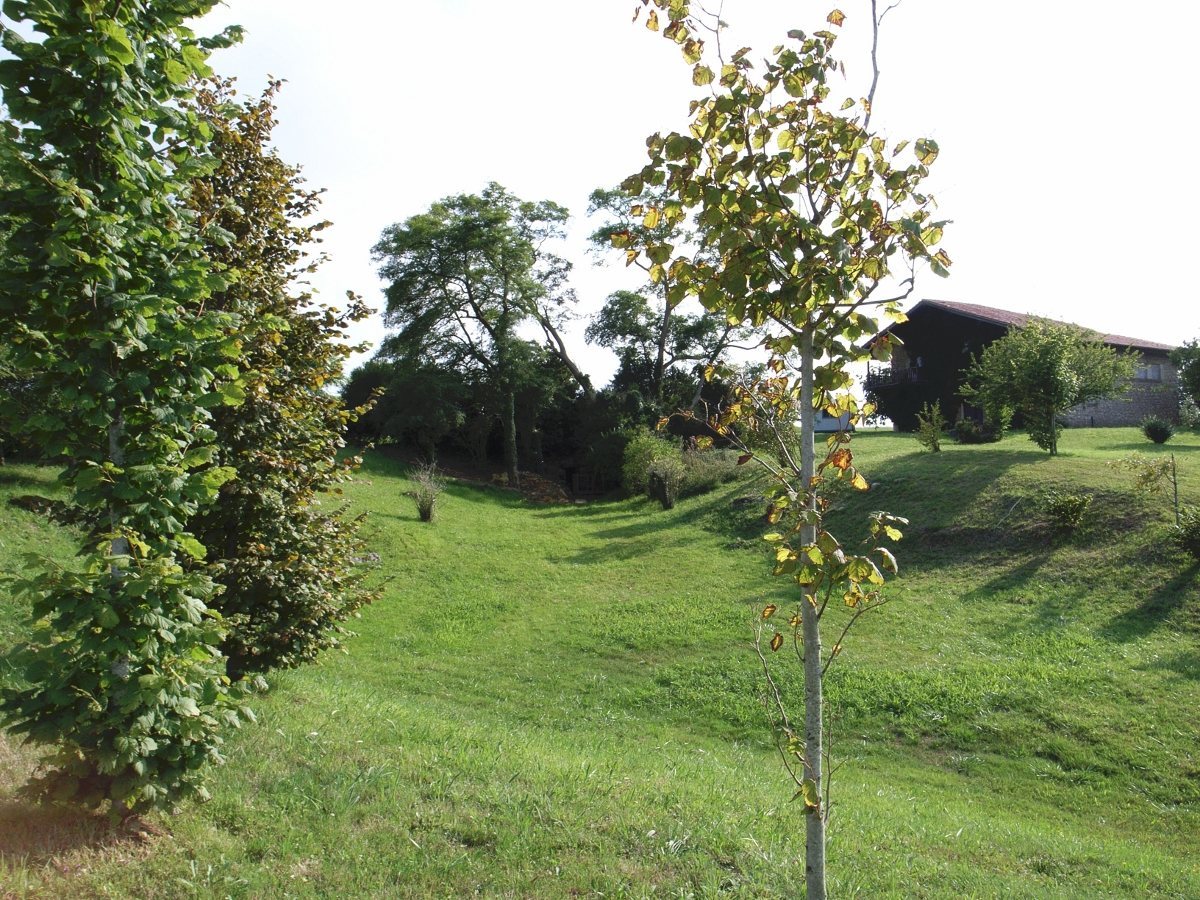
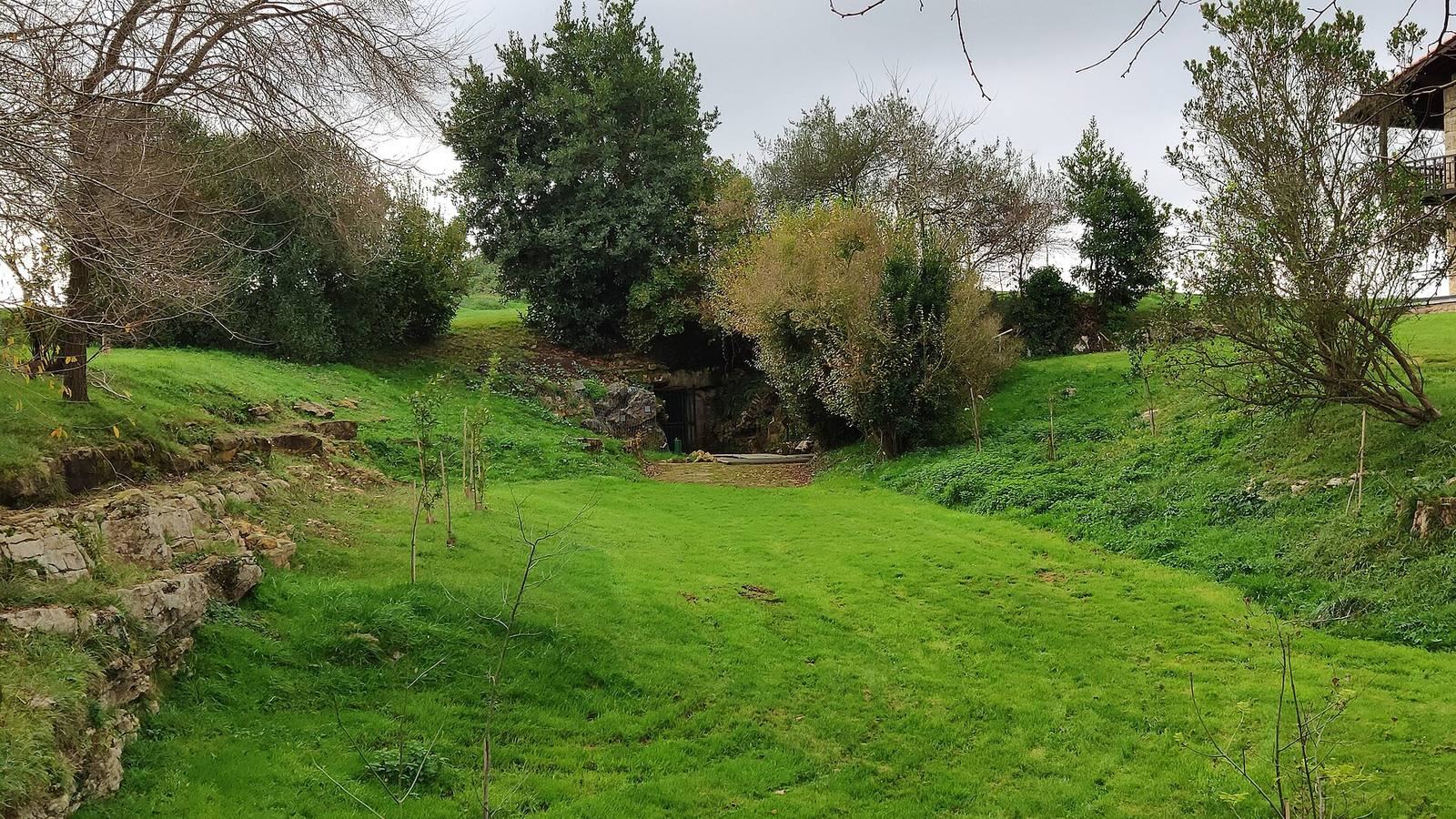
The cave lies in a small Pliocene limestone hill, in a meadow about two kilometres from the centre of Santillana del Mar. Its entrance is 156 metres above sea level and about 120 metres above the Saja River, which flows roughly two kilometres away. The present coast is about five kilometres distant. When the Great Hall paintings were made, the Bay of Biscay was lower and the shoreline is estimated to have been another eight to ten kilometres inland.
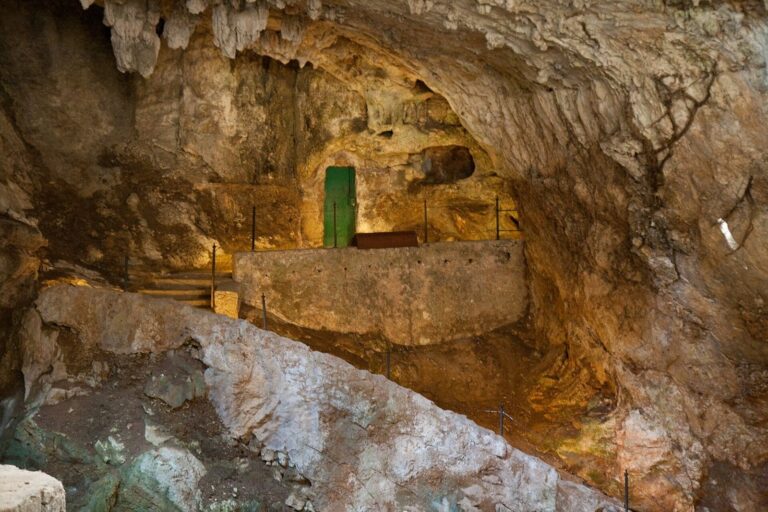
Altamira extends about 270 metres. It has a single entrance and a main gallery with few branches, ending in a long, narrow passage that is difficult to traverse. The main passage varies from about two to six metres in height. Major collapses occurred at different times, including one before Solutrean activity and others before or during later periods of occupation. Two further collapses probably occurred before the end of the Pleistocene, about 12,000 years ago, and smaller collapses continued afterward.
Vestibule
The broad vestibule received daylight before the entrance was blocked. It contains archaeological deposits and two pits probably used to cook deer or other meat. Its role as a long-term dwelling area is uncertain. Some interpretations consider it part of a place occupied over generations, while later research suggests that the principal shelter may have been outside the cave and that water carried some vestibule deposits in from elsewhere.
Great Polychrome Hall
The second chamber is the Great Polychrome Hall, named for its multicolored ceiling paintings. Its vaulted ceiling measures about 18 by 9 metres. The original space beneath it was approximately 1.1 to 1.9 metres high. The floor was lowered to improve viewing, with a central strip left at its former level. Before the entrance was blocked, some daylight reached the hall from the vestibule, but not enough for painting. The chamber’s temperature is about 13.5 to 14.5 degrees Celsius and its relative humidity about 94 to 97 percent.
Inner galleries and chambers
Beyond the vestibule and Great Hall, the cave includes a gallery, the Black Bison Room, the Hall of the Pit, the Horse’s Tail passage, and the Great Hall of Tectiform Signs. The vestibule and Great Hall may have formed a more continuous space when the paintings were made than the present layout suggests. Other chambers lie beyond sunlight and required artificial illumination. Their remains indicate occasional access rather than habitual occupation.
Paintings and engravings
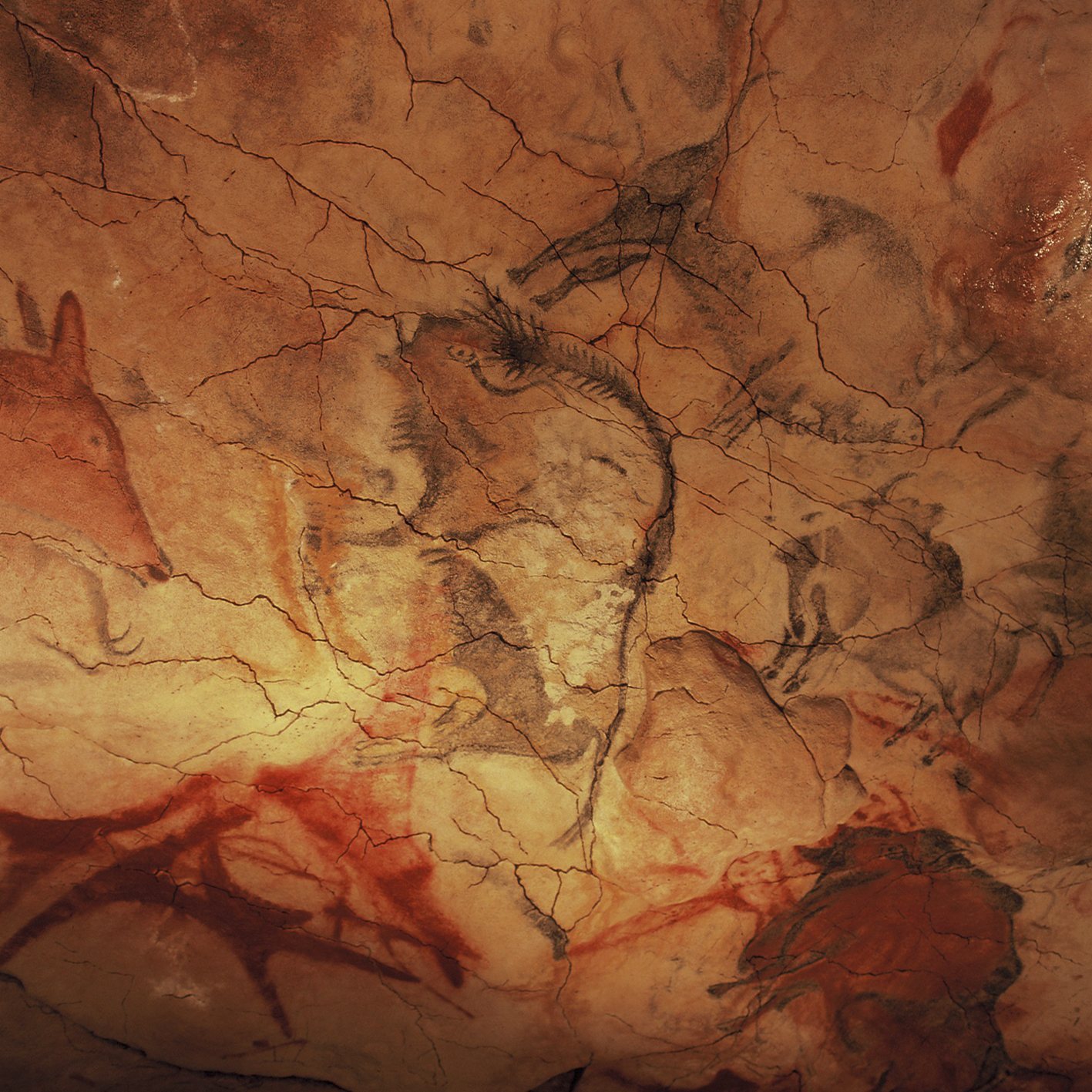
The cave’s images were made in different phases and styles. They include animals, human-like figures, abstract forms, and signs, painted, engraved, or created by combining the two techniques. Much of the work belongs to the Franco-Cantabrian tradition, a prehistoric-art region spanning northern Spain and southwestern France, known for realistic animal figures. Black, red, and ochre are the main colors.
Artists used charcoal, iron-oxide pigments, ochres, and hematite, applying them dry or mixed with water. The possible use of animal fat as a binder remains uncertain. Charcoal formed black outlines, while artists probably cut other outlines into the rock with a burin, a pointed stone tool for engraving. Pigment was applied with fingers or tools. It may also have been blown through bird-bone tubes: three tubes with traces of ochre were recovered in excavations, and another was found in 1981. Natural projections in the rock helped give some figures volume. Artificial light was needed for work in the Great Hall and deeper chambers; torches or lamps using animal fat or marrow have been proposed, though broken bones beneath some paintings provide only possible evidence for marrow fuel.
Great Hall ceiling
The ceiling has a rear area beyond the Great Hind with red and black figures and engravings, a right-hand area with red and multicolored animals and engravings, and a large multicolored group on the left. The main bison group includes 16 multicolored bison and one black bison, about 1.4 to 1.8 metres long. Eleven are standing; the others are lying or reclining, and some appear to be moving. The resting animals have been interpreted as wounded or dead, or as rolling in dust.
One particularly expressive bison occupies a bulge in the vault, its body contracted, legs folded, and head lowered. The Great Hind, the cave’s largest figure at about 2.25 metres long, combines engraved details and outline with stylized legs and modeled color. A small black bison appears beneath its neck, and a herd of bison is shown at its feet. At one end of the vault, an ochre horse has black on its mane and part of its head, with a red hind inside its outline. Breuil considered the horse among the oldest figures on the ceiling.
Deer, boars, horses, roof-like tectiform signs, and shield-shaped signs also appear in the Great Hall. Dozens of engraved horses lie beneath the multicolored paintings and were made earlier than them. Their attribution to a single artist is tentative. The shield-shaped signs probably belong to the same period as the multicolored images and use a similar red ochre.
Other chambers and passages
In Gallery II and Room II, finger-traced marks on soft clay ceilings are known as macaronis; a possible bull or aurochs, an extinct wild cattle species, is also present. Room III has red tectiform signs on projecting ceiling surfaces. Gallery IV contains overlapping engravings of deer and hinds, including one hind with unfinished legs. Gallery V has a black bison without legs, an engraved bull, and a possible black-painted horse. A recess called Room VI contains a prominent black bison.
The widened area between Rooms VII and VIII is divided into two groups of simple black drawings, signs, and lines. Zone C is on the left when moving inward, and Zone D on the right. Room IX, the Hall of the Pit, precedes the final passage. In Zone E, to the left before that passage, four black animals assigned to the Lower Magdalenian include a possible ibex, a hind, and two further possible ibexes. A black figure of an unidentified four-legged animal is also present.
The Horse’s Tail is a narrow passage about two metres wide. It contains as many as 19 paintings and engravings of bison, deer heads, horses, and bovids, members of the cattle, bison, sheep, goat, and antelope family, as well as tectiform signs. Some images are sketches and others are complete; they measure about 30 to 50 centimetres.
Archaeological and environmental evidence
Portable finds
Excavations recovered stone tools and personal or decorative objects, including bifaces, tools shaped on both sides, points, spears, scrapers, burins, blades, needles, beads, and pendants. Other finds include decorated mammal remains, decorated animal shoulder blades, shells used as tools or food, and fish bones. Archaeologist César González Sainz collected a decorated perforated baton in 1902. Hematite and the ochre-marked bird-bone tubes also provide evidence for the materials used in the cave. The recovered objects are now held in public and private collections in France and Spain.
Animal and food remains
Animal bones, traces, and images include foxes, cave lions, lynxes, red deer, horses, wild boar, cave bears, ibexes, chamois, roe deer, aurochs, and bison. Reindeer and seals occur in evidence associated with colder conditions, and mammoth remains were also found. Deer were a principal prey animal. Shell remains include limpets, periwinkles, and scallops; fish remains include trout, sea trout, and occasional salmon.