Cathedral of the Resurrection, Tutayev: An Orthodox Cathedral in Russia
Site at a Glance
- Rating
- 4.9
- Popularity
- Medium
- Country
- Russia
- Primary era
- Early Modern
- External website
- Open
- Eras represented
- Early Modern
- Civilizations
- Russian
- Site type
- Religious
- Remains
- Cathedral
On this page13 sections
History
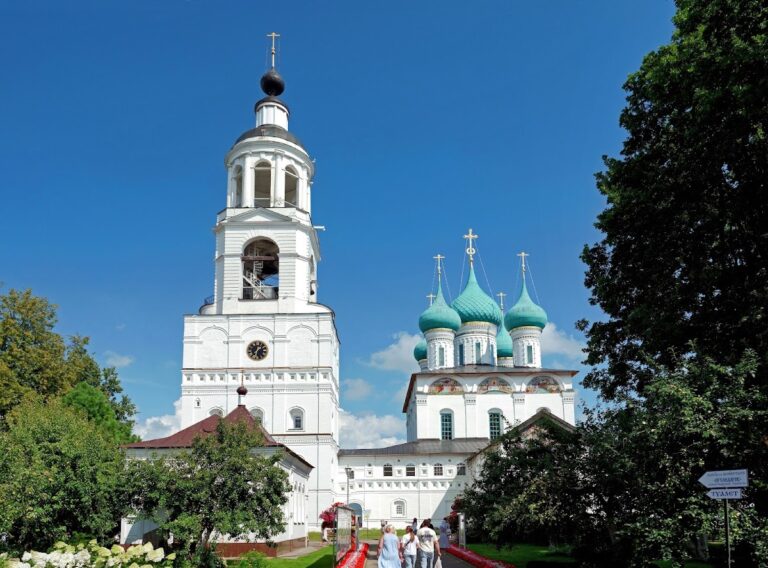
The Cathedral of the Resurrection is an Orthodox cathedral in Tutayev, Russia, built in the Yaroslavl architectural tradition between 1652 and 1687. It stands on the right bank of the Volga in the historic Borisoglebsk settlement, formerly part of Romanov-Borisoglebsk, and belongs to the Rybinsk Eparchy of the Russian Orthodox Church. The cathedral replaced earlier wooden churches and became the principal centre of worship for the settlement.
Origins and rebuilding
The cathedral occupies the site of an earlier wooden church dedicated to Saints Boris and Gleb, whose names gave the settlement its historic identity. Local tradition places a church on the site as early as 1238, although that early date remains uncertain. In 1652, a stone church with tent-shaped roofs, a refectory, and two side chapels was built and consecrated there.
By 1670, cracks had appeared in the tent roofs, and the community decided to build a larger two-level church. The rebuilding was promoted by the priests Ivan Grigoryevich and Osip Fyodorovich, the local elder Nikita Malodushkin and his associates, and the lay elders Zakhar Kotlovanov, Kornil, and Matfei Sedunov. Metropolitan Jonah of Rostov approved the plan, while builders from Yaroslavl were brought to the settlement.
The Yaroslavl builders greatly expanded the project. Rather than simply repairing the earlier church, they replaced it with a cathedral surrounded by a gallery. The principal altar was consecrated in the summer of 1675, while construction and decoration continued into the 1680s. The work was completed within the broader building campaign that lasted from 1652 to 1687.
The new cathedral brought together worship formerly divided among several smaller churches. Some wooden churches in poor condition were dismantled, and their furnishings were transferred to the new building. The upper church was dedicated to the Renewal of the Church of the Resurrection in Jerusalem. Its side chapels honoured Saints Peter and Paul, Saints Boris and Gleb, and Saint Nicholas. The lower church was dedicated to the Smolensk Icon of the Mother of God.
The cathedral and the church schism
The cathedral was built during the early period of the Russian church schism. The Old Believers were Orthodox Christians who rejected reforms to Russian church rites and texts introduced in the seventeenth century. Nearby Romanov became involved in this movement and remained a centre of Old Belief until the nineteenth century.
The Old Believer preacher Lazarus was active in the area. In 1682, he was burned at Pustozersk together with Archpriest Avvakum, one of the leading opponents of the church reforms. The cathedral therefore took shape during a period of religious division that strongly affected the communities around Romanov and Borisoglebsk.
The separately standing bell tower and the brick enclosure with its Holy Gates were erected during the same general period as the cathedral. The upper part of the bell tower was rebuilt in the eighteenth century, probably after the earlier structure had deteriorated, and the tower became somewhat lower.
Survival and continuing worship
The cathedral remained open during the Soviet period. Its continued use allowed much of its liturgical furniture, iconostasis, icons, and interior decoration to survive. During the final twenty years of his life, the Tutayev resident and Orthodox confessor George Sedov worked to restore and preserve these furnishings. He was later canonized by the Russian Orthodox Church.
The cathedral is a protected federal cultural-heritage monument of the Russian Federation and remains an active Orthodox church. Its most venerated icon, the large image of the Merciful Savior, continues to shape religious practice. Before the feasts of the Translation of the Relics of Saint Nicholas to Bari and the Protection of the Mother of God, the icon is transferred between the summer and winter churches.
A summer procession carries the icon through the Borisoglebsk side of Tutayev on the tenth Sunday after Easter. Another procession crosses to the Romanov side on the Sunday before Saint Elijah’s Day, travelling by ferry across the Volga and stopping at churches there. The Borisoglebsk procession was interrupted while the icon was kept in Rostov from 1749 to 1793 and again from the 1930s until 1990. The Romanov-side procession was established in 1888.
Remains
Hilltop setting and exterior
Main church
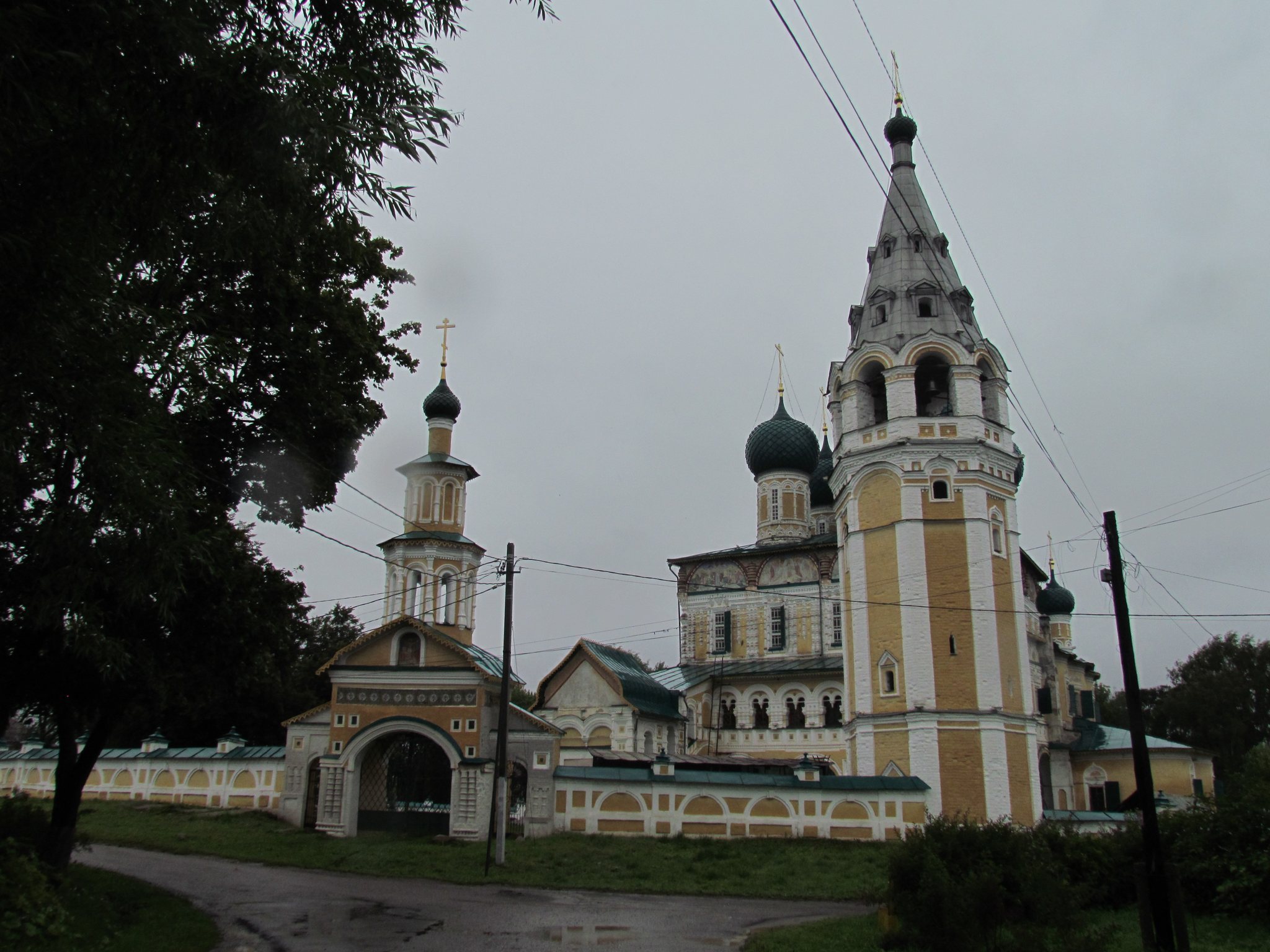
The cathedral stands on high ground on the western, right-bank side of Tutayev, on a broad hill above the Volga. It occupies a square enclosed by a brick wall and closes the perspective of streets that formerly served as the main routes through the Borisoglebsk settlement. A ravine lies to the north, while the altar faces the river. Historically, the principal approaches came from the south and west.
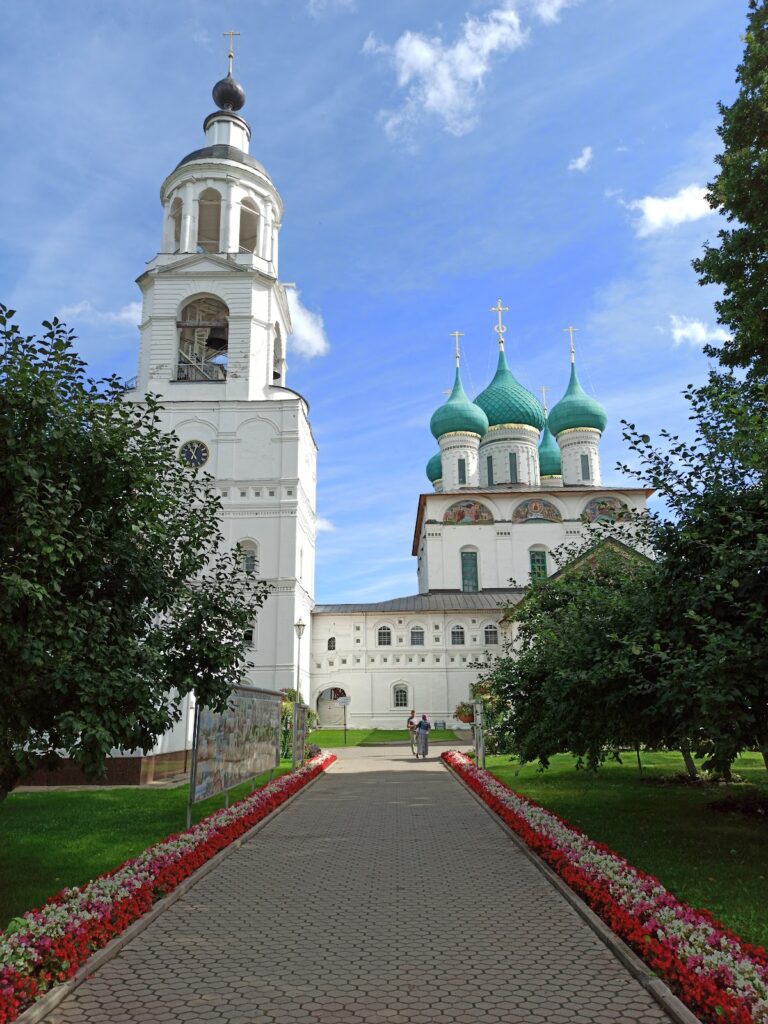
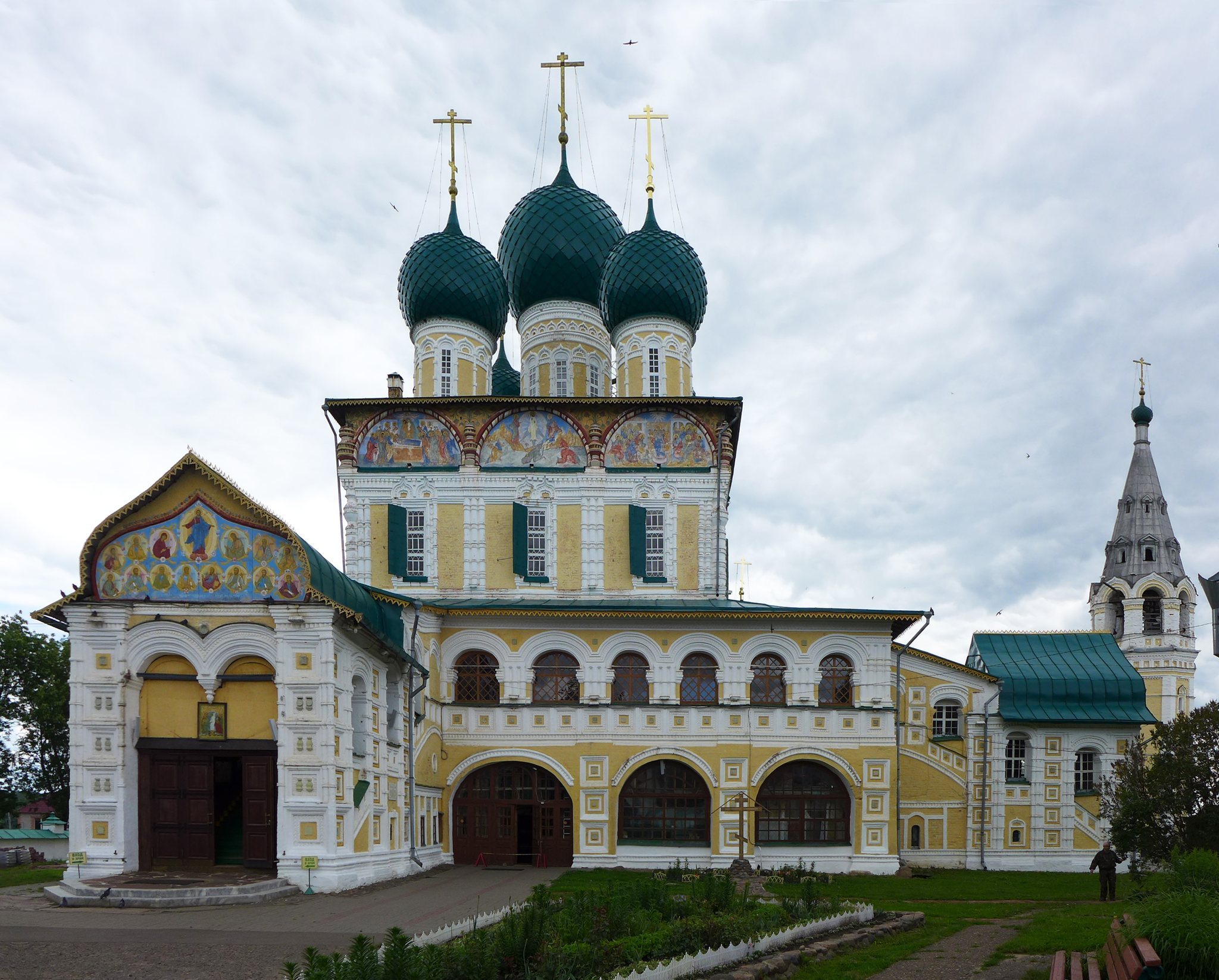
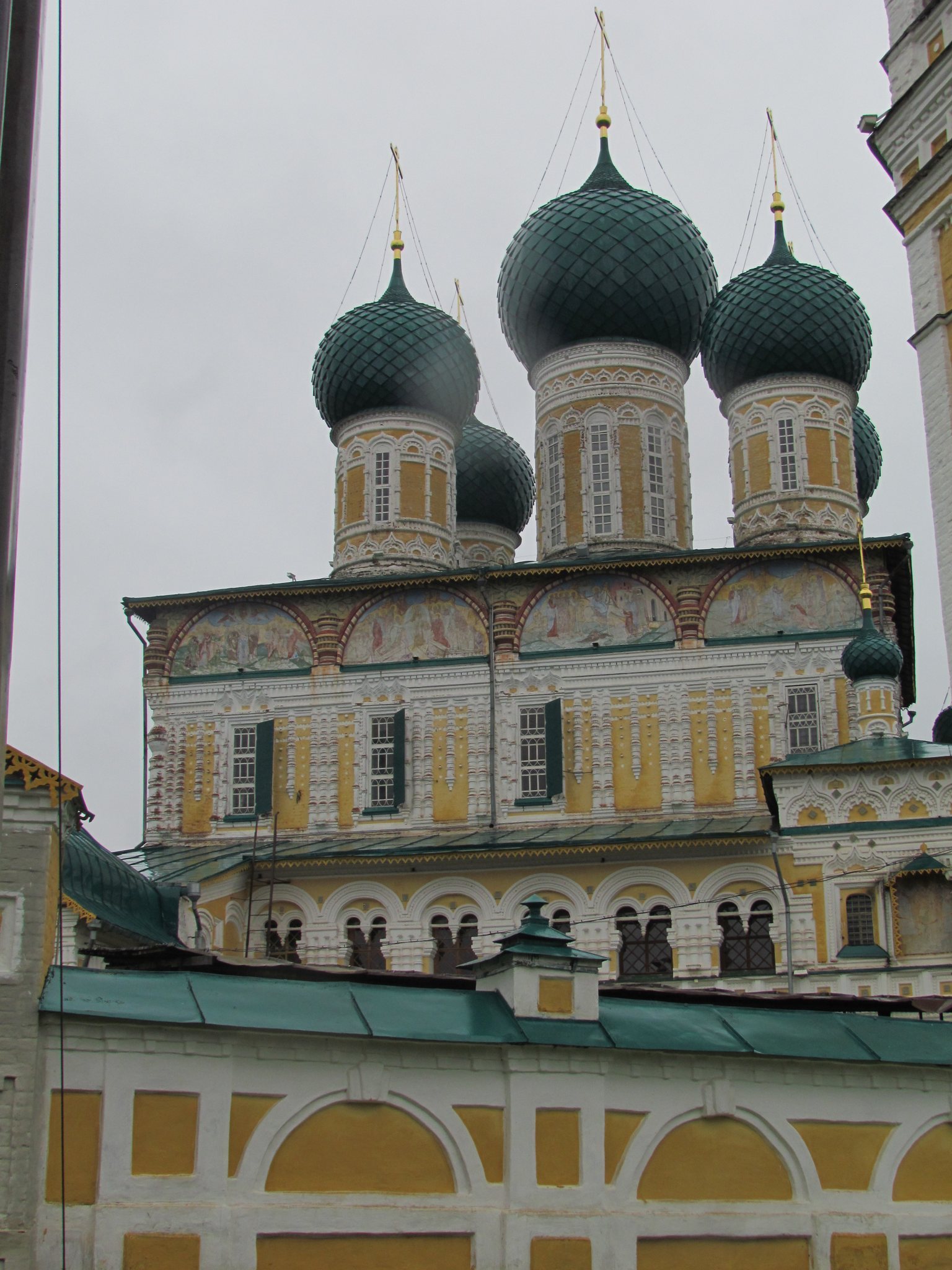
This is a large, two-level, four-pier brick church with five domes raised on tall drums. It belongs to the Yaroslavl architectural tradition, a regional seventeenth-century style known for large brick churches, surrounding galleries, elaborate brick and tile ornament, and painted surfaces. The cathedral’s extensive gallery has richly decorated porches on the south and west sides. Both porches are displaced to the left rather than centred on the building.
The lower part of the gallery is formed by broad vaulted arches. These once opened onto the exterior and are now glazed, while the windows of the lower church are set within their depth. Above them, an elegant arcade of semicircular windows forms the upper gallery, with clustered half-columns between the openings. The main volume receives light through windows above the gallery, through the drums beneath the domes, and through smaller windows between the central structure and the surrounding passage.
The side chapels stand on the gallery and carry small cupolas on blind drums. The northern chapel is reinforced with buttresses. At the altar end, two levels of three semicircular apses project from the building. The repeated arch forms of the gallery appear again in the upper windows and in the false semicircular gables known as zakomaras. Richly ornamented horizontal divisions further unite the exterior composition.
Shaped brickwork, relief ornament, tiles, half-columns, and deep recessed panels called shirinki cover the building. Many of the panels contain tiled inserts, and related patterns continue across the porches. The main church is especially lavishly decorated, with ornament extending beyond the gallery to the principal walls.
Bell tower and enclosure
The separately standing tent-roofed bell tower is placed a considerable distance from the cathedral, toward the altar end on the slope above the river. It stands in the southern part of the grounds. Its position was intended to produce a more harmonious silhouette for people approaching by the Volga, which was an important historic navigation route.
The brick enclosure contains the Holy Gates and defines the cathedral’s square. Together, the wall, gates, bell tower, and church form a planned architectural group above the river. The bell tower’s eighteenth-century upper rebuilding altered its original proportions and left it somewhat lower than before.
Painted interiors and sacred furnishings
Painted program
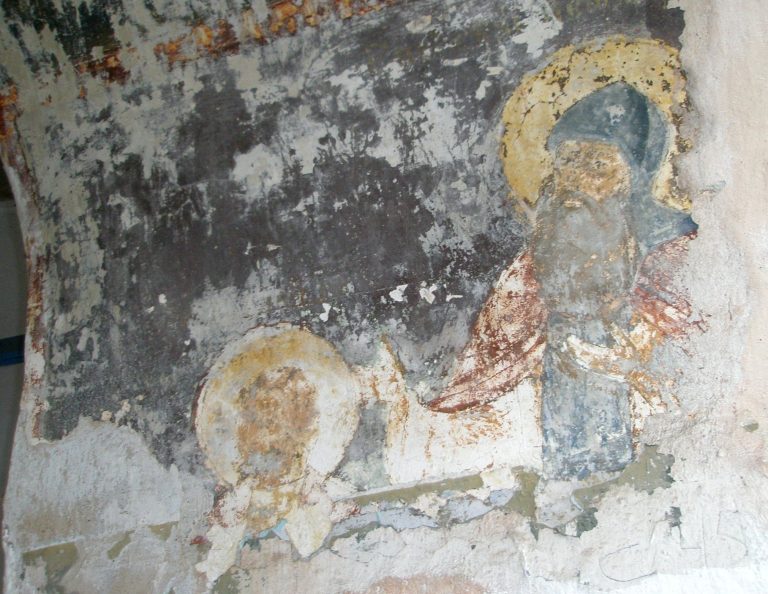
Yaroslavl painters whose names are unknown decorated the cathedral in the 1680s. The wall paintings include Gospel scenes and a monumental Last Judgment across the west wall of the central chamber. The south wall represents the Seven Ecumenical Councils, the principal councils recognised by Eastern Orthodox Christianity as defining major points of doctrine.
The north gallery contains scenes associated with the Resurrection. The south gallery illustrates the Creation, Adam and Eve in Paradise, and other episodes from the opening chapters of Genesis. The west gallery depicts the Flood, Noah, and the building of the Tower of Babel. The southern entrance stairway contains an Apocalypse cycle, representing the final events described in Christian scripture.
Many scenes carry explanatory inscriptions with biblical and Gospel passages, as well as verses associated with Simeon of Polotsk, a seventeenth-century Orthodox cleric, writer, and poet. The painted program also includes less common subjects, including the Old Russian tale of Eulogius the Stonecutter, the expulsion of the prophet Jonah into the sea, the baptism of Vladimir the Great, and the figure of Saint Eulogius.
The upper walls contain decorated window surrounds, clustered half-columns, and a painted frieze beneath the roof. False zakomaras hold painted biblical scenes. These paintings were repainted in oil in the late nineteenth century and again in 1952. Exterior frescoes and icon-like images, including Saint Nicholas on the south facade beside his chapel, were also repeatedly overpainted in oil.
Iconostasis and furnishings
The wooden iconostasis, the screen of icons separating the sanctuary from the main worship space, was made in the early eighteenth century, after the cathedral itself. Its finely gilded mouldings are restrained in comparison with later Baroque iconostases and harmonise with the seventeenth-century wall paintings. The cathedral contains seven iconostases and seven altars.
Numerous old icons, wooden sculptures, and ancient chandeliers survive inside the cathedral. Sculpted lions stand at the bases of the benefactors’ places between the iconostasis and the southwest pier. Their simplified forms may reflect the work of local craftsmen. The furnishings and principal shrines continue to move between the summer and winter churches as part of the cathedral’s liturgical arrangement.
Merciful Savior icon
The monumental icon of the Merciful Savior, also called the Borisoglebsk Savior, measures approximately 298 by 276 centimetres and is about three metres high. It shows Christ from the waist upward, with his face occupying much of the image. The blessing hand and the Gospel are disproportionately small, perhaps because the painter initially planned a different composition.
The icon’s date and origin remain uncertain. Traditions place it in the fourteenth or fifteenth century and associate it with Dionysius Glushitsky, a Russian Orthodox monk and icon painter. Other traditions describe its miraculous arrival on the Volga, its presentation as a princely gift, or its former place within the wooden painted ceiling of the earlier church. Some researchers have proposed an eighteenth-century origin in Rostov, followed by its transfer to Romanov-Borisoglebsk.
In the summer church, the icon stands near the northwest pier, close to the north wall. In the winter church, it is placed in the southeast corner. A special passage beneath the image allows worshippers to crawl through on their knees. Each church has a frame with a lifting mechanism for moving the heavy icon between the two worship spaces.
Crucifix and Saint Nicholas
Another major shrine is a carved wooden Crucifix set within an icon showing the Virgin Mary, Mary of Clopas, Mary Magdalene, John the Theologian, and Longinus the Centurion. The Crucifix is tentatively dated to the fifteenth or sixteenth century. Its partly geometric treatment is traditionally connected with a discovery on the bank of the Volga.
A carved wooden altar canopy and a shrine containing a sculpture of Saint Nicholas of Mozhaisk were made in 1654. The canopy bears flat carvings of six-winged seraphim, angelic beings described in the biblical Book of Isaiah. The shrine doors form an openwork lattice decorated with stylised flowers.
The sculpture of Saint Nicholas of Mozhaisk stands in the summer church to the right of the Merciful Savior, near the northwest pier. It is well preserved and shows the saint holding a short, curved sword in his raised right hand. A model of a church formerly occupied his left hand. For different feasts, the sculpture is dressed in robes of varying colours and embroidered slippers. Its gold-embroidered mitre dates from the late nineteenth or early twentieth century and was nearly lost during the Soviet period.