Cát Tiên Archaeological Site: An Ancient Religious Complex in Vietnam
Site at a Glance
- Rating
- 4.5
- Popularity
- Low
- Country
- Vietnam
- Primary era
- Medieval
- Eras represented
- Classical, Medieval
- Civilizations
- Unclassified
- Site type
- Religious
- Remains
- Sanctuary
On this page16 sections
History
The Cát Tiên archaeological site is an ancient religious complex in Lâm Đồng Province, Vietnam, built by an unidentified society and tentatively dated to around the 4th to 8th centuries. Its religious practices were associated with Brahmanism, an early tradition related to Hinduism, and Hindu worship. The complex was the first religious urban center identified in Lâm Đồng and the Central Highlands, and it has informed study of early state formation in the southern region and its relations with neighboring polities.
Dating and political setting
The date of the complex remains debated. An initial assessment after the first excavations placed it between the 7th and 11th centuries. Later study of its architecture and objects, together with radiocarbon testing of charcoal recovered nearly three metres inside a tower, supported an earlier date, around the 4th to 8th centuries.
The builders and political allegiance are also uncertain. Cát Tiên may have belonged to a small state within Funan, or to an independent polity existing alongside Funan and Chenla, early historic polities in mainland Southeast Asia. Its relationship to the earlier community associated with the Phú Mỹ site, whose remains date to centuries before the Common Era, is unresolved.
The complex lay within an east-west trade network that was especially active around the 3rd or 4th century, possibly both. Its fortunes later declined as trade routes shifted toward the maritime region of Malacca from the late 5th century.
Rediscovery and archaeological work
Museum staff discovered the complex by chance in 1985 during an ethnographic field survey. Before then, local residents had collected stone figures, lingas and yonis, pottery fragments, and broken bricks and roof tiles without recognizing their archaeological importance. Some mound sites had also been looted before archaeologists investigated them.
Excavations began in 1994. Four campaigns ran from 1994 to 2000, followed by four between 2001 and 2006. Further work took place in 2020, and by 2021, nine excavations had been carried out at the complex and its outskirts.
Protection and interpretation
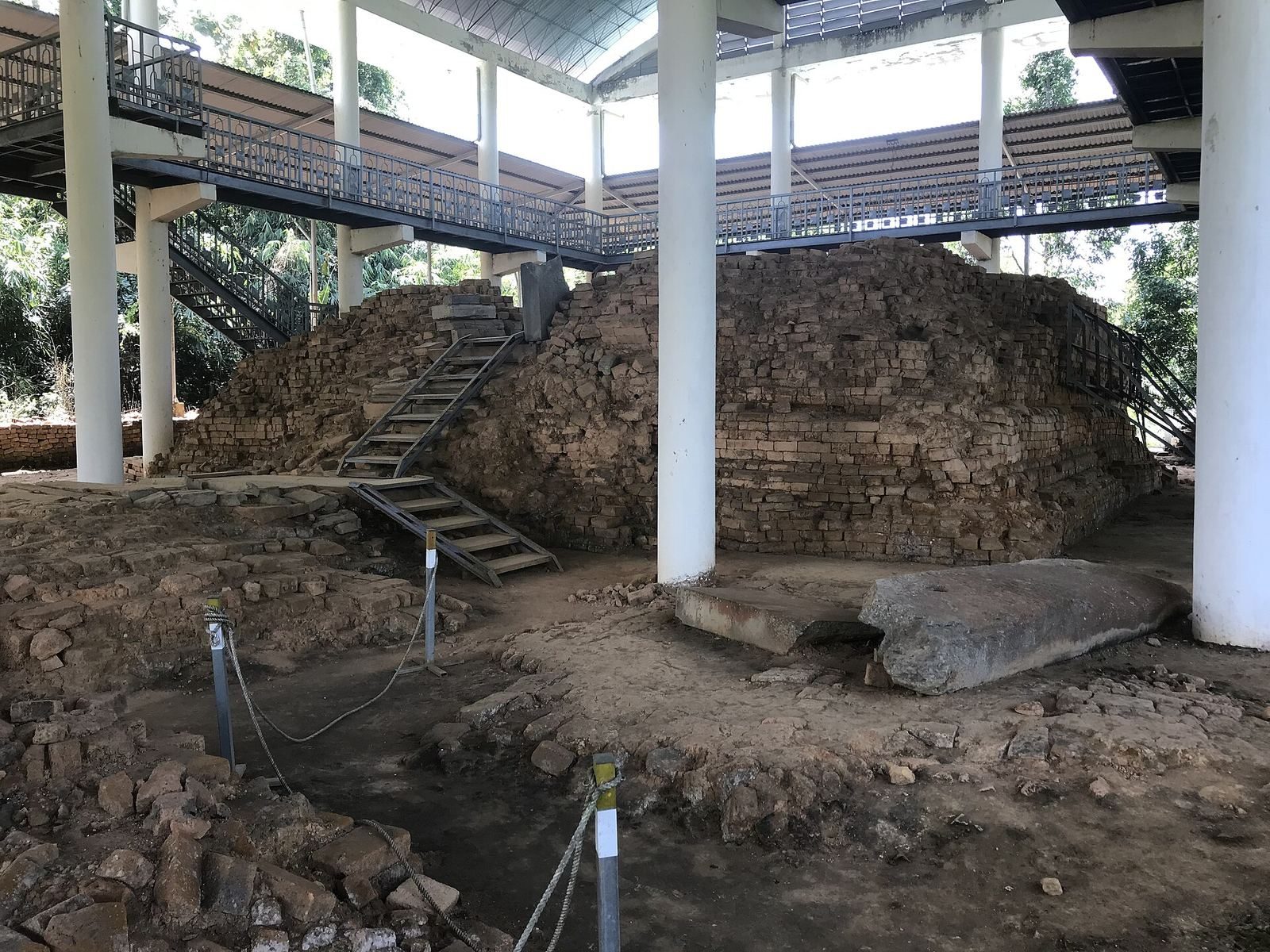
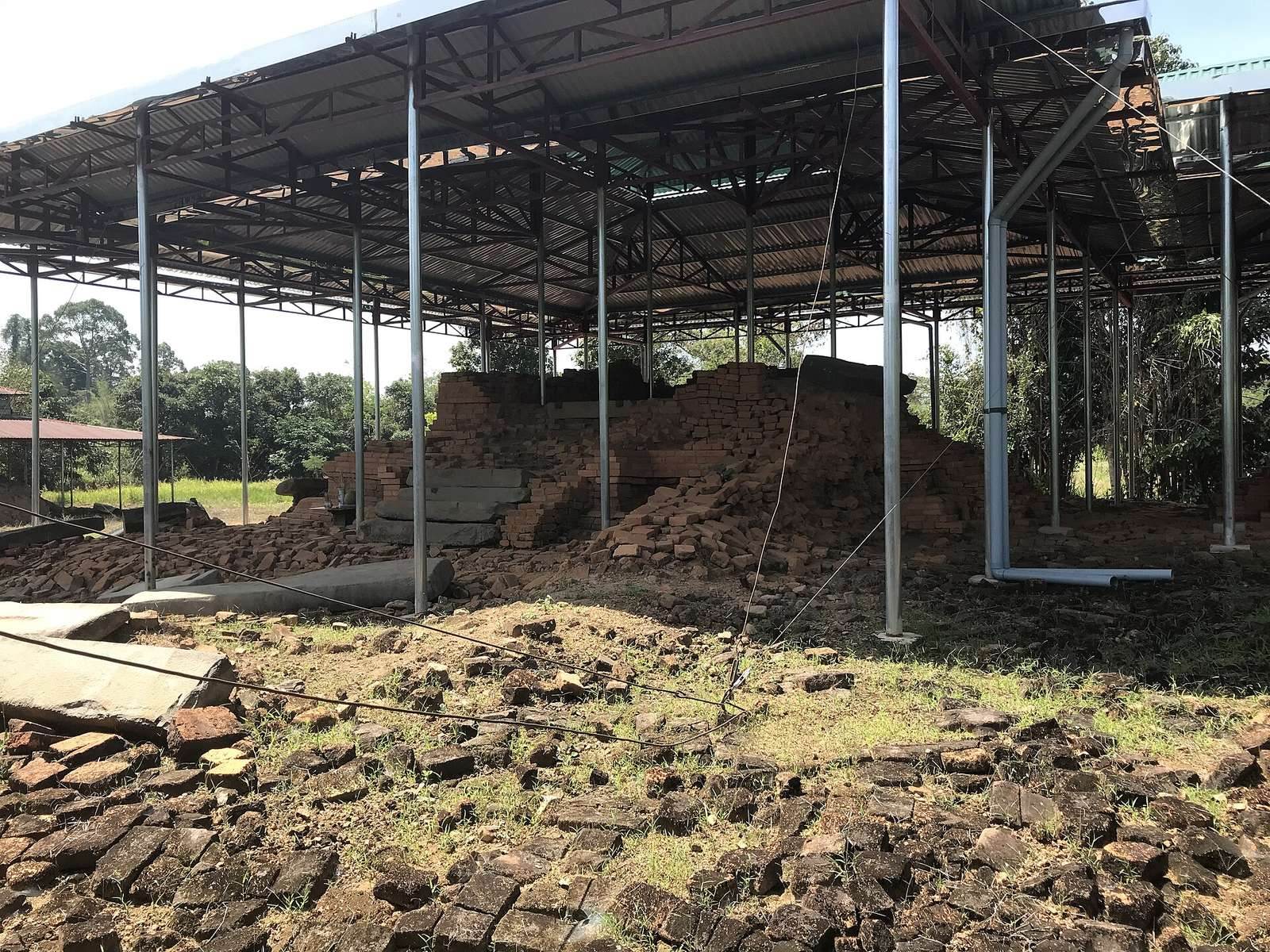
Cát Tiên was recognized as a national-level historical and cultural monument in 1997. Protective roofs and fencing were installed to safeguard the remains. In 2006, amid concerns about conserving recovered objects, an archaeologist and museum director recommended prioritizing the documentation of finds over further excavation.
Remains
The archaeological complex extends for about 15 kilometres along the Đồng Nai River system, including the Đạ Đường River, across a basin covering hundreds of hectares. It occupies the river’s left bank among alluvial flats and scattered mounds, within the arc of the southern Annamite range. A more enclosed area of about 24 hectares forms a narrow valley between two earthen hills, 30 and 50 metres high. Its gently curving center projects in a semicircle toward the river. One mound lies in Đồng Nai town, another large mound in Đức Phổ commune, and seven mound groups in Quảng Ngãi commune, where remains are most concentrated. Brick walls extend from the riverbank toward higher mounds, while paved routes connect mound groups and lead toward the river.
Temples and towers
The complex includes temples, tomb towers, altars, and long houses, built mainly from locally made bricks with stone brought from elsewhere. Temple-and-tower structures have stepped forms and walls about 2 to 2.5 metres thick. Their spacious interiors contain a central altar combining a linga, a symbol of the Hindu god Siva, and a yoni, representing the feminine generative principle. A vent beneath the altar descends through layers of brick and sand to deposits that included gold leaves and small stone figures. Temples face east, with large brick-paved courts in front.
Mounds 2A and 2B
The exterior walls at mounds 2A and 2B carry carved lotus-petal designs. Two large stone pillars and a temple lintel weighing more than one tonne are also associated with the complex. The lintel is carved with lotus flowers and flowing, stylized clouds. Another lintel from the site is identified with the Kampong Preah style, a Khmer art style used in temple decoration.
Mound 6A
The temple at mound 6A is among the more complete examples. Its east-facing front has repeated square offsets, and the forecourt is semicircular. A hollow square brick pillar stands at the center on a base with three levels. The combination of an offset square plan and semicircular forecourt has been compared with architecture at Óc Eo cultural sites in Tây Ninh and Đồng Tháp. Óc Eo is the name of an archaeological culture and site complex in southern Vietnam.
Mound 7 and hill temple 1A
The temple at mound 7 has a square plan aligned north to south. Hill temple 1A occupies the top of a hill. These structures form part of a wider landscape of temples, tomb towers, paths, and other traces of ancient building.
Brickwork, kilns, and water channels
Bricks were made in several sizes for different purposes and decorated with geometric patterns, lotus forms, scrolling leaves, and representations of Mount Meru, the cosmic mountain in Hindu and Buddhist traditions. Bricks pierced with peg holes and roof tiles with hooked joints were used together in a distinctive drainage system.
Brick kilns
Four brick kilns were found in Bảy Mẫu field during the eighth excavation, in September 2006. Ash, charcoal, and traces of blackened and bright-red fired bricks lay 0.1 to 0.3 metres below the cultivated surface. The kilns averaged about 15 metres long and more than 3 metres wide. They ran east to west, with their mouths facing south to catch the wind. Their bricks matched those from the sanctuary ruins.
Ritual water channels
A brick water outlet near mound 6, called a somasutra, carried water used in worship. It measures 5.76 metres long and 40 centimetres wide. A related brick channel system, about 40 centimetres wide and 30 centimetres deep inside, runs east to west for more than 100 metres, distributing ritual water to temples and tomb temples.
Objects and ritual deposits
About 1,140 objects made from varied materials have been recovered. The finds include gold relief fragments, rings, and small lingas; tin and silver vessels; bronze mirrors, plates, lampstands, cymbals, bells, jewelry, figures, boxes, tools, and casting moulds; and iron spears, knives, and nails. Stone objects include figures of Ganesha, lingas, yonis, lintels, turned pillars, steps, facing slabs, axes, and fragments bearing Sanskrit, a classical language of ancient India. Pottery finds include ceramics, porcelain, bricks, roof tiles, funerary jars, and lamps.
Gold leaves and figures
Among the gold objects are 265 relief fragments depicting what has been called a labyrinth of the gods. Their designs were made by incising the gold and hammering raised forms from its reverse. Other pieces include thin gold sheets cut into flowers or marked with ancient writing, and figures of beings with multiple heads and arms. Some figures have been tentatively identified as characters from the Ramayana, an ancient Indian epic, including Hanuman, its monkey hero, and Ravana, its antagonist.
A ritual pit containing ash held eight gold leaves showing elephants and turtles, arranged along its four sides and corners, as well as a leaf depicting a curved, seven-headed serpent. The serpent may represent a protector of the Buddha’s remains. Other gold-leaf designs show Hindu deities including Siva, Uma, Brahma, and Lakshmi, as well as priests, dancers, worshippers, and warriors. Animal images include lions, elephants such as the divine elephant Airavata, boars, snakes, fish, Nandin, the bull associated with Siva, goats, birds, and Hamsa, a sacred goose or swan. Waves, leaves, linked lotus petals, floral scrolls, spirals, spheres, crescents, and Sanskrit writing also appear. One gold leaf depicts Lakshmi.
Lingas, yonis, and casings
Lingas, linga-yoni objects, and yonis are made from gold, silver, bronze, quartz, other stone, and terracotta. A small gold linga is described as the smallest found in Southeast Asia. A single-piece semiprecious quartz example, 25 centimetres long and weighing 3.435 kilograms, is identified as the largest of its kind in the region. A stone linga-yoni set measures 2.26 metres long and is identified as the largest in Southeast Asia. Another stone linga, 2.1 metres high and 80 centimetres in diameter, is identified as the largest in Vietnam and the largest stone linga found in Southeast Asia. A bronze example imitates the rounded shaft of three-level stone lingas.
Several linga casings have lids and contain smaller objects made of gold, silver, bronze, or iron. One bronze casing measures 52 centimetres high and 25 centimetres across; three terracotta examples have been described as the first of their kind found at prehistoric sites in Vietnam. Their range of forms has been linked to cultural exchange with Champa, a historical kingdom and cultural tradition in what is now central Vietnam, while their materials, types, and carving also show local characteristics.
Other finds and burials
A silver box from the ritual pit at mound 6A measures 18 by 9 centimetres. It is oval, with a raised image of a long-maned lion lying down and unusual surrounding decoration. Its origin has been tentatively placed in Mesopotamia or Central Asia, possibly within the Kushan cultural sphere, a historical realm associated with the Kushan dynasty.
Pottery vessels have features associated both with Óc Eo culture and with prehistoric pottery from southeastern Vietnam. Funerary jar burials include grave goods such as small eight-petaled gold flowers among cremated remains. A flattened, round stone object with a circular handle measures 11 centimetres across and 2 to 3 centimetres thick. Marks on its underside may be writing, but its identification as a seal remains uncertain. A statue of Uma riding the buffalo demon Mahisa is also associated with the site.