Castle of Roddi: A Medieval Fortification in Italy


Site at a Glance
- Rating
- 4.2
- Popularity
- Low
- Country
- Italy
- Primary era
- Medieval
- External website
- Open
- Eras represented
- Medieval, Early Modern
- Civilizations
- Holy Roman Empire
- Site type
- Military
- Remains
- Castle
On this page10 sections
History
Castle of Roddi is a medieval fortification in Italy, standing on the summit of the hill occupied by the village of Roddi in Piedmont. Its earliest construction dates to the eleventh century, while major alterations over later centuries gave it a definitive form between the late fourteenth and early fifteenth centuries under the Faletti family. During the Middle Ages, it was a fief of the Marquises of Monferrat, the rulers of the historic marquisate whose territories included parts of present-day Piedmont.
Medieval origins and Faletti transformation
The castle developed through successive medieval building phases rather than a single campaign. The late fourteenth- and early fifteenth-century work associated with the Faletti family established the form of the imposing fortification that survives today. Its position above the settlement supported its defensive and territorial function within the lands governed by Monferrat.
The Della Mirandola succession
In 1525, Giovanna Carafa, the wife of Giovanni Francesco II Pico della Mirandola, bought the castle, its subject lands, and the jurisdictional rights connected with the territory of Roddi d’Alba. She purchased them from Anna d’Alençon, widow of Guglielmo IX Paleologo, Marquis of Monferrat, and guardian of Bonifacio IV, paying 6,000 gold scudi del sole. Representatives of the Roddi families then swore allegiance to Carafa, and an imperial diploma issued by Charles V, the Habsburg emperor whose dominions included territories in Italy, confirmed the acquisition.
The castle became a refuge for the Della Mirandola family after Giovanni Francesco II Pico and his son Alberto were murdered inside the Pico family castle in 1533. Galeotto II Pico, a member of the dynasty that ruled Mirandola, had usurped their legitimate rule, prompting Giovanna Carafa, her surviving children, and her grandchildren to move to Roddi.
Later ownership and present roles
The Della Chiesa family of Saluzzo took possession of the castle in 1690. After the Congress of Vienna, it passed to the House of Savoy and later to the Italian state. Municipal ownership began in 2001.
In 2007, Castle of Roddi joined the circuit of eight castles associated with the UNESCO-listed Vineyard Landscape of Piedmont: Langhe-Roero and Monferrato. This World Heritage designation recognizes the historic wine-growing landscape for its outstanding universal value. The castle is also part of the Castelli Aperti circuit of Lower Piedmont and is designated Italian national heritage. Part of the building houses the International School of White Alba Truffle Cuisine. At its foot, the institution traditionally called the “University of Truffle Dogs” has operated since 1880, training dogs used to search for truffles. Antonio Monchiero, known as “Barot,” founded it.
Remains
Fortification and layout
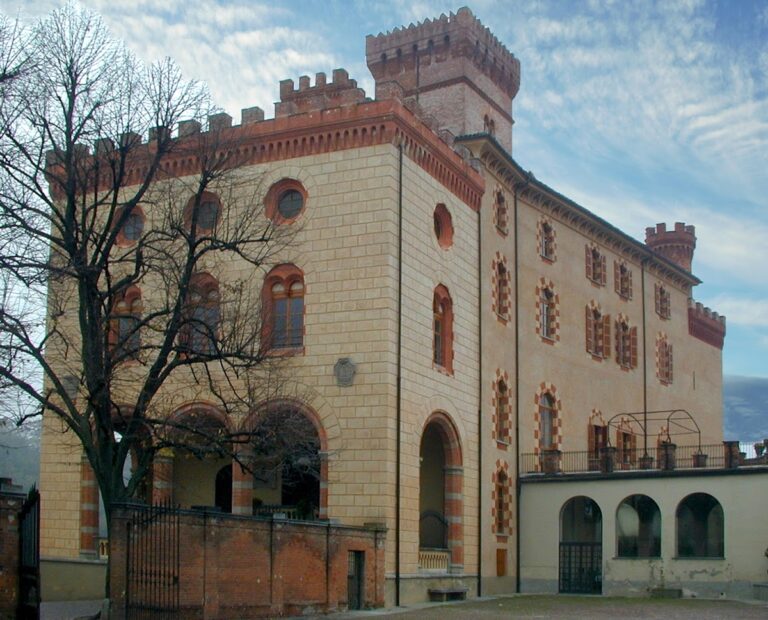
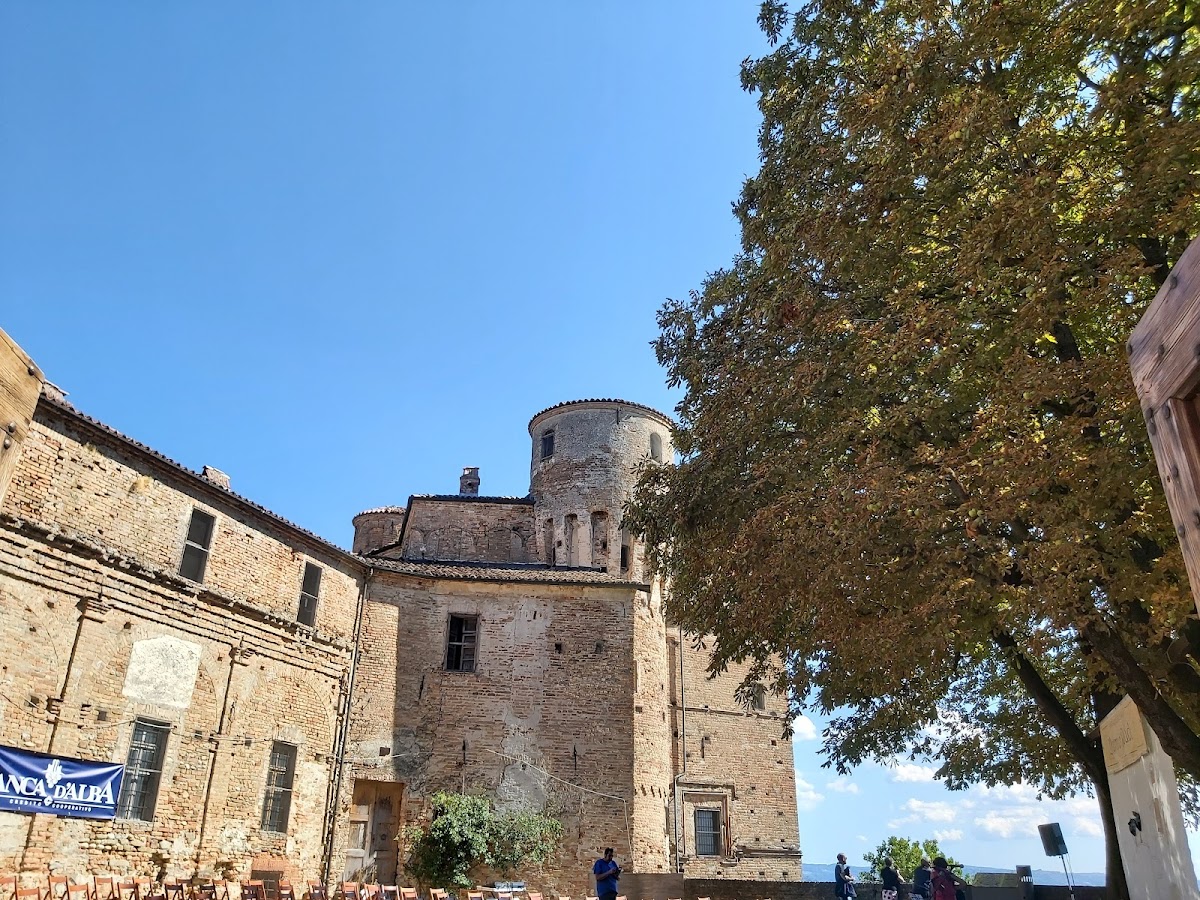
Castle of Roddi is a tall, imposing structure organized around a central three-storey body with two massive cylindrical towers at opposite corners. The upper storey incorporates machicolations, projecting openings or galleries through which defenders could attack assailants below. The former drawbridge provided the original approach to the stronghold, while entry today is through an external courtyard.
Defensive towers
Master tower and donjon
The tall, slender master tower is built within a donjon, the principal fortified tower that served as a stronghold and final refuge during a siege. Its elevated position also made it an observation point within the castle’s defensive system.
Lower corner tower
The second cylindrical tower is lower than the master tower and is cantilevered, projecting from the main body of the fortification. Together, the two towers define the castle’s distinctive corner-based defensive arrangement.
Interior spaces
The interior preserves rich decorative work and wooden coffered ceilings. A section of the castle retains its sixteenth-century kitchens, providing a surviving domestic element within the medieval fortification.