Caer Gybi: A Roman Fortlet and Naval Base in Wales

Site at a Glance
- Rating
- 4.4
- Popularity
- Very Low
- Country
- United Kingdom
- Primary era
- Classical
- External website
- Open
- Eras represented
- Classical, Medieval
- Civilizations
- Roman
- Site type
- Military
- Remains
- Fort
On this page7 sections
History
Caer Gybi is a Roman fortlet and naval base in Holyhead, Wales, United Kingdom, built during the late 3rd or early 4th century in the period of Britannia Superior, a late Roman provincial administration in Britain. The site occupied a strategic position on Holy Island and later became the setting for a Christian monastery.
Roman coastal defence
The fort was probably a smaller outpost of Segontium, a major Roman fort at modern Caernarfon, and was linked to it by road. Its role likely included defending the western coast against Irish sea-raiders. A watchtower on Mynydd y Twr, the summit of Holyhead Mountain, may have served as a lookout for the fort. The precise date of construction is uncertain, although around AD 300 is also proposed.
Caer Gybi was probably abandoned around AD 393. This may have occurred when Roman troops were sent to respond to the revolt of Eugenius of Gaul. The original Latin name of the fort is unknown.
Monastic foundation and later church
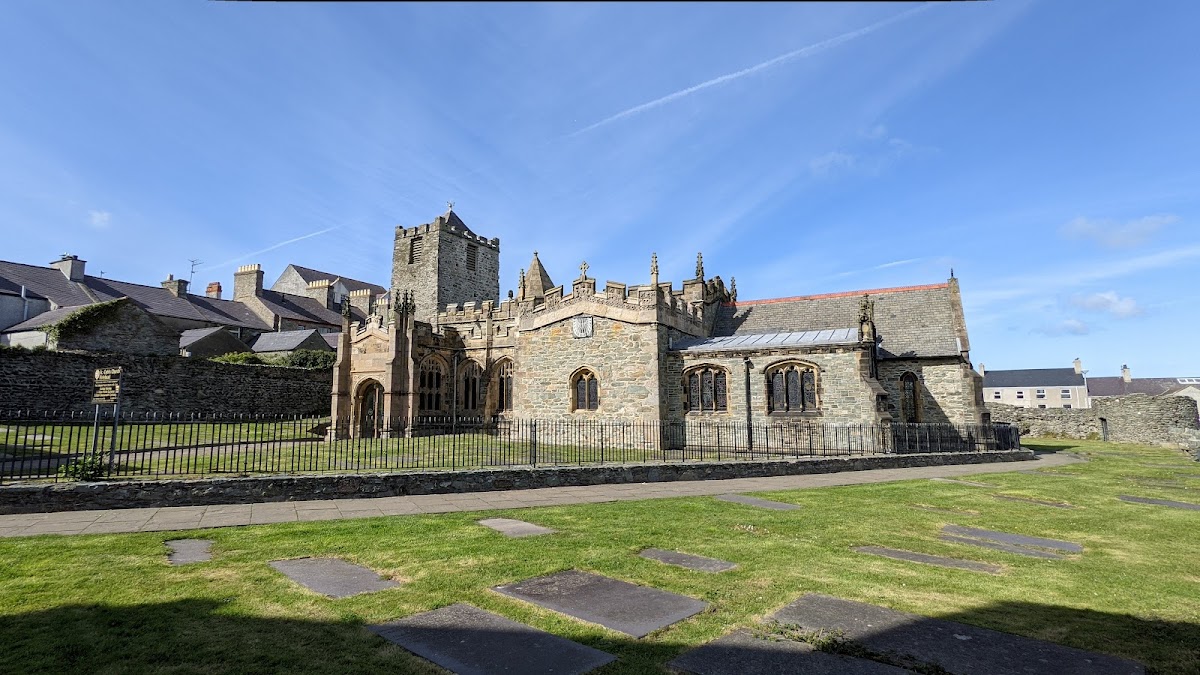
In the 6th century, Maelgwn Gwynedd, a king of the major north Welsh kingdom of Gwynedd, gave the former fort to Saint Cybi. Cybi established a monastery there, extending the site’s use into the early Christian period. Vikings looted the church within the fort during the 10th century. A replacement Church of St Cybi was built outside the enclosure in the 13th century and remains on the site.
Remains
The surviving remains show a compact coastal installation enclosed by substantial Roman defensive walls and corner towers. The fort stands in the centre of present-day Holyhead, while its fourth side opened toward the sea and probably included a quay for Roman warships.
Fort enclosure and towers
Defensive walls survive on three sides of the fort. They are approximately 4 metres high and 1.5 metres thick, with masonry laid in a distinctive herringbone pattern. Circular watchtower remains can be seen at the corners. The most prominent is the north-east tower, which rises to approximately 7.9 metres. Its upper section may have been rebuilt during the medieval period.
Adjoining Roman building
Excavation outside the northern walls revealed a building adjoining the north-west tower. Its construction was similar to that of the tower and was probably Roman, adding to the surviving evidence for activity around the fort’s enclosure.
Church and chapel
The present Church of St Cybi stands outside the former Roman enclosure. Nearby, the small detached chapel called Eglwys y Bedd is reputed to stand over Saint Cybi’s grave, preserving the site’s association with the 6th-century monastic foundation.
Nearby sites