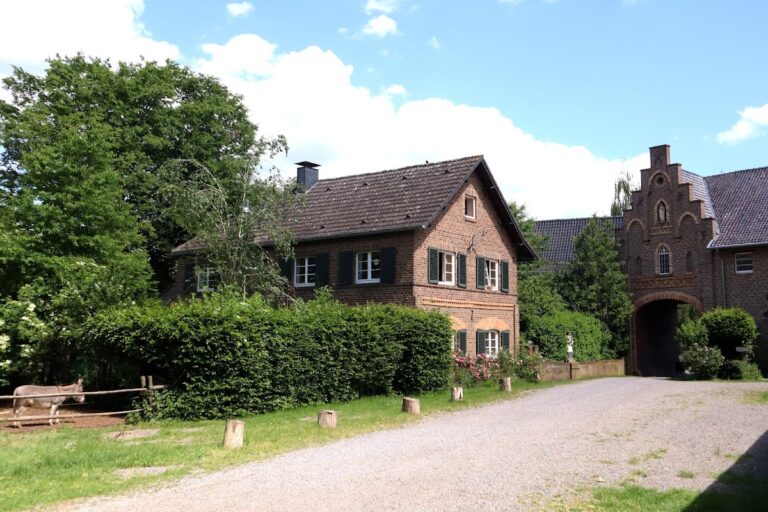
Burg Müddersheim: A Water Castle in Germany


Site at a Glance
- Rating
- 4.5
- Popularity
- Very Low
- Country
- Germany
- Primary era
- Early Modern
- Eras represented
- Early Modern
- Civilizations
- Holy Roman Empire
- Site type
- Domestic
- Remains
- Castle
On this page9 sections
History
Burg Müddersheim is a lowland water castle in Germany, at the edge of Müddersheim, now a district of Vettweiß. Its documented history begins in 1057, when Anno, the Archbishop of Cologne, recorded granting the Polish queen Richeza the usufruct, or right to use and benefit from property, of the castle. Richeza was a granddaughter of Emperor Otto II and had left Poland after the death of her husband, King Mieszko II, in 1034, amid threats from anti-German and anti-Christian groups.
Medieval lordship
After Richeza’s death, Anno transferred Burg Müddersheim to the St. Kunibert collegiate foundation in Cologne. The lordship was not part of the neighboring Duchy of Jülich. Instead, it was a subordinate lordship of Electoral Cologne, the ecclesiastical territory governed by the archbishops and electors of Cologne. Its first known feudal holders were the knights of Müddersheim, members of whom are recorded from 1130.
By the middle of the fourteenth century, the Lords of Schleiden held Müddersheim as feudal lords. In 1351, Johann of Schleiden sold the castle and its associated rights to Goedert of Aldenrode. The transaction included five hides of arable land, six acres of vineyards, twelve acres of meadowland, seventy acres of woodland, and a mill.
Changing ownership
Marriage brought the castle and lordship to the Kinzweiler family in 1426. During the fifteenth and sixteenth centuries, other families held shares in the property. In 1653, Wilhelm of Kinzweiler had his grandson Adolf of Hocherbach formally enfeoffed with Müddersheim, meaning that the land and its rights were granted to him as a feudal holding. Adolf died without children, so the inheritance passed in 1670 to his sister Anna Katharina, who was married to Johann Heinrich of Hanxler.
Müddersheim was pledged to Rudolf Adolf of Geyr of Cologne in 1701. He purchased the castle and lordship in 1707. Rudolf Adolf of Geyr then built the present water castle between 1718 and 1720, establishing the complex that survives today. Burg Müddersheim remains in the possession of the Barons of Geyr zu Schweppenburg.
Eighteenth- and nineteenth-century grounds
The new castle was surrounded by extensive gardens and parkland. Most of the original eighteenth-century park design was later altered during the nineteenth century, changing the setting created when the present complex was built.
Remains
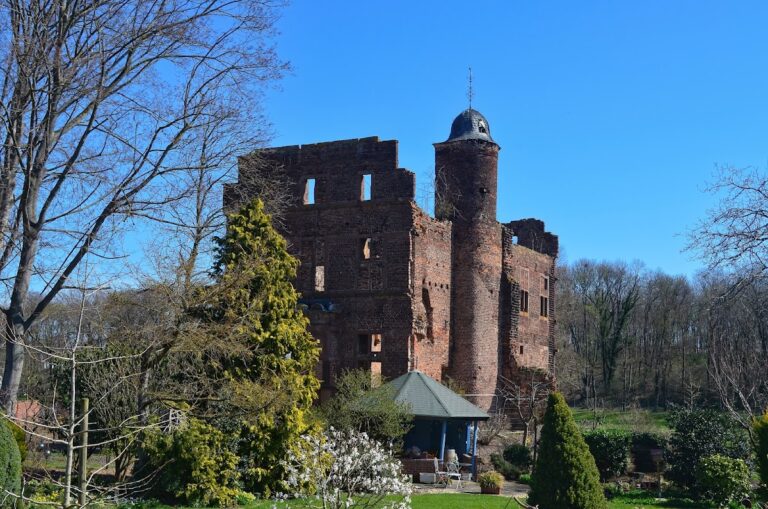
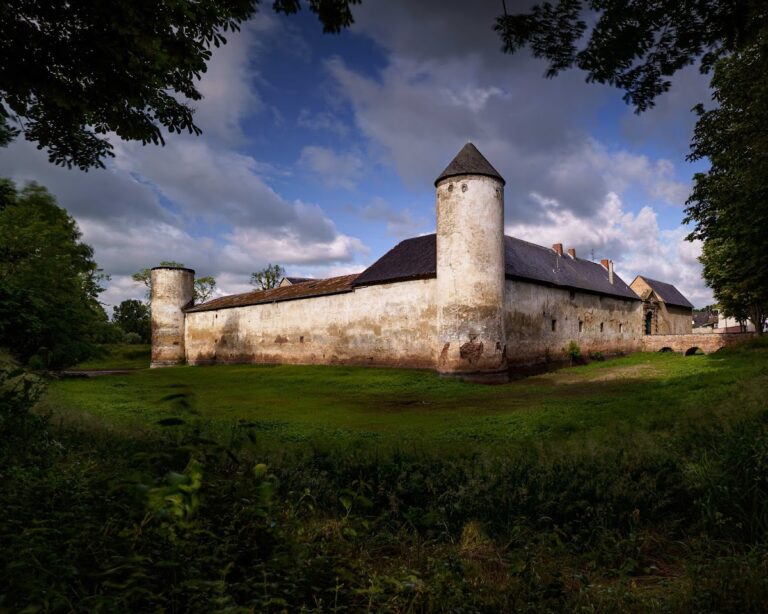
Burg Müddersheim is a brick-built lowland castle beside the Neffelbach, at approximately 135 metres above sea level. The preserved complex is organized around a two-storey rectangular main house and a three-winged outer bailey, with a representative gate building on the southeastern side. Gardens and parkland extend around the buildings, although much of their eighteenth-century design was revised in the nineteenth century.
Principal buildings
Main house
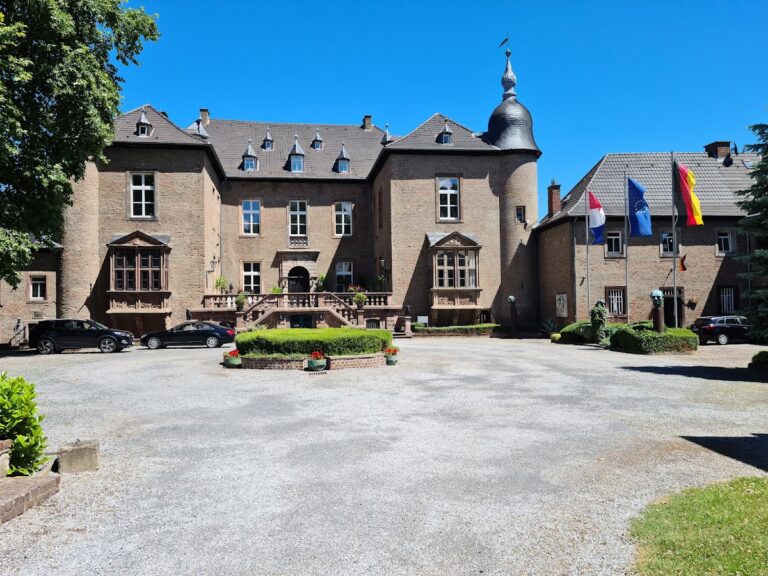
The main house stands on an almost square plan and has two storeys beneath a hipped roof, which slopes down on all sides. On the courtyard side, a single-axis central avant-corps projects slightly from the facade. It is crowned by a gable and accompanied by an exterior flight of stairs, giving the central part of the building a pronounced architectural focus.
Outer bailey and gate building
A three-winged outer bailey forms the other principal part of the preserved complex. Its southeastern side contains a representative gate building, providing the formal entrance to the castle grounds. Together, the outer bailey and main house define the surviving arrangement of the water castle.
Gardens and parkland
Extensive gardens and parkland surround the castle buildings. They originated with the construction of the present complex between 1718 and 1720, while the landscape arrangement visible today reflects the substantial nineteenth-century redesign of the earlier park.
Nearby sites