Bottle Creek Indian Mounds: A Mississippian Ceremonial Center
Site at a Glance
- Rating
- 5
- Popularity
- Very Low
- Country
- United States
- Primary era
- Medieval
- External website
- Open
- Eras represented
- Medieval, Early Modern
- Civilizations
- Unclassified
- Site type
- Religious
- Remains
- Sanctuary
On this page5 sections
History
Pensacola Cultural Center
Bottle Creek Indian Mounds is an archaeological site on Mound Island near Axis, Alabama, United States, occupied from approximately 1250 to 1550 by peoples of the Pensacola culture, a regional tradition within the Mississippian culture of the southeastern and midwestern regions of North America. The site became the largest Mississippian chiefdom on the north-central Gulf Coast and served as a ceremonial, social, political, religious, and trade center for the Mobile-Tensaw Delta and the central Gulf Coast.
Bottle Creek also provided a point of contact between the Gulf Coast and other Mississippian cultural areas in the interior Southeast. Its waterways made the remote center accessible by dugout canoe, the principal regional means of transportation. In this setting, the site functioned as a gateway into Pensacola society and as a focal point for exchange and interaction.
Discovery and Preservation
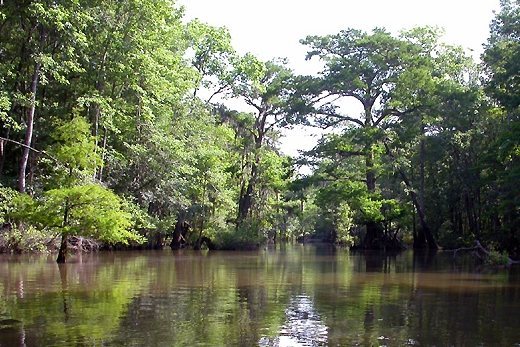
The site was first mapped during the 1880s. Its position within the delta, surrounded by swamp and large cypress trees, made it difficult to reach and helped protect it from much of the looting experienced by comparable sites in the Southeast.
Professional investigation began in 1932, when David L. DeJarnette of the Alabama Museum of Natural History studied Bottle Creek partly to determine whether it had a cultural relationship with Moundville, which was connected to the site by a river system. Bottle Creek was added to the National Register of Historic Places, the United States’ official list of cultural resources considered worthy of preservation, in 1974. On March 10, 1995, it became a National Historic Landmark, a designation recognizing exceptional importance in the nation’s history. The Alabama Historical Commission owns and monitors the site.
Remains
Island Landscape and Platform Mounds
The archaeological site occupies Mound Island, a low, swampy island within the Mobile-Tensaw River Delta north of present-day Mobile. It lies near the confluence of the Tombigbee and Alabama rivers, where branches and bayous form a network at the head of Mobile Bay. Wetlands and large cypress trees surround the island, while the landscape itself is difficult to cross on foot.
Bottle Creek contains 18 platform mounds, earthen structures with broad, level summits used for buildings, ceremonies, or elite and religious activities. Five mounds are arranged around a central plaza, creating the site’s principal ceremonial layout. The tallest mound rises approximately 45 feet, or 14 meters, above the island.