Biete Medhane Alem: A Rock-Hewn Ethiopian Orthodox Church in Lalibela
Site at a Glance
- Rating
- 4.8
- Popularity
- Very Low
- Country
- Ethiopia
- Primary era
- Medieval
- External website
- Open
- Eras represented
- Medieval
- Civilizations
- Ethiopian
- Site type
- Religious
- Remains
- Church
On this page6 sections
History
Zagwe Foundation and Sacred Purpose
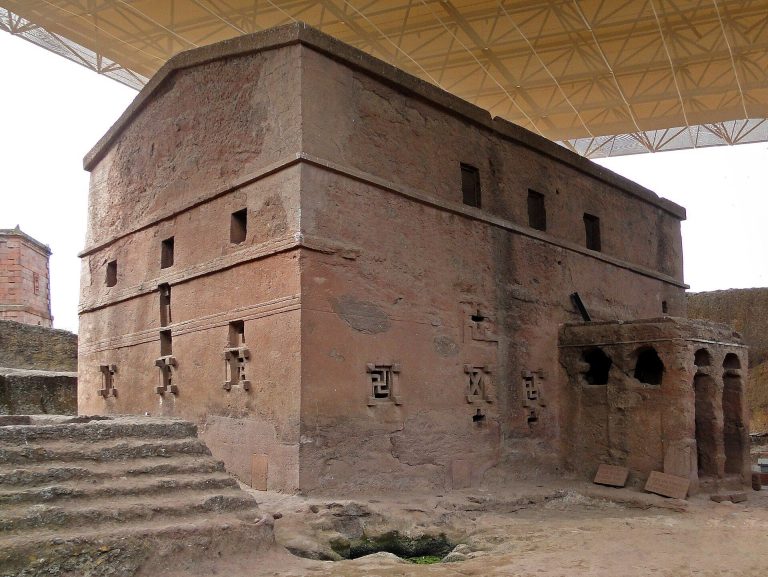
Biete Medhane Alem, meaning “House of the Saviour of the World,” is an underground Ethiopian Orthodox church in Lalibela, Ethiopia. Built during the Zagwe dynasty, the medieval Ethiopian ruling house associated with Lalibela’s rock-hewn churches, it is generally dated to the thirteenth century and is traditionally linked to King Gebre Mesqel Lalibela. The church is one of eleven rock-hewn churches in Lalibela and belongs to the group of six north of a local river that builders associated with the Jordan River.
The Lalibela complex was conceived as a reproduction of the Holy Land at a time when the consolidation of Islamic control in that region had made Christian pilgrimage more difficult. Biete Medhane Alem was intended to reproduce the Church of Saint Mary of Zion in Aksum, which was destroyed in 1535 by the army of Ahmed Ibn Ibrahim Al-Ghazi, a military leader associated with the Adal Sultanate.
Tradition, Pilgrimage, and Heritage
Ethiopian cultural tradition connects the construction of Lalibela’s churches with a vision received by King Gebre Mesqel Lalibela, who was instructed to build a church. A related legend says that Lalibela and a group of angels constructed Biete Medhane Alem with miraculous speed. These traditions form part of the church’s continuing religious identity, while the building remains a pilgrimage destination for Ethiopian Orthodox Christians, particularly during Timkat, the Ethiopian Orthodox celebration of Epiphany.
Biete Medhane Alem forms part of the Rock-Hewn Churches of Lalibela UNESCO World Heritage Site, which was inscribed in 1978.
Remains
Excavated Form and Layout
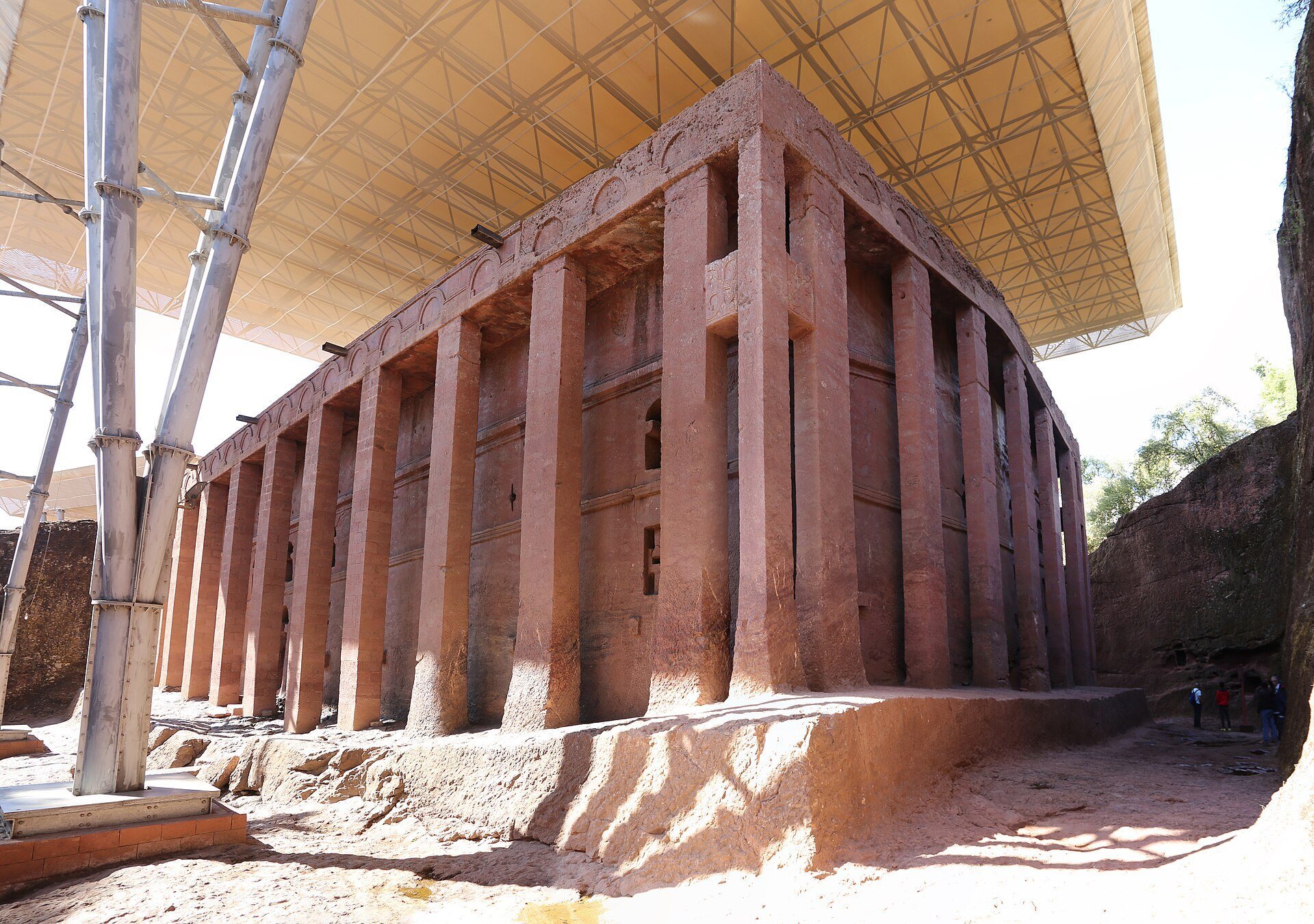
Biete Medhane Alem is a monolithic rock-cut church, meaning that it was excavated from a single mass of living rock rather than assembled from separately quarried blocks. It is described as the largest and tallest church in the Lalibela complex and as the largest monolithic church in the world. The building measures approximately 34 metres from east to west, 24 metres across, and 11 metres high. Its interior volume is about 10,000 cubic metres, while approximately 15,000 cubic metres of rock were removed from the courtyard during excavation.
The church follows an east-west basilican plan, a longitudinal layout organized around a central nave and flanking divisions, and contains five naves. Eight bays, or structural compartments, are supported by twenty-eight pillars that rise toward semicircular ceiling arches. A prominent external colonnade, a row of pillars, surrounds the building with thirty-four rectangular pillars. The church is fully exposed from the surrounding rock and has a carved pitched roof with two sloping sides meeting at a ridge. Three entrances open to the west, north, and south, and the interior has no paintings.
Religious Features and Protection
The Lalibela Cross is kept inside Biete Medhane Alem and is regarded as one of Ethiopia’s major ecclesiastical treasures. A suspended protective roof now covers the church.