Beiting: An Ancient City and Uyghur Capital in Xinjiang
Site at a Glance
- Popularity
- High
- Country
- China
- Primary era
- Medieval
- Eras represented
- Medieval
- Civilizations
- Tang
- Site type
- City
On this page12 sections
History
Beiting, also known as Beshbalik, is an ancient city site in Jimsar County, Xinjiang, China. It became a Tang frontier administrative and military center in the seventh and eighth centuries, then served as a political capital under Uyghur rule. Its historical importance reflects successive periods of Chinese, Turkic, Uyghur, and Mongol authority.
The name Ting, meaning “court,” is associated with the site’s role as the royal court of the Later Jushi, an ancient polity in the region. The Old Turkic name Beshbalik means “five cities,” though scholars differ on whether this referred to divisions within the city or to settlements across the surrounding area. Beshbalik is linked to events of 713 in the Kul Tigin inscription. The location of the ancient city was long disputed, with proposed identifications including Urumqi, Yanqi, and counties in Changji Prefecture. By the 1980s, the ruins at Jimsar had become the prevailing identification.
Han frontier and Later Jushi
In 62 BCE, the Han established a Wuji Commandant, a frontier military post, in the area. During the Eastern Han, the military officer Geng Gong led farming at a garrison there. The site is identified with the Later Jushi royal court at Jinman. Jinpu, a name used in an account of the court, is generally regarded as a mistaken form of Jinman.
Chinese authority withdrew amid upheavals in the third century. Gaoche, Rouran, Tiele, and Turkic groups successively controlled the region.
Tang administration and political change
After the Tang campaign against Gaochang in 640, the Tang established Tingzhou in the area in 646, following the submission of the Western Turkic ruler Ashina Helu. The city also became the seat of Jinman County. In 702, under Empress Wu Zetian, it became the headquarters of the Beiting Protectorate, a frontier government responsible for territories north of the Tianshan Mountains.
In 789, the Buddhist monk Wukong spent several months at Beiting on his return from a pilgrimage to India. The district deputy administrator Yáng Xígǔ and monks at Longxing Temple invited Śīladharma, a monk from Khotan, to translate the Daśabhūmika-sūtra, a Buddhist scripture. Śīladharma translated its Sanskrit text while other monks recorded the work, refined its wording, checked its meaning, and compared the Sanskrit and Chinese versions. They followed the same process for another scripture. When Duàn Míngxiù, the Tang protector-general of the Four Garrisons and Beiting, arrived, Wukong travelled with him toward the court. With the Gobi route impassable, they took the Uyghur route. Wukong left his Sanskrit books in Longxing Temple’s library, since the Chányú, a title for a steppe ruler, was not Buddhist, and carried his Chinese translations to the capital.
The Tibetans briefly captured Beiting in 790, compelling Tang forces to withdraw from the area. Karluks, Tibetans, and Uyghurs then contested control of the region.
Uyghur and Qocho rule
Uyghur rule was established in the Gaochang region by the early ninth century, and Beiting served as a secondary capital. After the Kyrgyz sacked the Uyghur capital of Ordu-Baliq in 840, many Uyghurs moved to the Jimsar area and the Tarim Basin, where they founded the Kingdom of Qocho. Beiting became a capital of the Uyghur realm and later of Qocho, also known as the Gaochang Uyghur kingdom.
In 981, the kingdom’s ruler invited Song envoys Wáng Yándé and Bái Xūn to Beiting. Their reception included formal gifts, a banquet, music, and other entertainments. The following day they went boating on a pond and visited the Yìngyùn and Tàiníng temples, which had been built in 640.
Wáng described the region as a major horse-raising center. Horses were valuable: he wrote that a good one could be exchanged for a bolt of silk, while an inferior animal kept for meat was worth one zhang. His account also mentions metalworking in gold, silver, copper, and iron, as well as jade carving. Meat was a staple food for poorer residents, and the kingdom’s territory extended west to Anxi, the Tang Empire’s western frontier.
Mongol and Yuan-era contests
The Uyghurs submitted to Genghis Khan in 1207. During the first half of the thirteenth century, Beiting was a political center for the Uyghur ruler, or Idiqut, and his wife Altalun, a daughter of Genghis Khan. Mongol forces recruited Alans into the Right Alan Guard, a military unit that also included Mongol, Chinese, and recently surrendered soldiers. A Chinese-led military colony was established at Beiting.
A regional Yuan government office, or branch secretariat, was established there in 1251. After Möngke’s death, Ariq Böke used Beiting as one of his bases in his struggle with his brother Kublai Khan, surrendering in 1264. Following a revolt in 1276, the Mongol prince Kaidu occupied much of the province. In 1283, the Yuan established a local pacification commission at Beiting, appointed Ch’i Kung-chih as its commissioner, and stationed newly surrendered troops there for garrison duty and farming. Duwa of the Chagatai Khanate took the area in 1286. The Yuan re-established the Beiting Supreme Marshal’s Office, a senior military command, in 1295; after a prolonged struggle, the Chagatai Khanate secured control.
Decline and later research
Conflict between the Chagatai Khanate and the Yuan weakened Beiting’s prosperity, and the city was abandoned in the late thirteenth century. Warfare destroyed it in the early fifteenth century. In Ming-era Chinese records, the name Beiting was also used for the East Chagatai Khanate, whose capital was located at the city.
Remains
The irregular city core covers about 1.5 square kilometres on the northern fringes of the Tianshan Mountains. Its layout includes an outer city and a central inner citadel, while its defenses combine earthen walls and broad moats. The principal surviving sections of the inner and outer walls date to the Tang period, in the eighth century.
Enclosures, walls, and gates
The outer enclosure measures approximately 1.5 kilometres from north to south and 1.0 kilometre from east to west. The city’s five parts comprise the outer city, a northern subsidiary enclosure, a western extension, the inner city, and a smaller enclosure within it. The walls are faced with rammed earth, earth compacted in layers, and strengthened at intervals by projecting bastions and corner towers overlooking wide moats. Foundations for at least four gates have been identified. Each gate had a barbican, a defensive structure protecting an entrance, and flanking watchtowers. The gates directed movement along the principal north–south and east–west routes. Later Uyghur and Mongol builders largely kept the Tang-period plan while making local repairs and changes.
West Temple
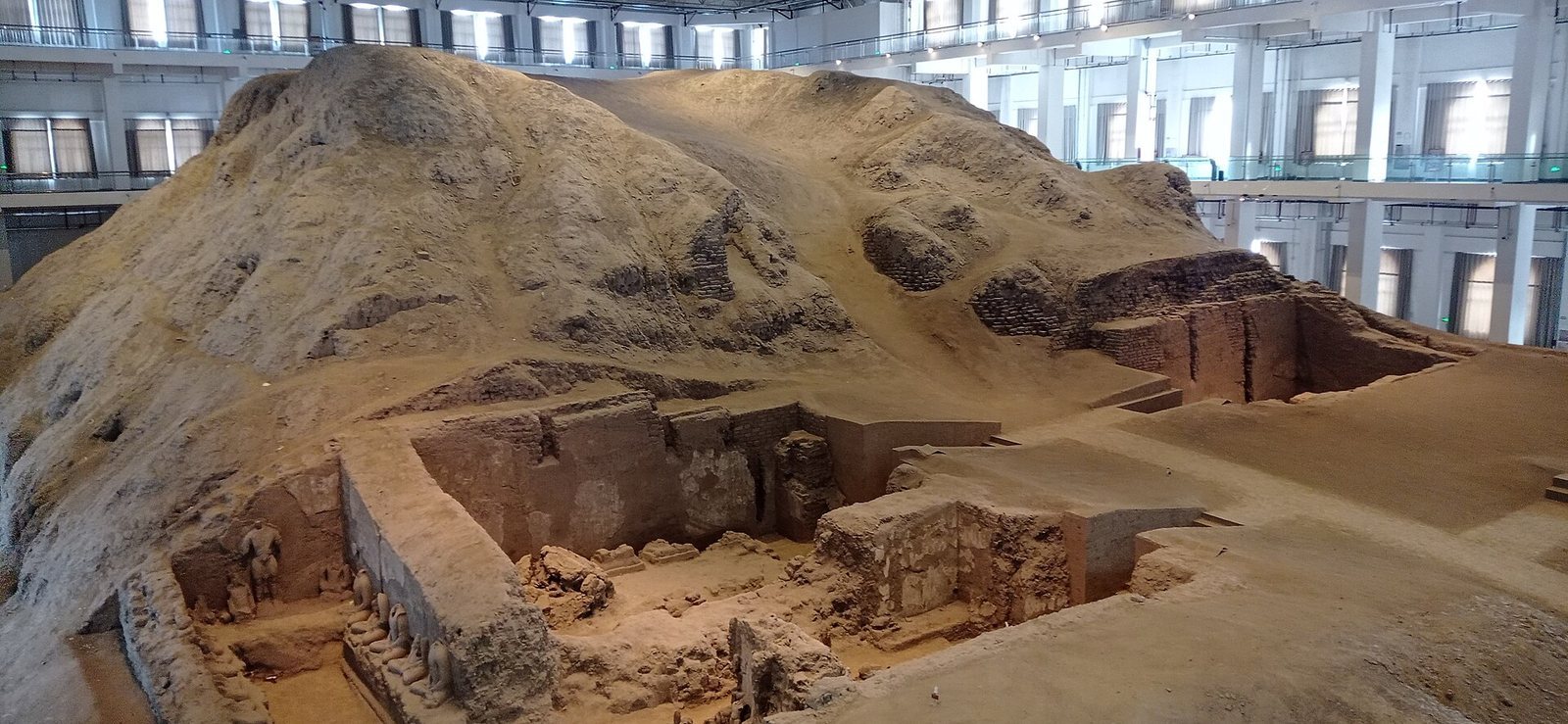
The West Temple, built during the Gaochang Uyghur period from the mid-tenth to the mid-thirteenth century, served as the royal temple of Qocho. It stands on a terrace on the east bank of the western river embankment, about 700 metres west of the city walls. The north–south rectangular complex is centered on a rammed-earth podium that survives to a height of 14.30 metres. Its lower structures were made of compacted earth, while the buildings above were constructed entirely of adobe, or sun-dried earthen brick. The main hall stood at the northern end; the southern courtyard held subsidiary halls, monks’ quarters, and storerooms. Excavations in 1979 and 1980 exposed the temple foundations.
Cave chambers and decoration
Three tiers of cave chambers occupy the east, west, and north faces of the West Temple podium. They contain Buddhist sculptures and wall paintings. Sculptures depict Buddhas, bodhisattvas, beings who seek enlightenment while aiding others, arhats, people who have attained liberation, the Four Heavenly Kings, guardian deities, and lions. The murals include repeated Buddha images, bodhisattvas, Uyghur donor portraits, protective deities, and jātaka stories about the Buddha’s former lives. Many carry inscriptions in Uyghur and Chinese. One painting, known as the King’s Procession, shows eight kings who disputed the division of the Buddha’s relics after his nirvana, or release from the cycle of rebirth, followed by their reconciliation and equal sharing of the relics.
Excavated finds
Excavations at Beiting since 2018 have recovered yellow-green glazed architectural fittings shaped like dragon bodies, pottery fragments inscribed with the name Bēitián Temple, a silver seal of Púlèi Prefecture, Kaiyuan Tongbao coins, and fragments of roof tiles decorated with lotus petals.
Surrounding landscape
Wáng Yándé described the northern mountains as a source of salammoniac, with smoke rising from them and flame-like light visible at dusk. He also mentioned caves that yielded blue mud. On exposure, it hardened into a sand- or stone-like material used locally to treat leather. His account describes a broad valley used for grazing and a pond where visitors went boating.