Basilica della Ghiara: A Marian Sanctuary in Reggio Emilia
Site at a Glance
- Rating
- 4.8
- Popularity
- Medium
- Country
- Italy
- Primary era
- Early Modern
- External website
- Open
- Eras represented
- Early Modern, Modern
- Civilizations
- Holy Roman Empire, Italian
- Site type
- Religious
- Remains
- Basilica
On this page23 sections
History
The Basilica della Ghiara is a Roman Catholic Marian sanctuary in Reggio Emilia, Italy, built by the Servites of Mary in the late Renaissance and early Baroque period. It is a minor basilica dedicated to the Assumption of the Virgin Mary, belongs to the Diocese of Reggio Emilia-Guastalla, and remains served by the Servite order, a Roman Catholic community devoted particularly to the Virgin Mary.
From Riverbed to Servite Church
The site lay beside the former course of the Crostolo River. After the river was diverted beyond the city walls in 1226, the gravelly ground acquired the name Ghiara, or Giarra. In 1313, the community of Reggio granted the area to the Servites, who established a convent and built a church dedicated to the Annunciation.
A larger Servite church followed in 1517, aligned with the former river course. In the convent garden behind its apse, an image of the Madonna and Child was painted on a wall. As the image deteriorated, Lelio Orsi made a drawing of it in 1569. Giovanni de Bianchi, known as Il Bertone, then painted a new image on the convent wall in 1573.
The Miraculous Image and New Sanctuary
Devotion to the image grew, and a small chapel was built for it in 1596. Tradition connected the image with two healings that year. On 29 April, Marchino, an orphan of about fifteen who had been deaf and unable to speak from birth, reportedly regained hearing and speech while praying before the Madonna. On 5 May at Fivizzano, Margherita, called Caugliana after her husband’s place of origin, was reportedly cured after eighteen years of illness.
Bishop Claudio Rangone appointed theologians, physicians, and jurists to examine the reported miracles. On 22 July 1596, Pope Clement VIII recognized the miracle and permitted public veneration of the image. The site quickly became a pilgrimage destination, and offerings from the faithful helped support the construction of a much larger sanctuary.
Duke Alfonso II d’Este requested designs for the new temple. Proposals came from Giovan Battista Aleotti of Argenta, Cosimo Pagliani of Siena, and Alessandro Balbi of Ferrara. The duke selected Balbi’s design. Bishop Rangone laid the cornerstone on 6 June 1597 in the presence of Alfonso II and Duchess Margherita Gonzaga. The existing Servite church and part of the former convent were demolished to clear the site.
Construction and Consecration
Construction was directed by the Reggio architect and sculptor Francesco Pacchioni, who also designed the dome and the interior stucco work. Cosimo Pagliani assisted with the dome. The church was substantially complete by 1619 and was solemnly consecrated on 12 May of that year.
The basilica’s religious importance rests on the venerated Marian image and the reported miracles associated with it. A marble monument outside the church bears the inscription Ut posteri notus foret and marks the former location of the image. The Servites continued to administer worship, while the adjoining cloisters later served as elementary schools before being converted into a hostel.
Restoration and Collections
Restoration took place between 1887 and 1890 under Nicolò Barabino, Luigi Samoggia, and Gaetano Chierici. Further restoration was undertaken during the 1990s. The basilica’s artistic heritage was given a dedicated institutional setting in 1982, when the Museum of the Basilica della Ghiara was established by the Temple Fabric and the Civic Museums. Owned by the municipality, it forms part of the Civic Museums network of Reggio Emilia.
The museum preserves the sinopia, or preparatory underdrawing, of the miraculous image, along with devotional silver and goldwork, seventeenth-century chandeliers donated by Duke Francesco I d’Este during the plague, Orsi’s 1569 study for the Marian image, and the votive crown donated by the community of Reggio in 1674. The adjacent treasury preserves the work of Reggio goldsmiths from the seventeenth and eighteenth centuries. Together with its architecture, Marian cult, paintings, and devotional furnishings, the basilica represents an important example of seventeenth-century Emilian art.
Remains
Plan and Exterior
The basilica is a large quadrangular building in the late-Renaissance, or Mannerist, style. Mannerist architecture uses Renaissance forms in more elongated, complex, and richly decorated arrangements. The principal facade faces east, while the projecting apse is at the west. The plan is a Greek cross set within a square. A Greek-cross plan has four arms of approximately equal length around a central crossing. The interior measures approximately 45 metres across and 60 metres from east to west, with the greater length created by the western choir arm.
Facade
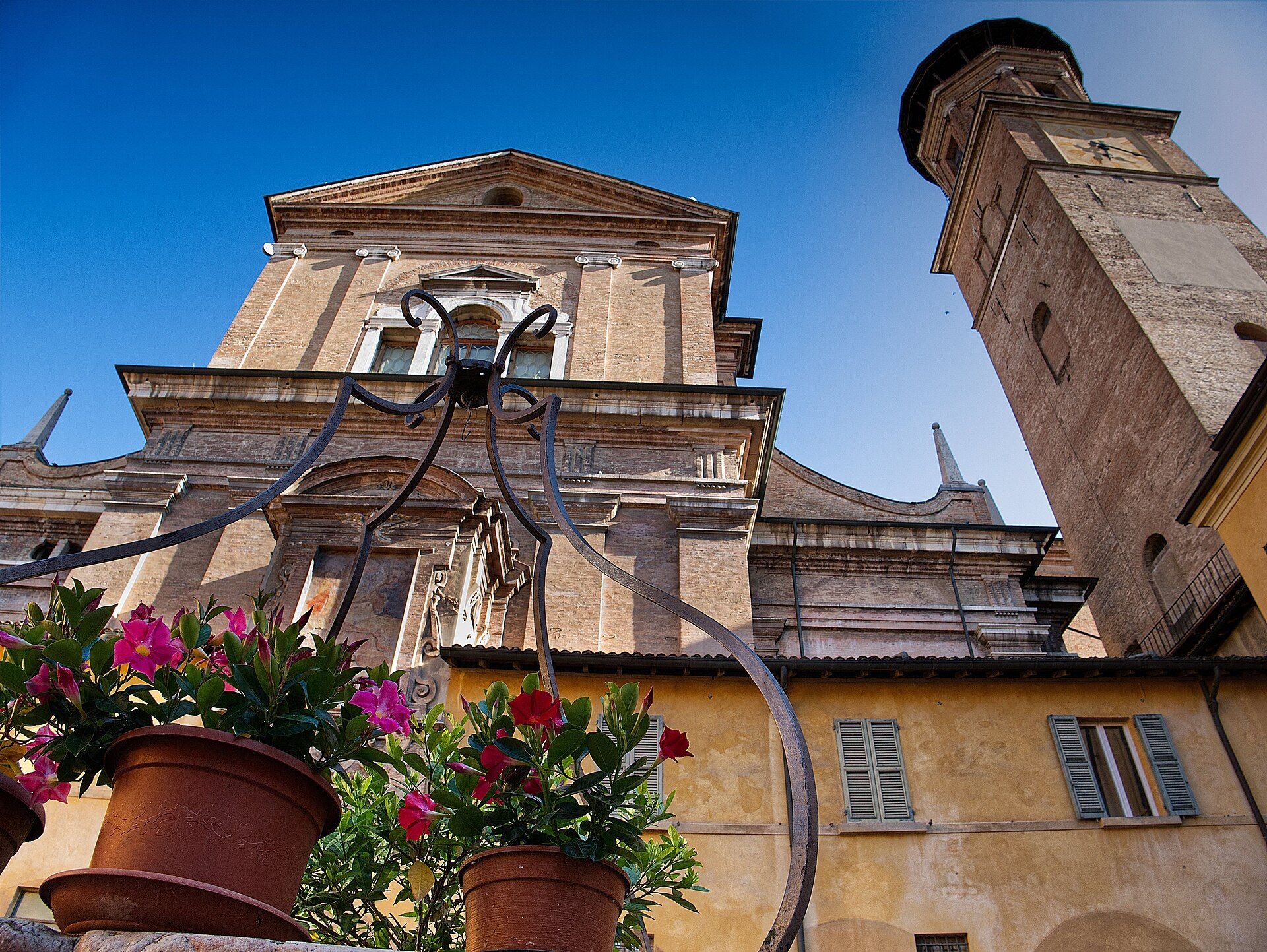
The eastern facade has two levels beneath a pediment. Doric pilasters define the lower level, while Ionic pilasters appear above. Brickwork is combined with white Veronese marble in the bases and capitals of the pilasters, the cornices, windows, and portals. The facade is divided into three vertical sections, each containing a portal surmounted by a Serlian window, a three-part opening with a central arch flanked by lower side openings.
The central portal has a marble bas-relief of the Virgin of Ghiara by Salvatore da Verona, donated by the municipality of Reggio in 1642. The two side doors date from 1631. Beside the main portal, bronze statuettes of Saint Prospero and the Immaculate Conception stand on the holy-water fonts. The first was commissioned by the wool-finishing guild, while the second, based on a design by Paolo Magnavacchi, was commissioned by the silk-spinners’ guild.
Bell Tower
The brick bell tower stands beside the apse on the right side of the church. It is approximately 52 metres high and has a square base measuring 8 metres on each side. Francesco Pacchioni began it in 1623. Its square shaft supports an octagonal bell chamber begun in 1630, topped by a rounded roof and associated roof structures. The dome and lantern originally intended for the tower were never completed.
A document dated 18 August 1612 records the purchase of 54 marble pieces for the tower. In June 1624, when the structure was nearly finished, the tower was judged unable to support the marble’s weight. The scheme was abandoned, and the material was reassigned to the basilica floor. A clock designed by the Servite Cherubino Ranzani was added in 1661. Luigi Croppi and Pietro Marchelli stabilized the tower in 1842 and added a covering of concentric roofs.
The tower contains five bells. The Fornara, donated by Reggio’s bakers, dates from the first half of the seventeenth century, measures 141 centimetres across, and weighs 1,624 kilograms. Two other bells from the same period measure 113 and 93 centimetres and weigh 850 and 530 kilograms. A fifth bell was cast in 1785, with a diameter of 77 centimetres and a weight of 325 kilograms.
Vaults, Dome, and Entrance Arm
Four substantial piers divide the interior into three nave-like spaces and support the central dome. Four smaller square rooms occupy the recessed angles of the Greek cross. Each is covered by a hemispherical dome that cannot be seen from outside. The central dome has a lantern, an upper structure that admits light, bringing the total number of domes to five.
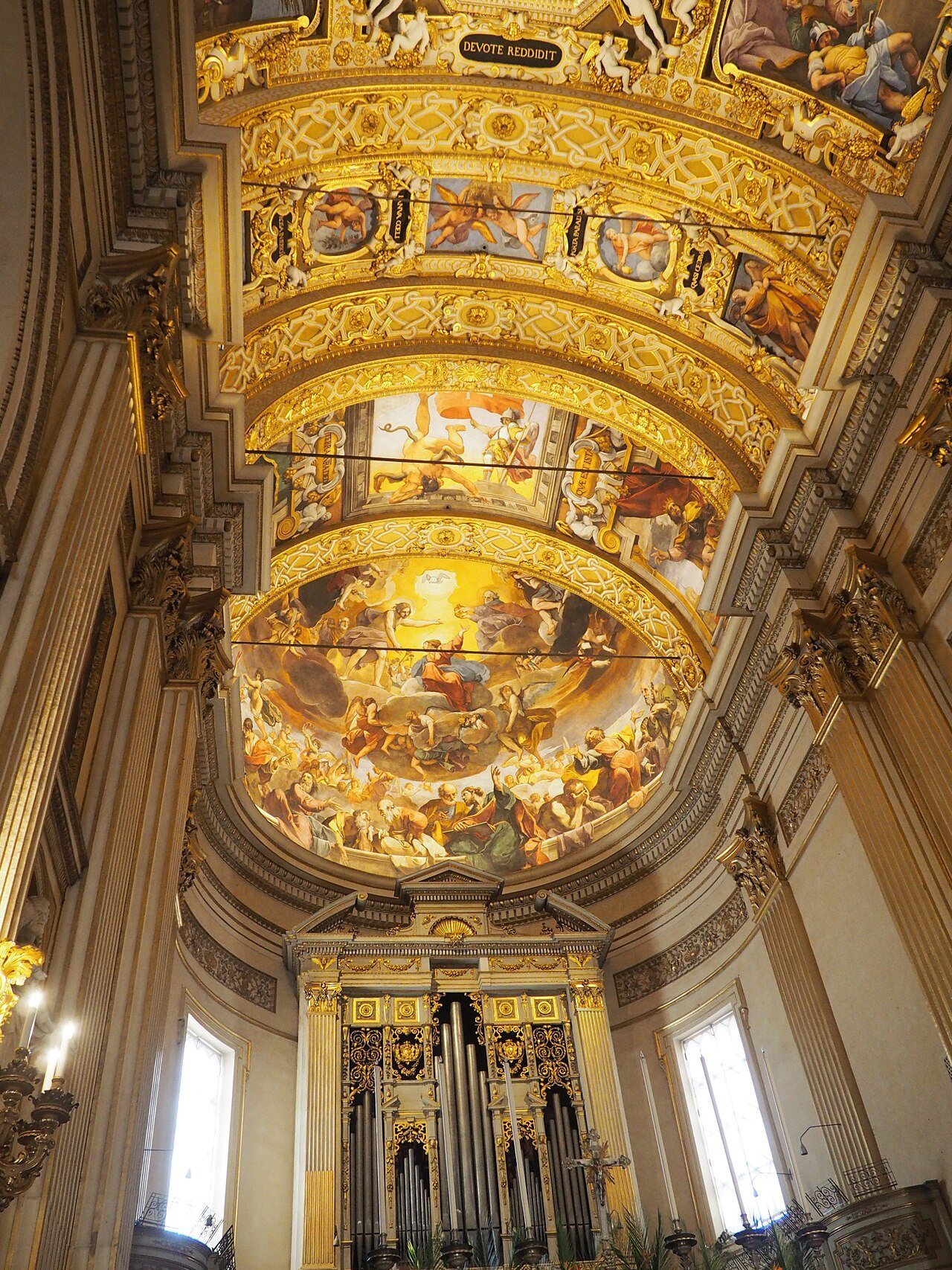
The interior combines restrained lower walls with richly ornamented vaults and domes. Gilding, stucco, marble, and frescoes create a transition between Renaissance decoration and the fuller effects of the Baroque. The principal pictorial program presents women of the Old Testament whose virtues are related to those of the Virgin Mary. The church’s building congregation approved the revised program on 21 February 1615, although the theologian who devised its theme is unknown.
Central Dome
Francesco Pacchioni erected the central dome after a design by Cosimo Pagliani, which Pacchioni revised. Lionello Spada frescoed it between 1614 and 1616, while Tommaso Sandrini supplied painted architectural illusionism, known as quadratura, to extend and frame the real structure. The pendentives show Almsgiving, Religion, Charity, and Prayer. The drum contains the four patron saints of Reggio and four Servite saints. Eight Old Testament figures appear in monochrome in the cupola, while the Apotheosis of the Virgin fills the area beneath the lantern.
Ceiling and Entrance Arm
Alessandro Tiarini painted the ceiling in 1619. Its pendentives contain four Sibyls, its eight lower compartments show Virtues, and its eight upper compartments contain angels bearing instruments of the Passion. In the central medallion, two angels appear with a cross, inviting a partly veiled figure to adore it.
The entrance arm contains vault paintings commissioned from Luca Ferrari in 1644 and completed with further frescoes in 1646. Their subjects include Gentleness, Faith, angels with shields and armour, a tower with battlements, Adam and Eve expelled from Paradise, Abraham serving the angels, and Rebecca giving water to Abraham’s servant. Pietro Desani and Pietro Armani painted the intercolumnar canvases depicting miracles of the Virgin. The counterfacade contains Tiarini’s large painting of the Death of Saint John the Evangelist.
Chapels and Altars
Pagani Chapel
The Pagani Chapel beside the right-hand entrance has frescoes by Camillo Gavasseti from 1630. Its pendentives show Isaiah, Daniel, Ezekiel, and Jeremiah. Eight Virtues fill the larger compartments, while eight angels paying homage to the central divinity occupy the smaller ones. Nicola Sampolo made the marble-and-bronze altar and its statues of Religion and Prudence. Alessandro Tiarini painted the 1629 altarpiece of the Virgin asking Saint Francis for the Child Jesus.
Calcagni and Casotti Chapel
Pietro Desani frescoed the Calcagni and Casotti Chapel in 1642. The pendentives contain the four Evangelists, the lower compartments show eight religious orders, and the upper compartments present their corresponding Virtues. Religion occupies the centre. One altar is by Francesco Orso and Giacomo Novo and has an Annunciation by Tiarini. Nicola Sampolo made the other altar and carved Faith, Charity, and Hope. The altarpiece showing Saint Jerome, Saint John the Baptist, and the Madonna of Loreto has been attributed variously to Lionello Spada and Sebastiano Vercellesi, with Saint Jerome considered indicative of Spada’s hand.
Gabbi and Silk Guild Chapel
Carlo Bononi of Ferrara painted the Gabbi and Silk Guild Chapel in oil in 1622. Its pendentives contain the Doctors of the Church, Christian theologians recognized for the importance of their teaching. The lower compartments show the eight Beatitudes, the upper compartments contain angels, and Spiritual Authority occupies the centre. Francesco Pacchioni made the altar facing the door in 1606, with statues of Religion and Justice, while his son Alberto made the side altar. Ludovico Carracci painted the altarpiece of Saint George Led to Martyrdom and Saint Catherine Fainting.
Marian Altar
The monumental altar of the Blessed Virgin was first placed behind the high altar, but it was dismantled because it was defective and obstructed the space. After disagreements over its position, Alfonso II ordered its reconstruction at the right-hand altar. Giovanni Battista Magnani designed and supervised the completed structure in 1615. Francesco Orso and Giacomo Novo made its bas-reliefs and statues of Abraham, Jesse, Saints Francis of Paola and Philip Benizi, and the prophets Isaiah and Jeremiah.
The celebrated Marian image is preserved in the altar’s upper chapel, which has a blue background scattered with stars. Four touchstone columns support the surrounding ornament, made to Magnani’s design by the Reggio goldsmiths Paolo Larioli and Gabriele de’ Chierici. Vincenzo Morenghi made the bronze torches beside the altar and decorated them with putti and high-relief figures. Five large silver lamps were made between 1734 and 1736 by Paolo Magnavacchi after a design by Ludovico Benedetti. The largest weighs 70 kilograms of silver of 900 fineness and is decorated with cherubs and angels.
City Altar
The municipality of Reggio erected the City Altar to a design by Giovanni Battista Magnani. Its marble altarpiece contains Guercino’s Crucifixion, painted in 1624 or 1624-1625. Christ appears on the cross, consoled by an angel. The work is regarded as one of Guercino’s most admired and debated paintings.
Painted Cycle and Southern Arm
The southern arm contains paintings commissioned from Alessandro Tiarini in 1618 and further works for the dome and vault in 1624. Their subjects include Deborah and Barak, Samuel being presented by his mother to the priest, Abishag serving the aged David, David with a harp, Solomon enthroned, and the archangel Michael driving away the demon with a cross standard. Angels with various attributes complete the decoration. In the apse basin, the Assumption of the Virgin is crowned by the Trinity and surrounded by angels, apostles, and saints.
In the arm leading toward the Marian altar, Lionello Spada painted Abigail presenting provisions to David, Judith and Holofernes, and Esther before the throne of Ahasuerus. Other images show the Virgin and Child crowned with stars, an angel with a palm, the Ark of the Covenant, an angel with an olive branch, and a crowned Virgin looking toward heaven. Michele Mattei painted the two intercolumnar pictures. The left arm contains Luca Ferrari’s Rachel at the Well, Jael and Sisera, and Drowning of Pharaoh’s Army in the Red Sea, together with figures of Purity, angels, and Virginity. Giulio Cesare Mattei painted its intercolumnar works.
Organ, Sacristy, and Treasury
Organ
Antonio Colonna installed the organ between 1637 and 1640. Members of the Traeri family and Francesco Peroni modified it during the eighteenth century, and Paolo and Giuseppe Benedetti rebuilt it completely between 1781 and 1783. Antonio Sangalli restored it in the nineteenth century, and Lingiardi moved it to its present position in the apse in 1890. Giovanni Tamburini restored it again in 1981.
The organ facade has 33 tin principal pipes arranged in five bays in a 5-9-5-9-5 pattern. The instrument has two 62-note keyboards, unequal temperament, entirely mechanical action, and three wedge bellows operated either manually or by an electric blower. Its pedalboard, which is not original, has 27 notes.
Sacristy and Treasury
The sacristy contains an ingenious clock by the Reggio maker Cherubino Ranzani, also named in records as Forzani or Sforzani. It indicates the days, the moon, the zodiacal phases, and the epact, a calendrical value used to calculate the moon’s age and the dates of movable religious feasts.
The treasury contains six repoussé silver candlesticks and a cross bearing the Este arms, donated by Duke Francesco I between 1631 and 1634. Other objects include a sixteenth-century silver Peace with a Deposition, an original design by Lelio Orsi, a nineteenth-century silver frontal, a processional cross, reliquaries, censers, chalices, plates, and other liturgical objects. Jewellery includes a gold-thread and enamel necklace with pearls and rubies, an emerald cross, jeweled arabesques, and the votive crown of the Senate and People of Reggio, donated in 1674.
Museum and Associated Memorials
The Museum of the Basilica della Ghiara occupies four rooms. Its iconographic room preserves the sinopia of the miraculous image. Other rooms display devotional silverware and goldwork, seventeenth-century candlesticks still used in the basilica, Lelio Orsi’s 1569 study, and the jeweled votive crown of 1674. These collections preserve the material history of the sanctuary’s Marian devotion alongside its architectural and painted decoration.
A monument erected in 1820 to Duchess Maria Teresa Cybo-Malaspina stands in the vestibule leading toward Via dei Servi. She was the wife of Ercole III d’Este, Duke of Modena and Reggio.