Barriles: An Aguas Buenas Archaeological Settlement in Panama
Site at a Glance
- Rating
- 4.7
- Popularity
- Low
- Country
- Panama
- Primary era
- Medieval
- Eras represented
- Classical, Medieval
- Civilizations
- Unclassified
- Site type
- City
On this page12 sections
History
Barriles is an archaeological settlement in Vía Caizán near Volcán, in Chiriquí Province, Panama. It developed within the Gran Chiriquí cultural area and was occupied mainly during the Aguas Buenas period, also called the Bugaba period, from about AD 300 to 900. Nine radiocarbon dates from the site include six clustered between AD 500 and 800, the period known as the Late Bugaba phase. The name Barriles, also used in the forms Sitio Barriles and BU-24, refers to small stone barrels found in the area.
Regional settlement before Barriles
The highlands around Barriles had earlier inhabitants. The Tropical Forest Archaic period in the region dates approximately from 4600 to 2300 BC. It was followed by the Concepción Phase, roughly 300 BC to AD 400, whose communities produced the earliest ceramics known in the area. These populations appear to have been relatively small and spread across separate locations.
During the Aguas Buenas period, the region developed a settlement system that included large villages and smaller farmsteads. Barriles appears to have been part of this expansion. Later Chiriquí phases, approximately AD 900 to 1500, saw villages dissolve into more temporary and dispersed settlements. This wider reorganization may have accompanied the rise and decline of Barriles as a political and ceremonial center.
Barriles as a community and center
Barriles has often been described as a socioceremonial center, but archaeological work increasingly presents it as a village with a substantial residential population. Estimates place that population at approximately 500 to 1,000 people. Domestic sectors identified through extensive sampling indicate that the settlement was more densely inhabited than other known sites in the region.
The site may have been the seat of a small regional polity whose settlements were linked by ceremonial ties, warfare, and the production or exchange of polished stone axes. These tools were useful for clearing forests and working wood. The organization of this polity and the extent of social inequality remain under investigation. Feasts, possibly connected with funerary rituals, may have drawn people to Barriles. Differences between social ranks appear to have been relatively subtle, rather than as sharply expressed as some earlier interpretations of the paired statues proposed.
A proposed eruption of nearby Volcán Barú, a dormant volcano and Panama’s highest mountain, was once placed around AD 600. That interpretation held that the eruption devastated settlements upstream from Barriles and encouraged migration toward the Caribbean watershed. Geological and archaeological research has instead favored a much later eruption, possibly around AD 1400. Research in the Caribbean watershed has also suggested that its populations may have been earlier and denser than previously believed.
Archaeological investigations and interpretation
Dr. Matthew Stirling carried out early investigations at Barriles in the late 1940s, recovering fragments of the statues and the large metate. Alain Ichon and Wolfgang Haberland studied the site’s ceramics during the 1950s and 1960s and collected samples from several small excavations. In the early 1970s, Dr. Olga Linares directed the multi-year Adaptive Radiations project in western Panama, with Richard Cooke, Anthony Ranere, and Payson Sheets among the archaeologists involved. The project surveyed part of the Río Chiriquí Viejo valley and identified dozens of sites, concluding that the valley supported substantial populations based on maize agriculture. Its interpretation of the neighboring Caribbean lowlands has since been debated.
A German-Panamanian team excavated a structure at Barriles in 2001. Dr. Karen Holmberg sampled volcanic layers from that excavation, while Dr. Scott Palumbo later conducted the most extensive investigation by sampling domestic sectors through hundreds of small excavations. His work indicated a considerably denser residential population than had been recognized at other regional sites. Ceramic and stone collections from the Adaptive Radiations project are housed at Temple University. Dr. Catherine Shelton briefly revisited Barriles in the 1980s, and Vidal Fraitts studied the statues during the 1990s without undertaking new fieldwork at the site.
Barriles has figured prominently in discussions of Macro-Chibchan identity. This term refers to a proposed broad linguistic and cultural grouping associated with Chibchan-speaking peoples of Central America and northern South America, although its application to Barriles remains interpretive. The conical-hatted figures may relate to a shamanistic religious tradition, but the proposed wider connections are difficult to demonstrate from the site’s material culture. Claims that the settlement was founded by separate African-descended and Asian-descended populations are not supported by accepted archaeological evidence. The ceramics and domestic organization have direct antecedents in the Concepción Phase, while the highly stylized statues may follow an artistic convention rather than portray the physical characteristics of particular populations. Some faces have also been interpreted as depicting possibly mutilated individuals.
There is likewise no accepted archaeological evidence that Maya groups conquered or occupied Barriles. Painted polychrome ceramics from the end of the sequence belong to the later Chiriquí, or Boruca, period and are associated with traditions also found in neighboring Costa Rica.
Remains
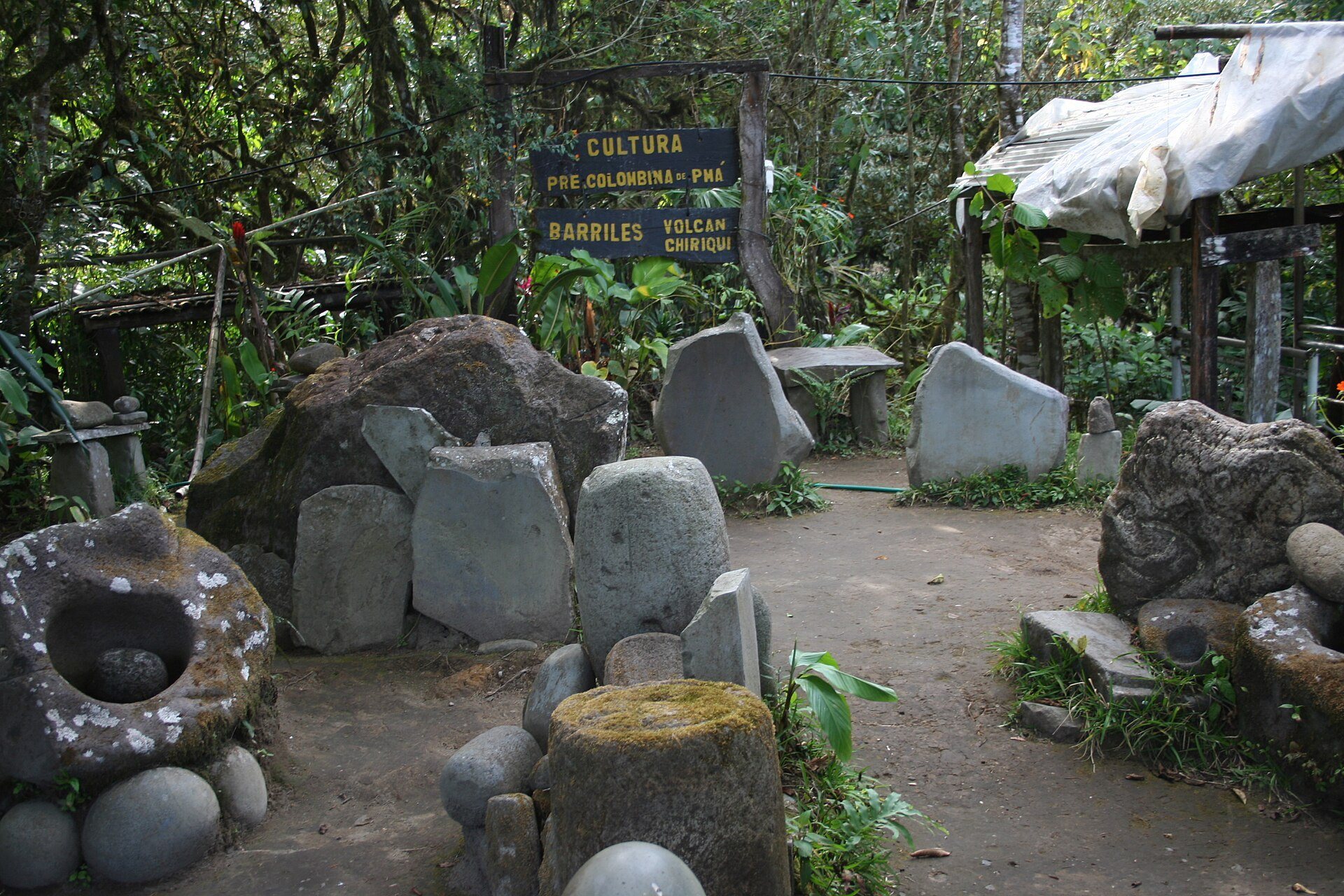
Barriles lies at approximately 1,200 meters above sea level, several kilometers west of modern Volcán on the western slopes of Volcán Barú. The site occupies a highland setting with a cool climate, a rainy season from May through November, and a dry, windy season during the remainder of the year. Its surviving remains include a mound associated with stone statues, an excavated structure, domestic sectors, stone tools, ceramics, and evidence connected with feasting and possible funerary practices.
Monumental features
Stone statues
A small mound was formerly associated with a row of 14 stone statues. Ten figures represent individuals standing alone. The other four show a larger or more corpulent figure, often wearing a conical hat and ornaments, seated on the shoulders of a naked man. Some of the lower figures also wear conical hats. These paired compositions have been interpreted as possible representations of higher- and lower-status groups, although archaeological work indicates that the social distinctions they express may have been less pronounced than earlier interpretations suggested.
The conical hats may also carry religious meaning, since the figures have been associated with a possible shamanistic tradition. The statues are highly stylized, and their forms have therefore been treated cautiously in discussions of population identity. Many of the statues, or fragments recovered from them, are displayed at the Museo Antropológico Reina Torres de Araúz in Panama City.
Large metate
A large metate, a stone grinding surface used especially to process foods such as maize, had a border decorated with small stone heads. The object has been interpreted as possible evidence of violence or human sacrifice, but that reading remains an archaeological interpretation rather than an established fact. Stirling recovered fragments of the metate during his investigations, and the large object is displayed at the Museo Antropológico Reina Torres de Araúz in Panama City.
Settlement remains
Excavated structure
The 2001 excavation exposed the remains of a structure at Barriles. The excavation block has remained open to visitors and supplied evidence for interpreting the site as a village rather than solely as a ceremonial center or cemetery. Its excavation forms part of the evidence for understanding how residential activity existed alongside the site’s monumental and ritual features.
Domestic sectors
Archaeological sampling has identified domestic sectors containing numerous small excavation areas. These areas provide evidence for a relatively dense residential settlement and for activities associated with ceremonial feasting and possible funerary practice. The results support an interpretation of Barriles as a lived-in community whose residents participated in practices that also brought people together for ritual occasions.
Artifacts and archaeological materials
Aguas Buenas ceramics from Barriles were generally unpainted, with occasional engraved, incised, or appliqué decoration. Painted polychrome pottery appeared toward the end of the sequence and belongs to the later Chiriquí, or Boruca, period. Stone artifacts included manufacturing debris, blades, axes, and metates. These objects were generally made from andesite, basalt, rhyolite, and chert.
The site’s acidic soils have affected the survival of organic materials, while the stone artifacts and ceramics preserve evidence of domestic production, food processing, woodworking, and changing regional traditions. The northwestern portion of Barriles is on private property and includes a small private museum, garden displays, and a replica excavation block containing artifacts. The objects displayed there do not all come from Barriles.