Balankanche: A Maya Ceremonial Cave Complex in Yucatán
Site at a Glance
- Rating
- 4.4
- Popularity
- Low
- Country
- Mexico
- Primary era
- Medieval
- Eras represented
- Medieval
- Civilizations
- Maya
- Site type
- Religious
- Remains
- Sanctuary
On this page14 sections
History
Balankanche is an ancient Maya cave complex in Tinúm Municipality, Yucatán, Mexico, about 3 km northeast of Chichen Itza. Used from approximately 300 BC to AD 1200, it formed part of the sacred landscape of that major Maya center and served as a ceremonial and cult site from the Late Preclassic period into the Postclassic period.
Water source and sacred landscape
The cave probably began as a source of water before becoming a sanctuary. Its underground water connected Balankanche with Maya religious ideas about caves and cenotes, natural limestone sinkholes or water-filled openings. These places were associated with rain and water deities and were also understood as entrances to the supernatural world, including the underworld.
Balankanche was associated chiefly with Chaac, the Maya deity of rain, storms, and life-giving water. Some traditions also connect the cave with Tlaloc, a central Mexican rain deity whose attributes entered certain Postclassic Maya ritual contexts, and with Xipe Totec, a central Mexican deity linked with agricultural renewal, regeneration, and sacrifice. The name Balankanche has been interpreted either as “seat of the balam,” referring to a sacred or priestly office, or as “throne of the sacred jaguar,” a phrase that may refer to Maya rulers rather than to the animal itself.
Ceramics from near the cave range from about 300 BC to the period before the Spanish conquest. Other evidence indicates especially substantial use between AD 900 and 1200, when Chichen Itza was flourishing. Buildings and four stone platforms once stood around the entrance, and these remains have been interpreted as evidence that several temples surrounded the cave.
Sealing of the sanctuary
The sanctuary was sealed sometime between AD 830 and 1000, during the first major decline of the Maya. It was dedicated to Tlaloc and contained the Jaguar Altar and the Altar of the Virgin Waters. The deliberate closure preserved ritual installations and offerings behind a constructed wall, leaving them concealed until the passage was reopened in the twentieth century.
Following the Spanish conquest of Yucatán, Balankanche was abandoned and fell into obscurity. Edward Thompson and Alfred Tozzer visited it in 1905, while archaeological exploration expanded from the 1930s. Arthur Pierce and biological teams worked at the cave in 1932 and 1936, and Wyllys Andrews conducted research during that decade. Edwin Shook and Robert E. Smith of the Carnegie Institution worked there in 1954, followed by investigations involving Andrews and Ramon Pavon Abreu.
Rediscovery and continuing interpretation
In 1959, José Humberto Gómez, a guide at Chichen Itza, discovered a passage deliberately sealed by the Maya. Opening it revealed the hidden sanctuary, including ritual installations and offerings preserved behind the wall. Local Indigenous priests objected because they feared that disturbing the sanctuary would anger the gods, reduce the region’s water, and bring jaguars against the people, particularly the archaeologists.
During a 19-hour appeasement ceremony held behind a temporarily reconstructed wall in a remote part of the cave, Wyllys Andrews participated alongside local priests. Declining oxygen levels caused headaches among those present. The event was historically important because a scholar took part in such a restricted ritual for the first time, allowing details of the practice to be recorded.
Balankanche passed through five broad phases as a water source, sanctuary, neglected place, archaeological site, and controlled public-visitation setting. It is administered by Mexico’s National Institute of Anthropology and History as part of the Chichen Itza archaeological zone. Some religious objects remain where they were found, preserving the relationship between the offerings and the cave spaces that held them.
Remains
Cave entrance and principal passage
Balankanche is an extensive karst cave system, formed as water dissolves limestone, with underground water still shaping its passages. The entrance lies within a botanical garden at the bottom of a funnel-shaped sinkhole. From there, a T-shaped route leads into the cave, whose principal axis runs north to south. Stone steps begin the descent, followed by a main tunnel with an artificially levelled floor. The tunnel has an elliptical section about 8 m wide and 5 m high, and the route to the principal chamber has been described as about 200 m long.
Low eastern tunnels contain small lakes and mud deposits formed by former changes in the watercourses through the main passage. Rainwater enters through the sinkhole and can flood these passages completely. Along the main route is a grotto called the Throne of the Sacred Jaguar, or El Tigre. A large rock resembling a skull stands nearby and is known as the Head, or La Cabeza.
Branches and sealed sanctuary
Eastern and western branches
Beyond the jaguar grotto, the cave divides into three branches. The eastern branch reaches a small lake after about 50 m. The western branch includes a northwest passage that runs parallel to the principal cave before ending in a forked dead end. These branches form part of the larger network of water-shaped routes extending beyond the main passage.
Sealed sanctuary
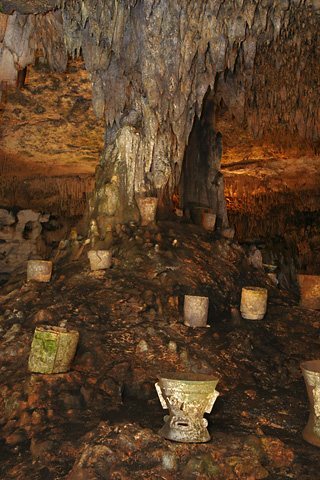
About 40 m from the division, the southern principal branch was once blocked by a wall deliberately built by the Maya. Later calcite streams gave the barrier the appearance of a natural dead end, concealing the continuation of the cave until the wall was opened in 1959. Behind it lies a grotto containing ritual censers and water-collecting pots coated with calcite stalactite deposits. The pots are approximately 0.3 m in diameter and 0.3 m high.
World Tree and jaguar chamber
A narrow passage extends about 60 m beyond the sanctuary grotto and reaches the World Tree Room. The chamber is also called the Wah-chan or La Ceiba Room and the Balama throne, or jaguar room. At its centre stands a large limestone column formed when a stalactite descending from the ceiling joined a stalagmite rising from the floor. It represents the sacred ceiba, or Maya World Tree, understood as an axis linking the heavens, the earthly world, and the underworld.
The World Tree Room lies about 28 m below the ground surface and includes a gallery approximately 7 to 7.5 m high. Calcite formations cover its walls and ceiling, while calcite-bearing water enters through an opening in the southeastern part of the ceiling. Ritual vessels are present in the chamber. From it, the cave extends into western, eastern, northeastern, and southeastern branches.
Western branch
The western branch is very low and dangerous. It contains a small lake and a collection of mortars, pestles, censers, pots, shells, and jade beads. These objects form a materially distinct group of ritual remains within the cave network.
Eastern branch and Shrimp Grotto
The eastern branch descends through a passage only about 0.5 m wide, filled with sand, silt, and fine gravel. After approximately 20 m, it reaches the Shrimp Grotto, also called Quarto de los Camarones. The chamber floor intersects the groundwater level and contains many mortars, pestles, ceramics, and other artifacts gathered from throughout the cave. White, eyeless subterranean shrimp live in the water at the bottom of the grotto.
Northeastern and southeastern passages
A northeastern passage from the Shrimp Grotto extends about 80 m and is half-filled with water. Archaeologists found a basalt head there; despite local opposition, it was removed and transferred to the National Museum in Mexico City. A small dry chamber at the end contains objects lying on the floor.
A second passage runs southeast for about 40 m. It is also half-filled with water and includes several dry sections before reaching a siphon area, where water fills the route and prevents ordinary passage farther onward.
Ritual groups and offerings
The cave contains six groups of chambers with offerings, vessels, censers, and ceramics. Group 1 is the principal group and surrounds the monumental natural column formed by the joined stalactite and stalagmite. The column has been interpreted as the trunk and branches of the ceiba, the Maya World Tree, and possibly as an image associated with falling rain.
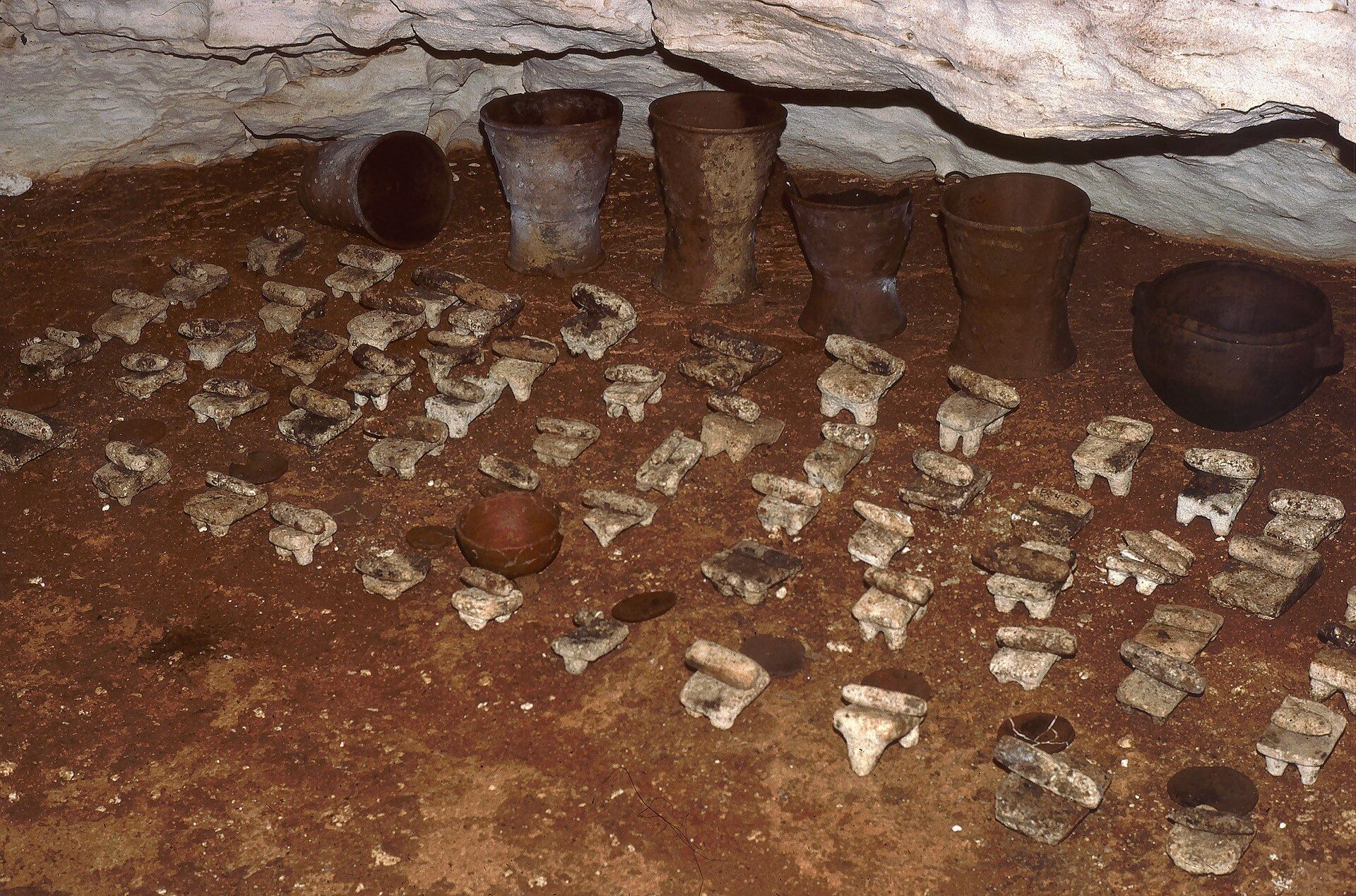
Offerings around the column included censers, vessels, metates, and other objects. A metate is a flat stone grinding surface used with a handstone. In a side niche covered by limestone, nearly 100 small limestone metates were arranged in five rows, with additional ceramic jars and bowls behind them.
Ceramics, censers, jade objects, offerings dedicated to Chaac, small stone implements, and other ritual vessels occur throughout the cave. Some Postclassic ceramics bear masks representing Tlaloc. The cave remains an active karst environment, with small openings and ledges indicating continuing dissolution of the limestone. Its interior is humid, hot, and poorly ventilated, and ventilation systems were later installed for controlled public visitation.