Avigliana Castle: A Medieval Fortress in Piedmont, Italy


Site at a Glance
- Rating
- 4.4
- Popularity
- Low
- Country
- Italy
- Primary era
- Medieval
- External website
- Open
- Eras represented
- Medieval
- Civilizations
- Holy Roman Empire
- Site type
- Military
- Remains
- Castle
On this page9 sections
History
Avigliana Castle is a medieval fortress in Avigliana, Italy, reputed to date from the tenth century and positioned on Mount Pezzulano above the town. Its strategic location at the outlet of the Susa Valley toward the Turin plain made it important for controlling Alpine routes toward France, including the Via Francigena, a major medieval pilgrimage and travel road linking western Europe with Rome, and the approaches through Mont Cenis, Clapier, and Montgenèvre.
Early fortification and the House of Savoy
Tradition attributes an earlier fortification on Mount Pezzulano to Cleph, king of the Lombards, in 574. The earliest reference to the present castle dates to 924, when it was associated with Arduin Glaber, margrave or count of Turin. The name castrum Avilianae appears in 961, while a chronicle written between 1058 and 1061 records that Margrave Arduin V regularly lived there.
During the tenth century, the castle also served as a defensive base during struggles against Saracen incursions, a medieval European term for Muslim raiders and forces operating in the Mediterranean and western Europe. The Counts of Savoy acquired Piedmont in 1091 through the inheritance of Adelaide of Susa. By 1137, Avigliana was one of Amadeus III’s preferred residences on the Italian side of the Alps and became a base for Savoyard expansion toward Turin. His son and heir, Humbert III, was born at the castle on 4 August 1136.
The castle also generated revenue for the Savoy family because it stood beside a busy commercial route toward France and Flanders and collected tolls. When a count was away, a castellan, an official responsible for administering and defending a castle and its territory, governed the surrounding lands on his behalf. The count, in turn, held the territory within the feudal hierarchy of the Holy Roman Empire, whose emperor stood at the head of a medieval and early-modern empire extending across much of central Europe.
Imperial conflict and Savoyard administration
Frederick Barbarossa, the Hohenstaufen ruler who became Holy Roman Emperor in 1155, destroyed the castle during his descent into Italy, along with the villages of Ferronia and Pagliarino. Thomas I of Savoy later rebuilt it. Around 1187, during the rule of Humbert III, imperial troops commanded by the future Emperor Henry VI besieged and captured Avigliana. The force advanced farther up the Susa Valley but withdrew when winter made the snow-covered Mont Cenis pass unusable.
After its rebuilding, the castle became one of the county’s principal command centres for roughly three centuries. Its presence encouraged the growth and reorganization of the settlement at the foot of the hill. Around 1235, Amadeus IV of Savoy granted Piedmont as an appanage to his brother Thomas. An appanage was a territory or revenue assignment given to a member of a ruling dynasty while ultimate authority remained with the senior ruler. The grant included Savoyard possessions south of Avigliana Castle and the lower Susa Valley.
The castle remained closely connected with the family history of Savoy. Amedeo VII, Count of Savoy, known as the Red Count, was born there on 24 February 1360. In 1368, Philip II of Savoy-Achaia, a rebellious prince who had governed Turin for the Count of Savoy known as the Green Count, was imprisoned at Avigliana while awaiting execution by drowning in Lake Avigliana. In August 1449, Bona of Savoy was born within the old castle. She later became the wife of Galeazzo Maria Sforza, Duke of Milan.
Fortress, destruction, and later history
After the fifteenth century, when the period of splendour associated with the Savoy court had passed, Avigliana functioned mainly as a fortress for the lower Susa Valley. Repeated damage and rebuilding altered the medieval complex, with its most recent rebuilding carried out by Amedeo di Castellamonte in 1655.
French troops under Marshal Nicolas Catinat captured Avigliana during the War of the League of Augsburg in 1691, a European conflict involving France and a coalition opposed to its expansion. In May of that year, the troops destroyed the castle with mines. It was not rebuilt, because the Savoyard forts at Brunetta di Susa, constructed in 1708, and Exilles had changed the area’s strategic role.
In 1882, Marquis Gerardo di S. Tommaso donated the ruins to the municipality, which restored them about a decade later. In 1927, the remains were incorporated into the Parco del Littorio, where black pines were planted. The site’s last recorded wartime use dates to the Second World War.
Local traditions have connected the ruins with stories of hidden treasure and restless spirits. One legend says that French soldiers infiltrated the quartermaster’s office during the final battle, stole a chest containing officers’ pay, and buried it in the grove to the right of the castle entrance. The story identifies a large boulder marked with an arrow as a supposed guide to the treasure. Other traditions describe ghostly apparitions near the ruins and claim that Philip II’s spirit still hovers over the nearby lakes after his reported drowning.
Remains
Hilltop fortress and medieval enclosure
Avigliana Castle survives in ruinous condition on the summit of Mount Pezzulano, at approximately 467 metres above sea level, immediately above the medieval town centre around Piazza Conte Rosso. The hilltop overlooks the Avigliana lakes, especially Lago Grande, as well as the Rivoli morainic hill and the Sacra di San Michele, the prominent medieval abbey founded on nearby Mount Pirchiriano.
In the eleventh century, the castle and village formed a basic fortified settlement on the hill. An older settlement extended along the northern foot of Mount Pezzulano beside the Via Francigena. In the thirteenth and fourteenth centuries, the castle followed the natural relief in an irregular, roughly elliptical enclosure. Its principal elements included an eastern residential wing with a chapel, a massive square tower at the centre, and a semicircular false tower at the southern corner.
Residential wing and inner courtyard
The residential wing was a multistory structure. Reception rooms and a chapel occupied its upper levels, while service rooms and cellars were arranged on the ground floor. The wing overlooked an upper inner courtyard that contained stables, a bread oven, and a granerium, a storage area for grain or other agricultural dues. The courtyard stores held the proceeds collected in kind from banna, taxes or other dues paid with goods rather than money.
Central tower and southern tower
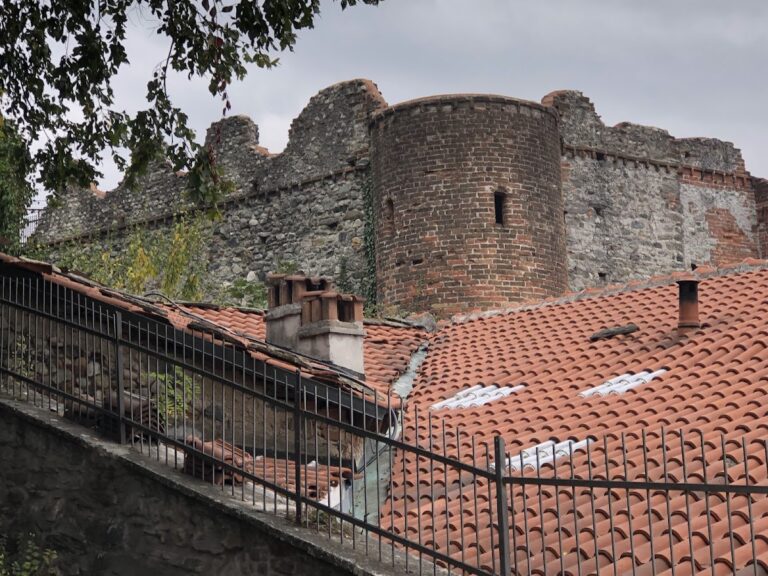
A massive square tower formed the centre of the medieval enclosure, while a semicircular false tower stood at the southern corner. Together with the high towers and enclosing walls, these elements gave the castle its character as a substantial hilltop fortress. Repeated destruction and rebuilding changed their medieval setting, and the surviving fabric is now limited to ruins.
Chapel and administrative rooms
The castle chapel was dedicated to Saint Mary Magdalene and is recorded in 1212. Administrative functions were also housed within the complex. An aula castri, or courtroom, first appears in the records in 1268, and a sala castri stood beside it by 1307. The latter served for social activities as well as formal government, reflecting the castle’s combined residential and administrative role.
Thirteenth-century records also mention a gate, a pit, an oven, and roofs covered with wooden shingles and tiles. These details belong to a complex repeatedly altered by destruction and reconstruction. The massive medieval structure that once commanded the lower Susa Valley now survives as a fragmentary group of ruins above Avigliana.
Nearby sites