Ancient Theatre of Philippi: A Greek Theatre Adapted under Roman Rule
Site at a Glance
- Popularity
- High
- Country
- Greece
- Primary era
- Classical
- Eras represented
- Classical, Medieval
- Civilizations
- Byzantine, Kingdom of Macedon, Roman
- Site type
- Entertainment
- Remains
- Theatre
On this page11 sections
History
The Ancient Theatre of Philippi is a Greek performance building at Philippi in Greece, first constructed in the mid-fourth century BCE and later reshaped under Roman rule. It was among the earliest stone theatre buildings. Its history followed the rise of Philippi from a colony of Thasos to one of the leading cities of Macedonia.
Foundation and Macedonian phase
Thasos, a Greek island in the northern Aegean, founded Philippi as a colony in 360 BCE. In 356 BCE, Philip II, king of Macedon from 359 to 336 BCE, captured the city, completed its fortifications and gave it his name. The theatre’s first building phase belongs to this period.
Roman rule and changing use
Under Roman rule, the theatre served public and religious purposes as well as political activity and the promotion of the emperor. It was renovated after 31 BCE and again in the second century CE, when Philippi was flourishing and the theatre was among its prominent buildings. These changes gave the building a typically Roman form.
In the second century CE or early third century, the theatre was adapted for arena spectacles, including gladiatorial contests and wild-animal shows. The conversion substantially altered the stage and seating areas.
Damage and decline
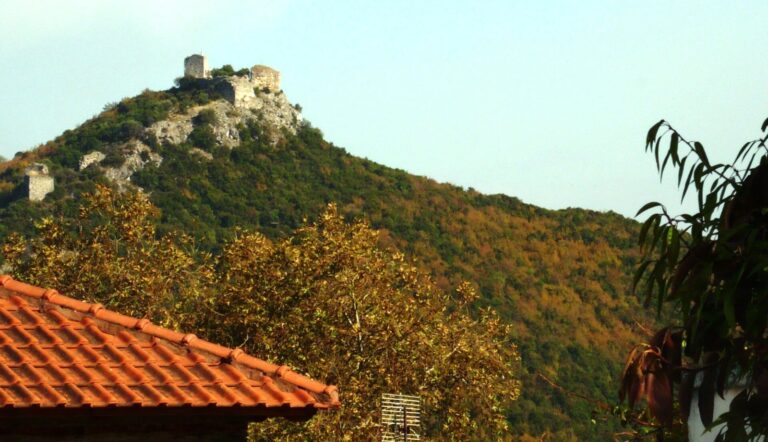
A powerful earthquake severely damaged the theatre in 619, and its stones were later reused in other buildings. During the seventh century, earthquake damage and incursions contributed to the contraction of the city, whose remaining life shifted to the acropolis, the fortified high part of an ancient city. Philippi was abandoned after the Ottoman conquest.
Excavation and renewed performance
French archaeologists excavated the theatre from 1921 to 1937. Work resumed in 1957 alongside rapid restoration, followed by investigation and recording from 1975 to 1992 and another phase of excavation and restoration research from 1992 to 2000. A modern performance of ancient drama took place in 1957, reviving theatrical use after about 24 centuries. The Philippi–Thasos Festival grew from this revival and was officially inaugurated in 1961; the theatre continues to host plays and music. It forms part of the Archaeological Site of Philippi, a UNESCO World Heritage property.
Remains
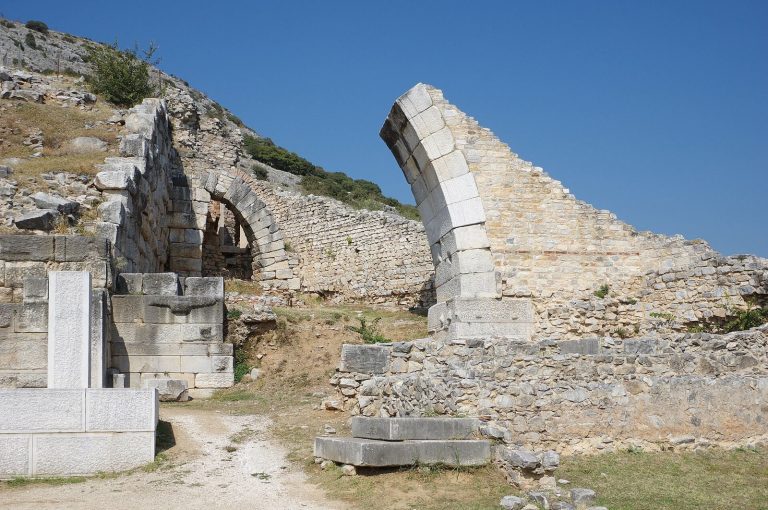
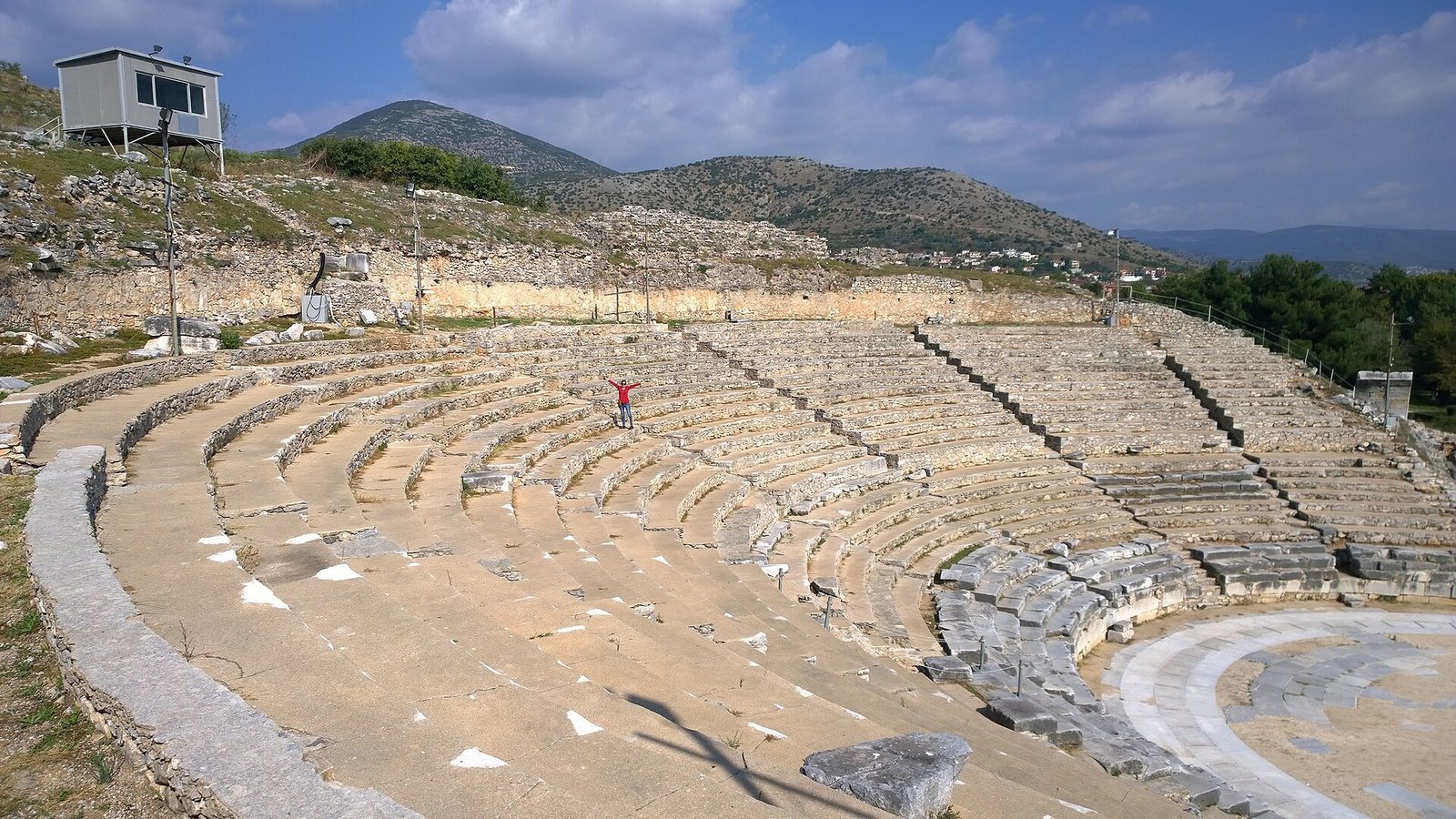
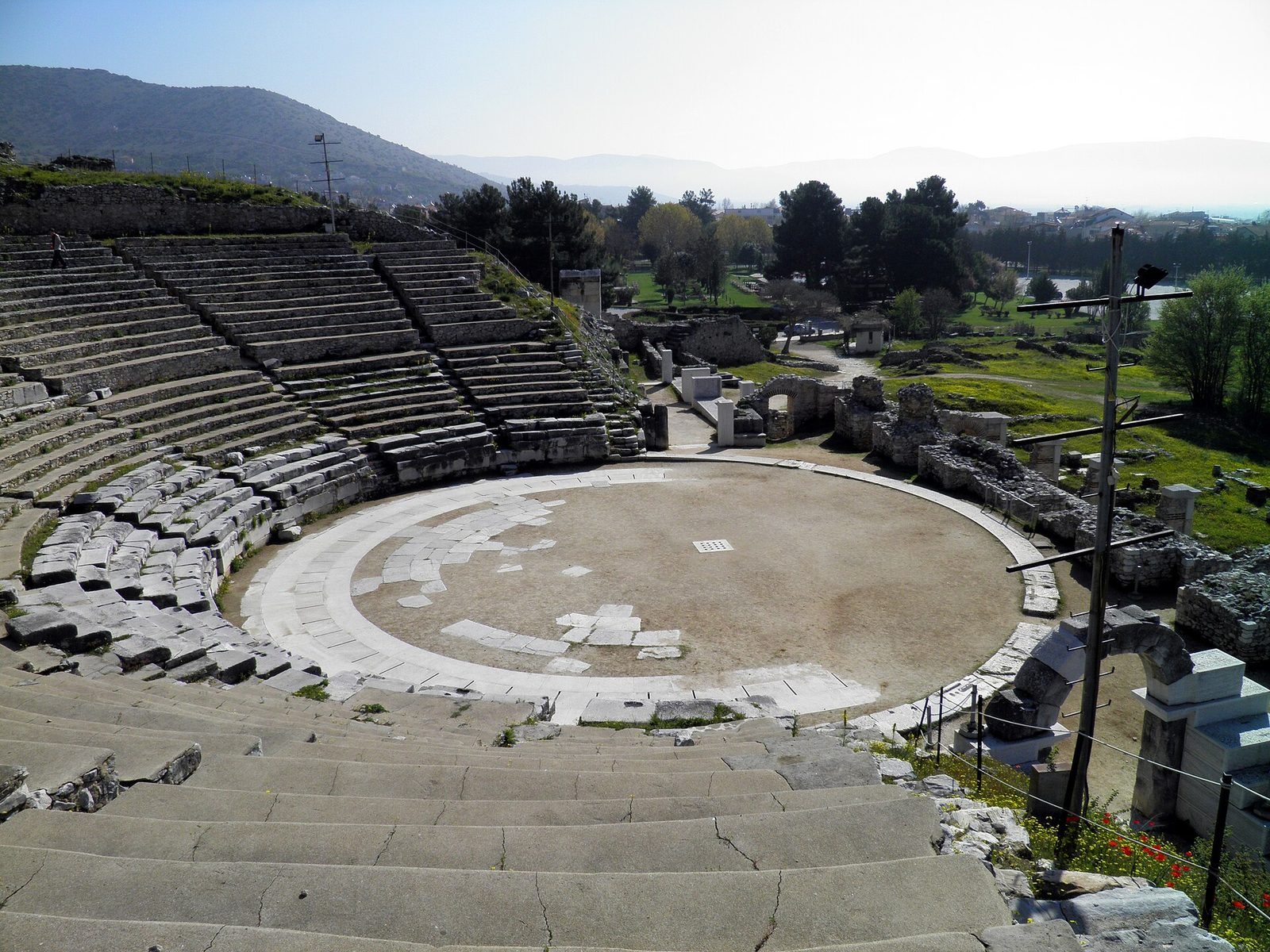
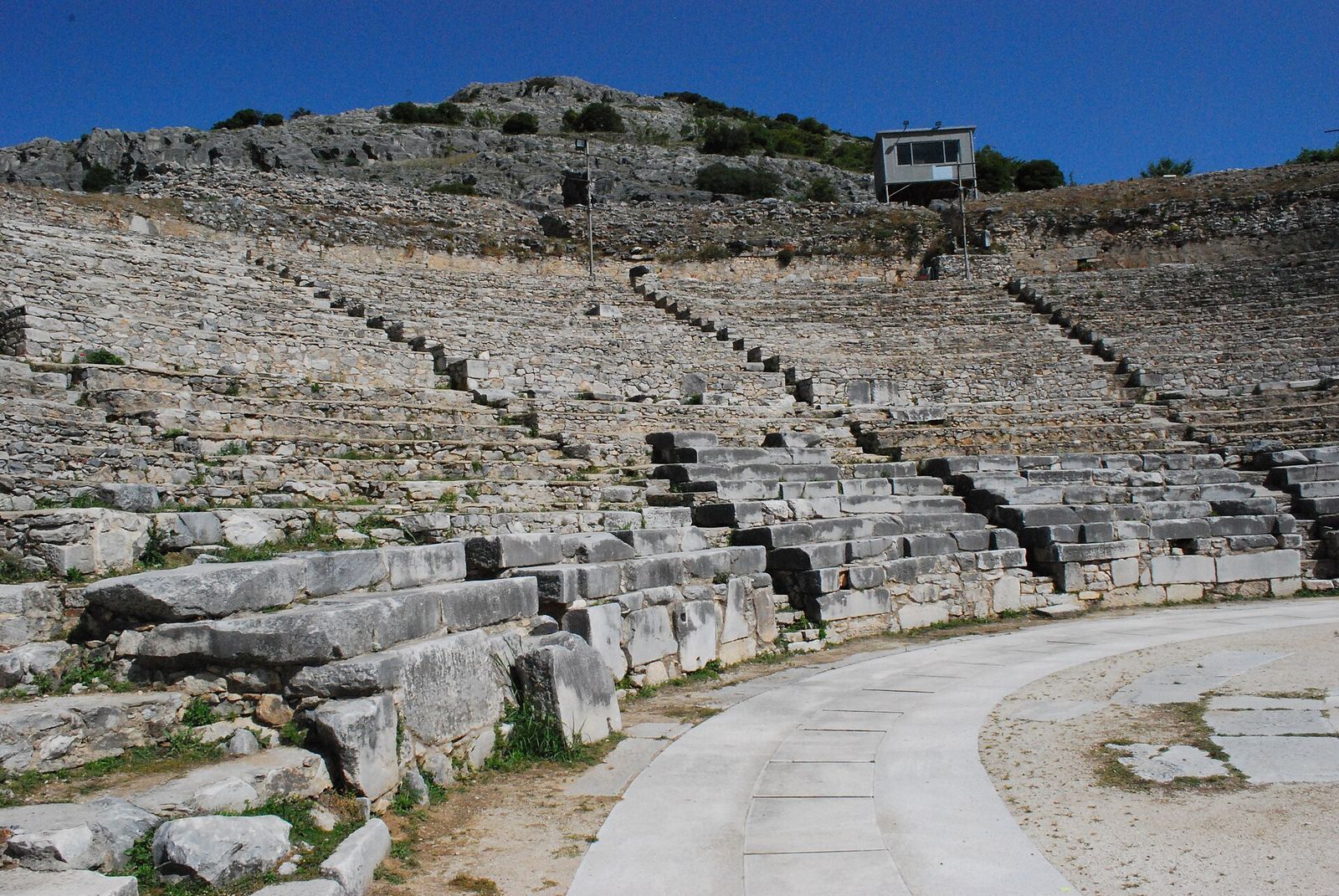
The ruins occupy the northeastern part of the archaeological site, on the southeastern slope of the acropolis. Built of marble, the theatre used the hillside’s incline and faced south, overlooking the city. Its eastern side adjoined the city wall. The original Greek arrangement included a semicircular auditorium, a circular orchestra (the central performance area), a stage building behind it and a side passage on each side leading into the performance space.
Early Greek structure
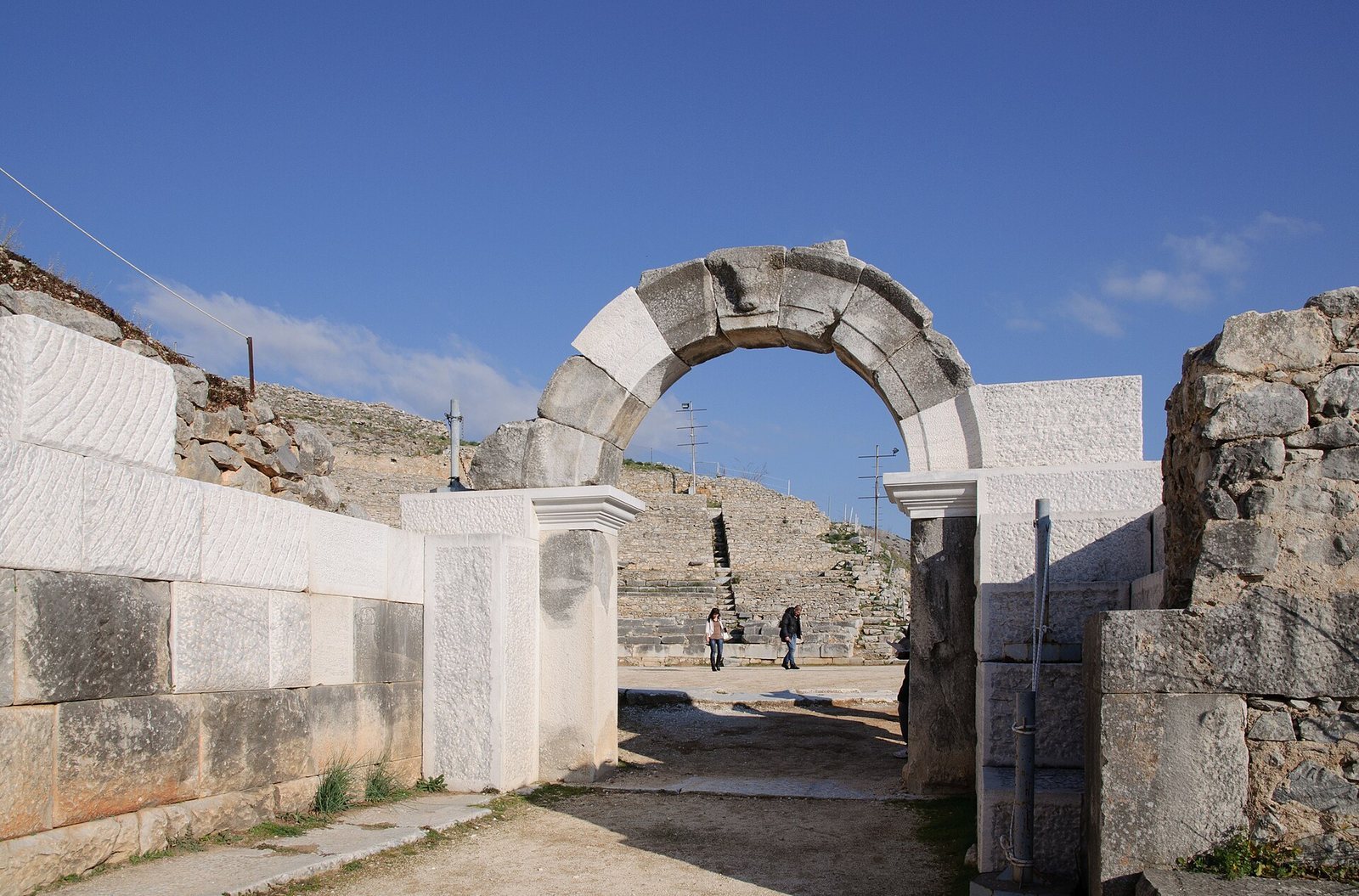
Fragmentary remains survive from the Late Classical period, which followed the height of Classical Greek culture, and the Hellenistic period, which followed Alexander the Great’s conquests and the spread of Greek culture across a wider region. Retaining walls on the eastern, western and southern sides supported the auditorium. The visible faces of the parodoi (side passages into the performance area) used isodomic masonry, with regular courses of similarly sized blocks; the ends nearest the orchestra were especially carefully finished.
Roman rebuilding and arena conversion
Second-century rebuilding
The second-century CE stage building was a monumental structure with three storeys and a wooden proskenion (the structure in front of the stage building). The orchestra and the auditorium above the side passages were enlarged, while seating extended over those passages, which were covered by vaults. Sculptural decoration drew on Dionysus, the Greek god associated with wine, festivity and theatre. A paved square lay south of the stage; buildings from the Early Christian period, when Christian communities and institutions were developing, later covered it. A rainwater channel runs around the paved Roman-period orchestra.
Arena alterations
For arena spectacles, builders removed the wooden proskenion, raised the floor beneath the stage and reconfigured the orchestra. They took out the first two seating rows and added a stone parapet and railings to protect spectators.
Seating, supports and conservation
At its fullest extent, the auditorium had seats and stairways built of rubble masonry and coated with cement mortar. A passage divided the seating into upper and lower tiers, each arranged in eight wedge-shaped sections. The lower tier had ten rows; the upper is estimated to have had ten to twelve. In the second half of the third century CE, two supporting arches were added to address structural problems in the auditorium’s retaining wall and the western side passage. Modern conservation repaired the eastern retaining wall and arches, as well as the stage building, side passages, orchestra and upper seating. In 2005 the western retaining wall was restored, and excavation examined the area between it and the western covered colonnade.