Altıgöz Bridge: A Six-Arch Seljuk Bridge in Afyonkarahisar


Site at a Glance
- Rating
- 4.1
- Popularity
- Very Low
- Country
- Turkey
- Primary era
- Medieval
- Eras represented
- Medieval
- Civilizations
- Seljuk
- Site type
- Infrastructure
- Remains
- Bridge
On this page6 sections
History
Construction under the Sultanate of Rum
Altıgöz Bridge is a medieval stone bridge in Afyonkarahisar, Türkiye, built during the Sultanate of Rum, the Seljuk sultanate that ruled much of Anatolia. Its construction was commissioned before 1209 by the emir Ebû Vefâ İlyas b. Oğuz, a military or political official who probably belonged to the Aq Qoyunlu, a Turkmen tribal confederation that later became a major power in eastern Anatolia and nearby regions.
The crossing may have replaced an earlier bridge. İlyas’s son, Sipâhsâlâr Ebû Hâmid Hacı Mehmed b. İlyas, later repaired it. This work is dated either to 1209–1210 or to 1237. The bridge’s construction inscription names the emir responsible for the work and is written in Thuluth, a large, flowing form of Arabic calligraphy used for monumental inscriptions. Its difficult, highly elaborate lettering has made the text challenging to read.
Earlier building material and modern restoration
A Byzantine building inscription, from the eastern Roman Empire that continued through the medieval period, was built into one of the bridge piers. It may point to an earlier Byzantine bridge at the crossing, although it could also have come from another building. The bridge was probably constructed partly with stone taken from the ancient theater of Prymnessos, associated with the modern village of Sülün.
The most recent restoration took place in 1985. By that time, the inscription tablet had fallen into the river and had been moved to a local museum. The restoration returned the tablet to the bridge, re-establishing its place within the structure.
Remains
Bridge structure
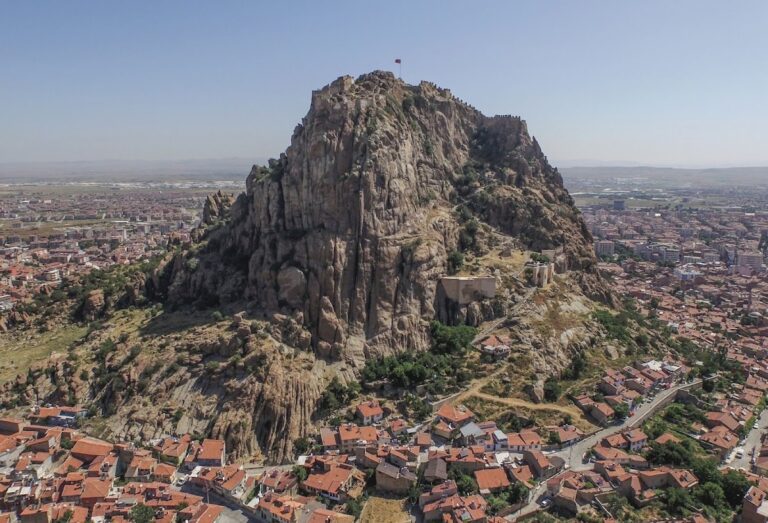
Altıgöz Bridge crosses the small Akarçay River in central Afyonkarahisar, near Çetinkaya railway station and north of, at the foot of, Cirit Rock. Cirit Rock is a prominent rocky landmark near the city. The stone arch bridge measures 44 metres in length and has six arches, or spans, which give it the Turkish name meaning “Six-Arch Bridge.” It remains in use as a field road.
Inscribed and reused elements
The construction inscription tablet was originally reused from an ancient marble sarcophagus. Its later return during the 1985 restoration forms part of the bridge’s surviving fabric. Another inscription, made for a Byzantine building, is incorporated into one of the piers. Together, these reused elements preserve evidence of earlier materials and building traditions within the medieval crossing.