All Souls College: A Research Institution in Oxford
Site at a Glance
- Popularity
- Very High
- Country
- United Kingdom
- Primary era
- Medieval
- Eras represented
- Medieval, Early Modern, Modern
- Civilizations
- British, English
- Site type
- Civic
- Remains
- University
On this page8 sections
History
Foundation and college life
All Souls College is a college and research institution in Oxford, England, United Kingdom. Henry VI and Henry Chichele founded it in 1438 to commemorate those killed in the Hundred Years’ War, a prolonged series of conflicts between England and France. Its name refers to the Feast of All Souls, a Christian observance for the dead. The founding statutes provided for a warden, the head of the college, and 40 fellows, or full members of its governing body. All were expected to take holy orders, meaning become clergy. Twenty-four were assigned to study arts and theology, and 16 to civil or canon law, the latter governing church affairs.
Under Warden Robert Hovenden, whose term ran from 1571 to 1614, undergraduates entered the college to serve the fellows in their households. The arrangement had ended by the close of the English Commonwealth, the republican government between the abolition of the monarchy in 1649 and its restoration in 1660. Four Bible Clerks, however, remained on the college foundation until 1924. All Souls now focuses primarily on research and has no student members.
Academic endowment and fellowships
A university commission in 1850 led the college to reduce its fellowships by ten and use the funds to establish two Chichele professorships, statutory academic chairs named for Henry Chichele. The chair in International Law and Diplomacy was created in 1859 and first held by Mountague Bernard; Montagu Burrows became the first holder of the Modern History chair. From 1870, a Chichele chair was accompanied by a college fellowship. The five current chairs cover economic history, the history of war, public international law, social and political theory, and medieval history. The college also began its Chichele Lectures in 1912. Initially focused on foreign history, they later broadened to include law, political and economic theory, and British history. They were once generally delivered by a single lecturer, while several speakers now often address a shared theme.
The college’s examination fellowship competition began in 1878. Applicants are usually Oxford graduates or Oxford postgraduate students who earned their first degree elsewhere, and must apply within three years of receiving a bachelor’s or master’s degree. Fellowships last seven years. Usually two are awarded each year, though there have sometimes been one or three, and occasionally none. Several dozen candidates typically take part, and about a dozen examination fellows are at the college at any one time.
The examination takes place over two days in late September, with two three-hour papers each day. Candidates choose a subject from classics, English literature, economics, history, law, philosophy, or politics for two papers. The other two are general papers, each requiring answers to three questions selected from a list. Four to six candidates proceed to an oral examination. Before 2010, candidates also wrote an open-ended essay on a word chosen in advance. Finalists were once invited to dinner with around 75 college members, but the practice ended after candidates worried it might influence how they were assessed; the dinner had not been part of the examination.
After more than five centuries as a college for men, All Souls began admitting women as fellows in 1979, the same year women became eligible for the examination competition. Some fellows opposed the change. The American philosopher Susan Hurley became the college’s first female fellow in 1981.
Chapel and traditions
The chapel remained largely unchanged until the English Commonwealth, when Puritans, who sought further reform of the Church of England, brought hostility to Oxford, then largely Royalist. A screen based on a design by Christopher Wren was installed in the 1660s and rebuilt by 1713. By the mid-19th century, the chapel required extensive renovation. Its services follow the Book of Common Prayer, the Church of England’s traditional liturgy, and use the King James Bible, an English translation first published in 1611.
Every hundred years, the college holds a commemorative feast and the Mallard ceremony, generally on 14 January. Fellows process with flaming torches and sing the Mallard Song as a figure called Lord Mallard is carried in a chair in search of a legendary bird said to have flown from the college’s foundations during construction. A person bearing a pole with a mallard attached leads the procession. The bird was alive in the ceremony’s earlier form, dead in 1901, and carved from wood in 2001. The custom’s origin is uncertain, but it is known from at least 1632. The last ceremony took place in 2001, and the next is due in 2101.
In 1710, Christopher Codrington bequeathed books valued at £6,000 and £10,000 to rebuild and endow the college library. Codrington, a Barbados-born colonial governor, had gained his fortune through sugar plantations and slaveholding. In 2020, the college stopped using the name Codrington Library in response to this legacy.
Remains
Setting and exterior
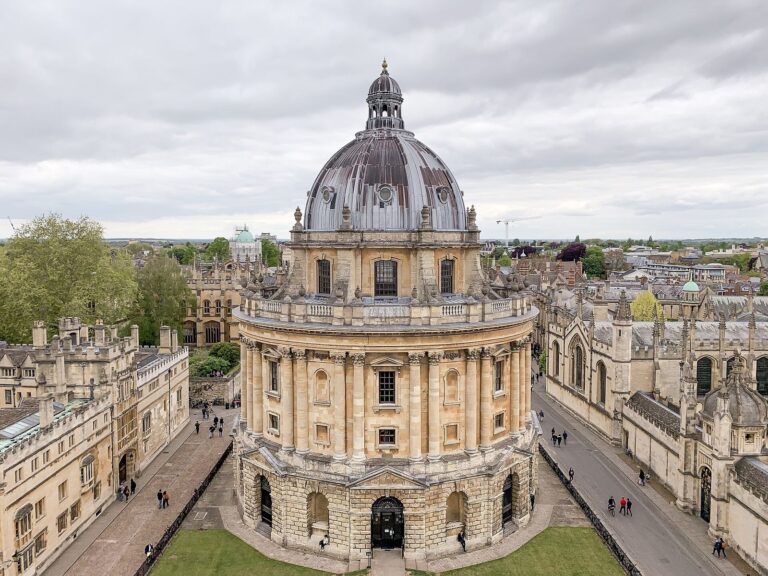
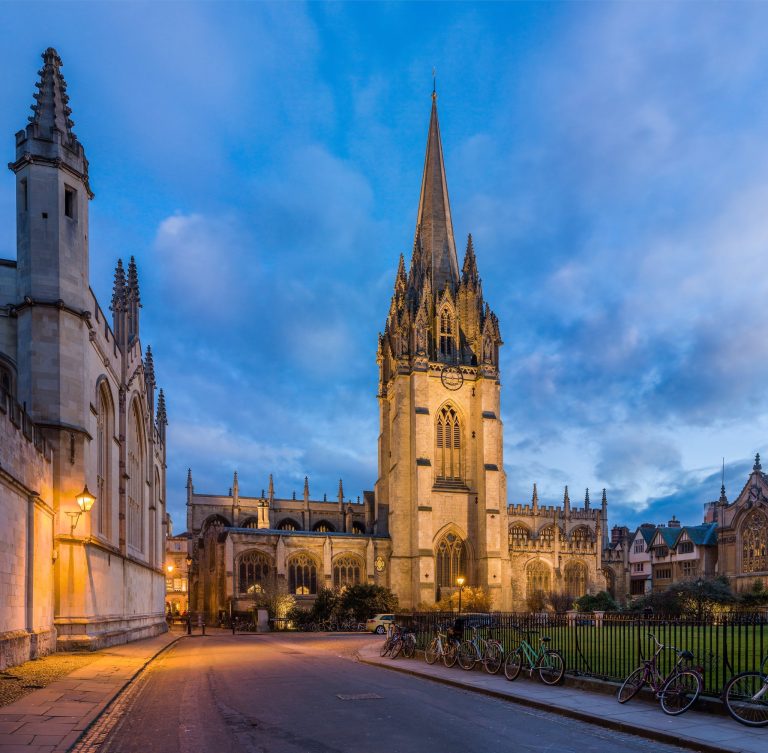
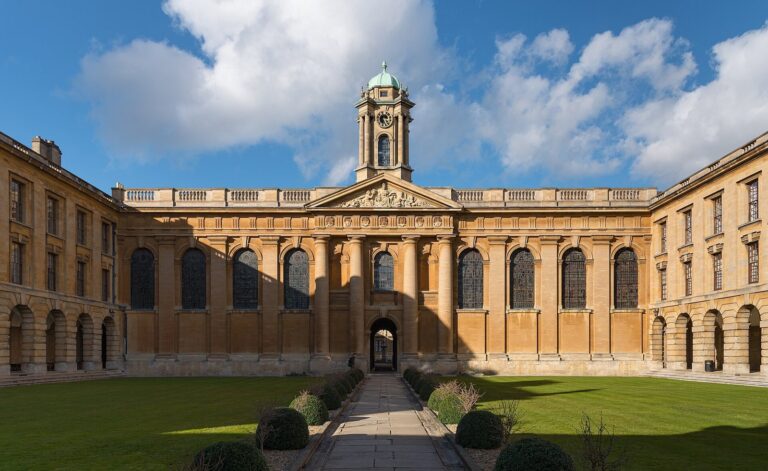
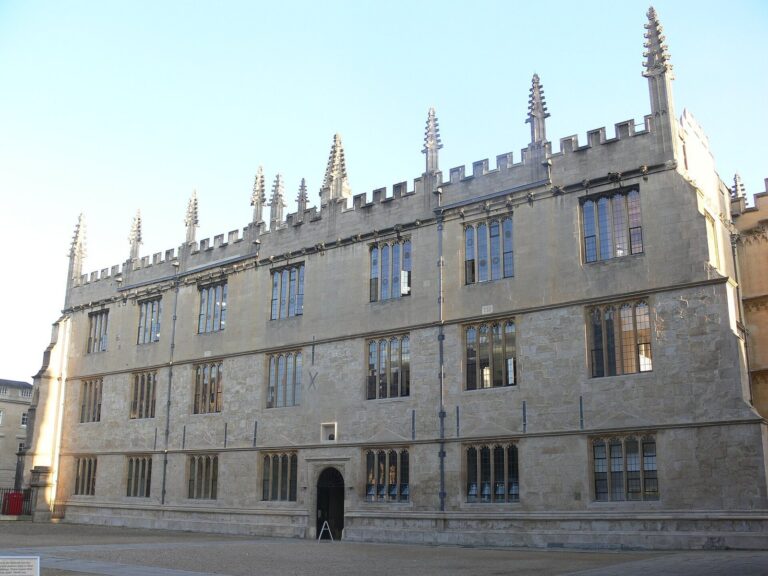
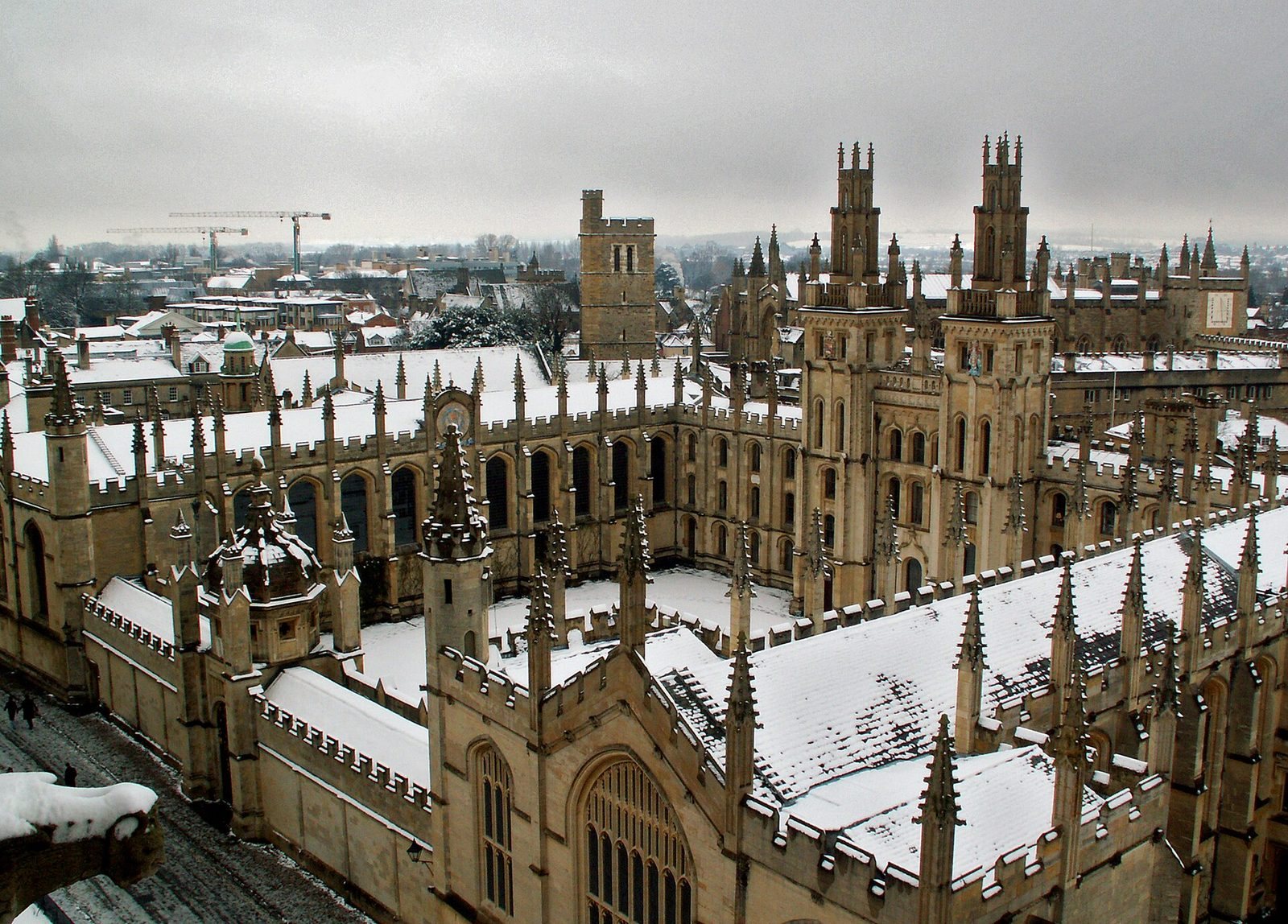
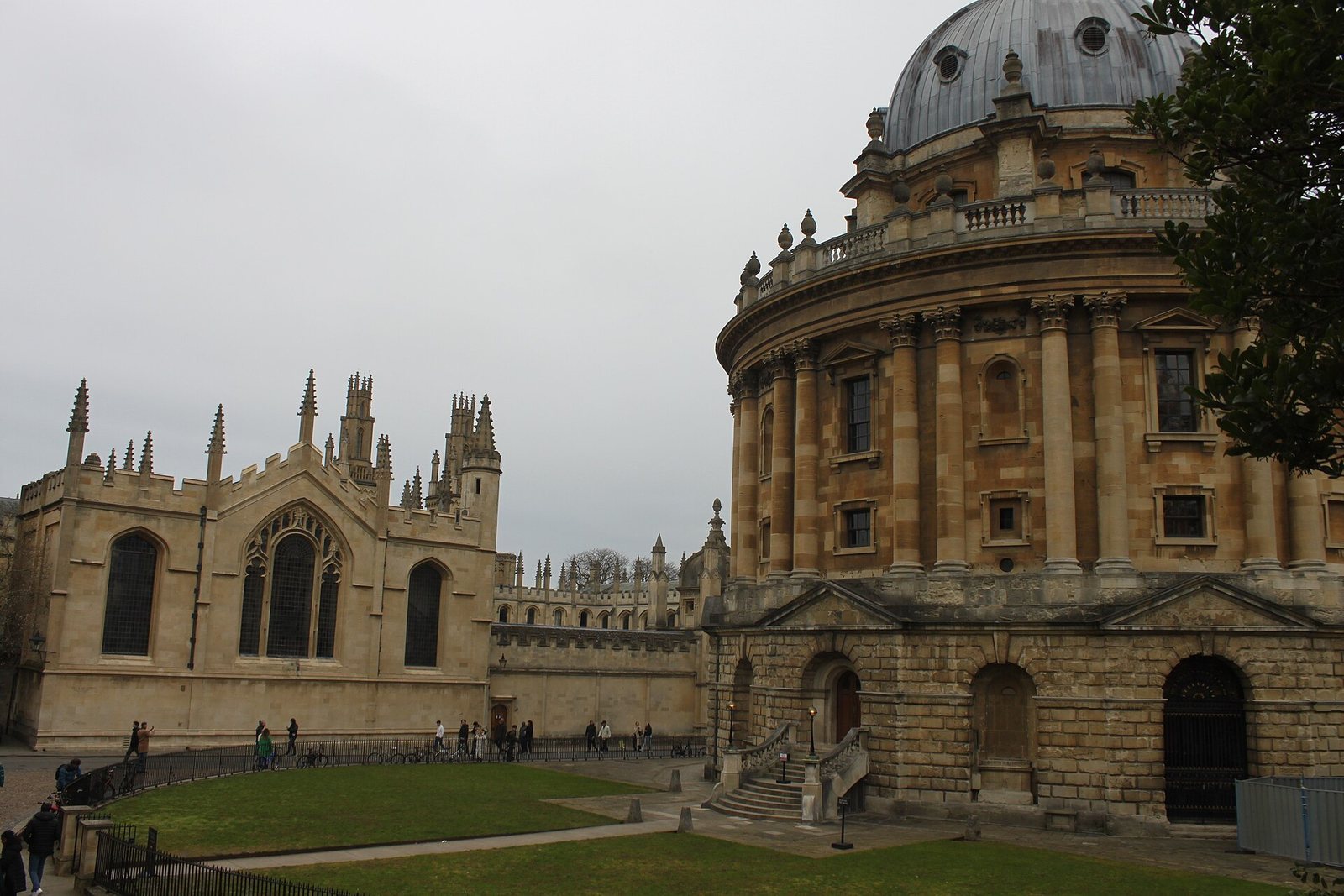
The college entrance stands on the north side of High Street, and its frontage runs along Radcliffe Square, where a gate provides an entrance. The Queen’s College lies to the east and Hertford College to the north. The Hawksmoor Quadrangle has twin towers. One range designed by Nicholas Hawksmoor has a Gothic exterior and a wholly classical interior; the college’s overall exterior has also been described as Gothicized classical. Pinnacles and towers form part of its exterior.
Library and sundial
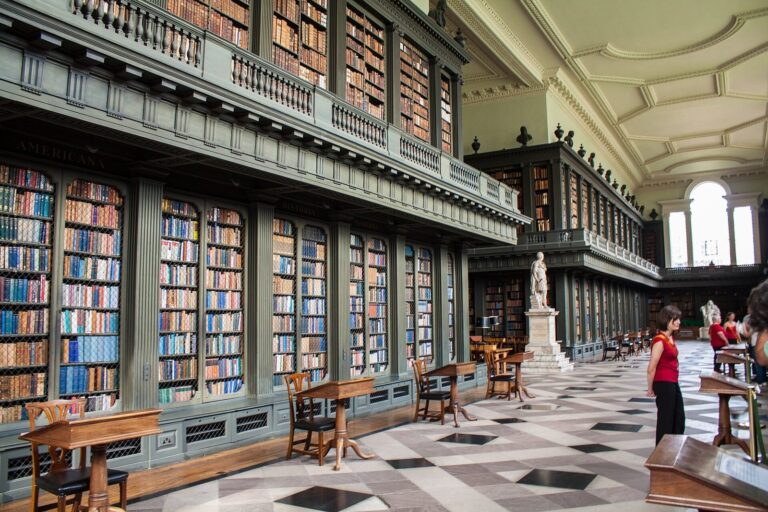
Designed by Nicholas Hawksmoor, the library was completed in 1751 and has remained in continuous use. Its collection contains about 185,000 items, roughly a third published before 1800, with strong holdings in law and history, especially military history. A sundial made in 1658 for the chapel’s south wall is attributed to Christopher Wren, who became a fellow in 1653. It was moved in 1877 and now sits above the library’s central entrance.
Chapel
Built between 1438 and 1442, the chapel contains 42 misericords from its construction. These are ledges beneath choir-stall seats that allow a person to rest while appearing to stand. The carvings resemble those at St Mary’s Church in Higham Ferrers, and both groups may have been made by Richard Tyllock. The chapel’s screen is classical in design, with a stone altar visible through it. Its present form reflects Victorian design ideals, and its stained-glass windows have been rearranged and repaired while retaining much of the original medieval glass.