All Saints, Margaret Street: A Victorian Gothic Revival Church in London
Site at a Glance
- Rating
- 4.8
- Popularity
- Medium
- Country
- United Kingdom
- Primary era
- Modern
- Eras represented
- Modern
- Civilizations
- British
- Site type
- Religious
- Remains
- Church
On this page14 sections
History
Chapel and shifting congregations
All Saints, Margaret Street is an Anglican church in London, United Kingdom. Its predecessor, Margaret Street Chapel, was built in 1752 and is credited to William Cudworth, a former Methodist who later held that moral law did not bind Christians. Cudworth leased the chapel in 1754, and a Protestant congregation outside the established Church of England had formed there by 1757. In 1776, the deist David Williams rented the building to promote a universalist form of worship.
The chapel closed in the 1780s, then reopened as a privately owned Church of England chapel, a type known as a proprietary chapel. Ownership later passed to the Crown, and J. D. Hazlewood served as its minister for a time. A fire on Titchfield Street damaged the chapel in 1825.
The Oxford Movement and rebuilding
In 1827, banker and politician Henry Drummond bought the chapel and its site, hoping to promote Irvingism, a Christian movement associated with preacher Edward Irving. Two years later, Drummond appointed William Dodsworth as minister. Dodsworth brought Oxford Movement ideas to the chapel. This nineteenth-century Church of England movement sought to renew Catholic teaching and worship, including the importance of the Eucharist, the Christian rite centred on consecrated bread and wine. The chapel drew supporters of the movement in London. Dodsworth left in 1837 and Charles Thornton succeeded him.
Frederick Oakeley became minister in 1839, changed the chapel’s interior arrangements and introduced Anglo-Catholic worship, an Anglican tradition emphasizing Catholic liturgy and sacramental practice. In 1845, after the Bishop of London challenged his claim to uphold Roman doctrine, Oakeley gave up his ministerial licence and became a Roman Catholic. William Upton Richards took his place. Oakeley had already begun planning a new church and raised about £3,000; Richards continued the project.
Alexander Beresford Hope brought the scheme together with the Cambridge Camden Society’s plans for a church shaped by its Gothic architectural ideals and traditional liturgy. With Bishop of London Charles James Blomfield’s approval, Richards acquired the chapel site and adjoining houses in 1849. The Ecclesiastical District of All Saints was established on 30 July that year. The society took charge of the rebuilding. Stephen Glynne was appointed to oversee it but did not participate, and Hope assumed responsibility. William Butterfield was chosen as architect. The church became a major work of the Victorian Gothic Revival and an early example of High Victorian Gothic, a mid-nineteenth-century approach that used elaborate forms and expressive building materials.
Charles Marriott preached the chapel’s final sermon on 7 April 1850, and its last service was held the following day. Edward Bouverie Pusey laid the new church’s foundation stone on All Saints’ Day, 1 November 1850. While construction proceeded, the congregation worshipped in Great Titchfield Street and, from 1855, at 77a Margaret Street. The church project, including the site and endowments, cost about £70,000, with several large gifts contributing to the expense.
Parish, community and music in the nineteenth century
The Oxford Movement also inspired the Society of All Saints, known as the Sisters of the Poor. At Richards’s encouragement, Harriet Brownlow Byron established a religious community serving people with disabilities and orphaned children. Richards celebrated the Eucharist for its members in 1851. The community moved in 1856 to Margaret Street, opposite the new church. On 5 May that year, Richards received the religious vows of Byron and two other women; the society was formally founded in August, with Byron as its superior by appointment of Samuel Wilberforce, Bishop of Oxford. Maria Rossetti joined as an associate sister in 1856, and her sister Christina later worked with the society’s House of Charity at Highgate. Christina Rossetti’s poem Yet a Little While has been interpreted as describing the church interior.
Bishop of London Archibald Campbell Tait consecrated All Saints on 28 May 1859. Richards remained vicar until his death on 16 June 1873, following strokes in 1869. He established a choir school in 1860. The church’s musical life had begun earlier: Richard Redhead became organist at the chapel in 1839 and continued at All Saints until 1864. In 1841, Oakeley translated the hymn Adeste Fideles for the congregation as Ye Faithful, Approach Ye. Although he did not publish his version, its use at the chapel helped it enter several nineteenth-century hymnals.
Berdmore Compton succeeded Richards in 1873 and served until July 1886. Archbishop of Canterbury Edward White Benson preached at All Saints on Ascension Day, 3 June 1886. William Allen Whitworth became vicar that November. He began a parish newspaper in 1887, established a mission at Pentonville from 1888 to 1897, and arranged Welsh-language services at the church from 1889 to 1895. He died in March 1905.
Worship and parish life in the twentieth century
George Holden led the church from 1905 until his death in 1908. He re-established a branch of the Confraternity of the Blessed Sacrament in 1906 and affiliated All Saints with the English Church Union the following year. His successor, Henry Mackay, served as vicar from 1908 to 1934. Mackay introduced incense in 1908, began using the term Mass for services in 1911, and added paschal candles in 1912. From 1913, the solemn Eucharist was called High Mass, and from 1915 the church’s priests were addressed as Fathers.
William Stevenson Hoyte was organist from 1868 to 1907. His pupil, composer and organist Healey Willan, often played at evensong when in London in the early twentieth century. Music director Walter Vale arranged Sergei Rachmaninoff’s Liturgy of St. John Chrysostom, which the Russian composer heard at All Saints when he attended in 1924. The church’s choristers sang at the coronations of Edward VII and Alexandra in 1902 and George V and Mary in 1911.
Dom Bernard Clements, an Anglican Benedictine monk, became vicar in 1934. He led the 1939 centenary commemorations of Oakeley’s appointment as minister of Margaret Street Chapel; preachers included the archbishops of York and Wales. In November that year, Archbishop of Canterbury Cosmo Gordon Lang preached at evensong. During the Second World War bombing of London, the choristers were evacuated to the countryside and fire damaged the roof of the parish school. Clements died in 1942. Cyril Edric Tomkinson became vicar in 1943 but resigned because of ill health in 1951; Kenneth Needham Ross succeeded him. The church marked the centenary of its consecration in 1959 with a High Mass at which the Archbishop of York preached.
The choir school had admitted its first chorister in 1848 and paused its work while the church was built, from 1854 to 1859. It closed in 1967 because of financial difficulties, and boys’ voices were replaced by sopranos. John Birch had served as organist and choirmaster from 1953 to 1958. Michael Marshall was vicar from 1969 to 1975. After Bishop of London Graham Leonard considered using All Saints as a centre for lay religious instruction in 1970, Marshall founded the Institute of Christian Studies at 84 Margaret Street, the former choir-school site. It began as a residential community, developed into a teaching centre and was formally opened by Archbishop of Canterbury Michael Ramsey in 1973. It closed around 1978. Marshall became Bishop of Woolwich in 1975. David Sparrow served as vicar from 1976 until his death in 1981.
David Hope became vicar in 1982 and organized a celebration of the Oxford Movement’s 150th anniversary the following year, with Ramsey preaching at evensong. In 1983 Hope restored the Feast of the Assumption, introduced a vessel called a monstrance to display the consecrated host for veneration, and established Tenebrae, a Holy Week service in which lights are gradually extinguished. He became Bishop of Wakefield in 1985 and David Hutt succeeded him in 1986. Alan Moses served as vicar in the early twenty-first century. All Saints remains an Anglo-Catholic parish in the Church of England’s Diocese of London and the Province of Canterbury. Because the parish does not affirm the ordination of women as priests or bishops, it came under the Bishop of Fulham’s episcopal oversight in 2020. The church is a Grade I listed building, a designation for buildings of exceptional architectural or historic interest in England.
Remains
Courtyard and exterior
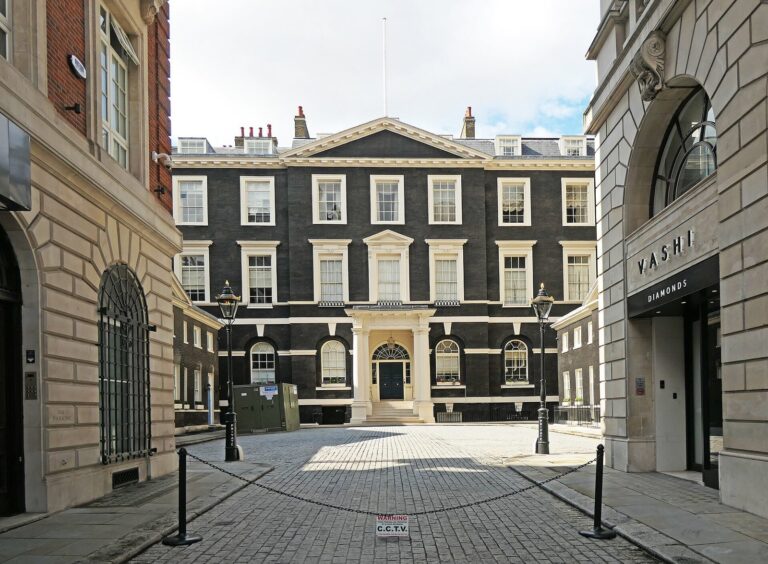
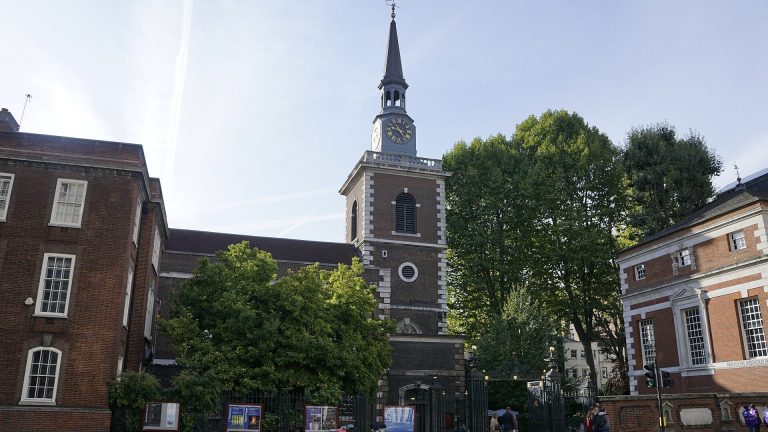
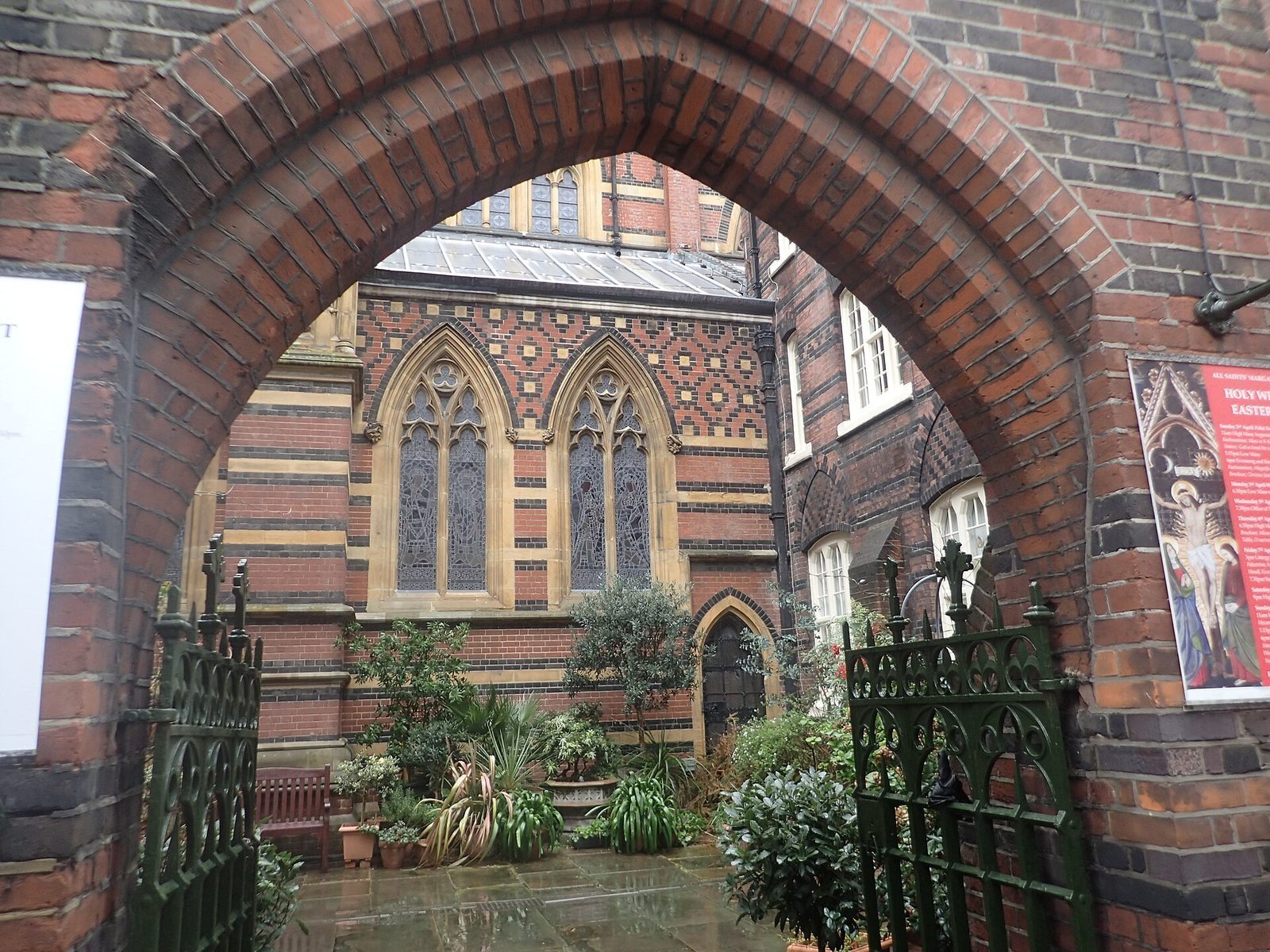
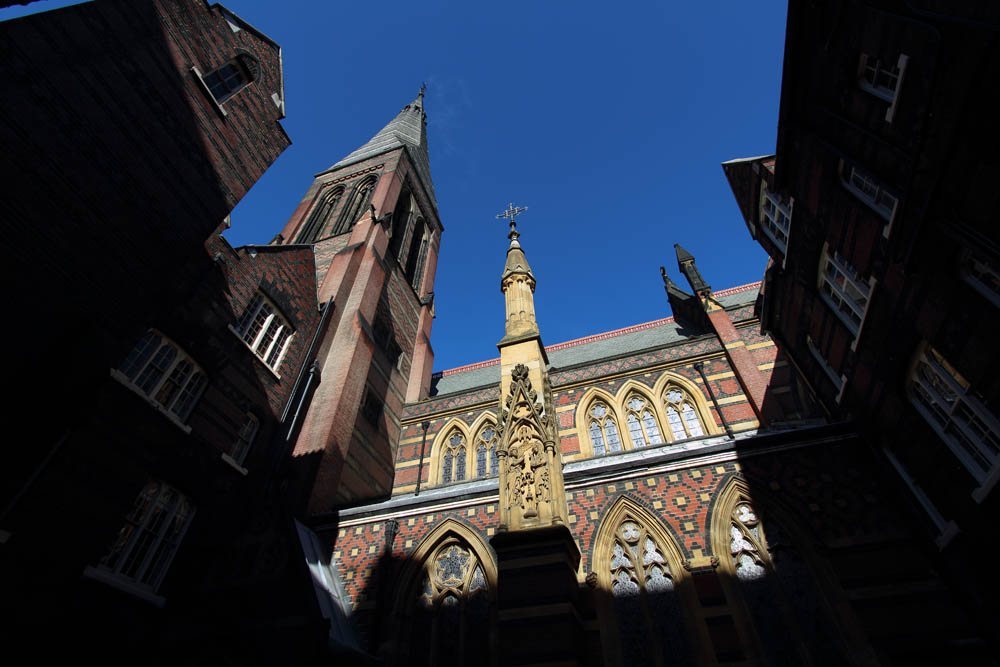
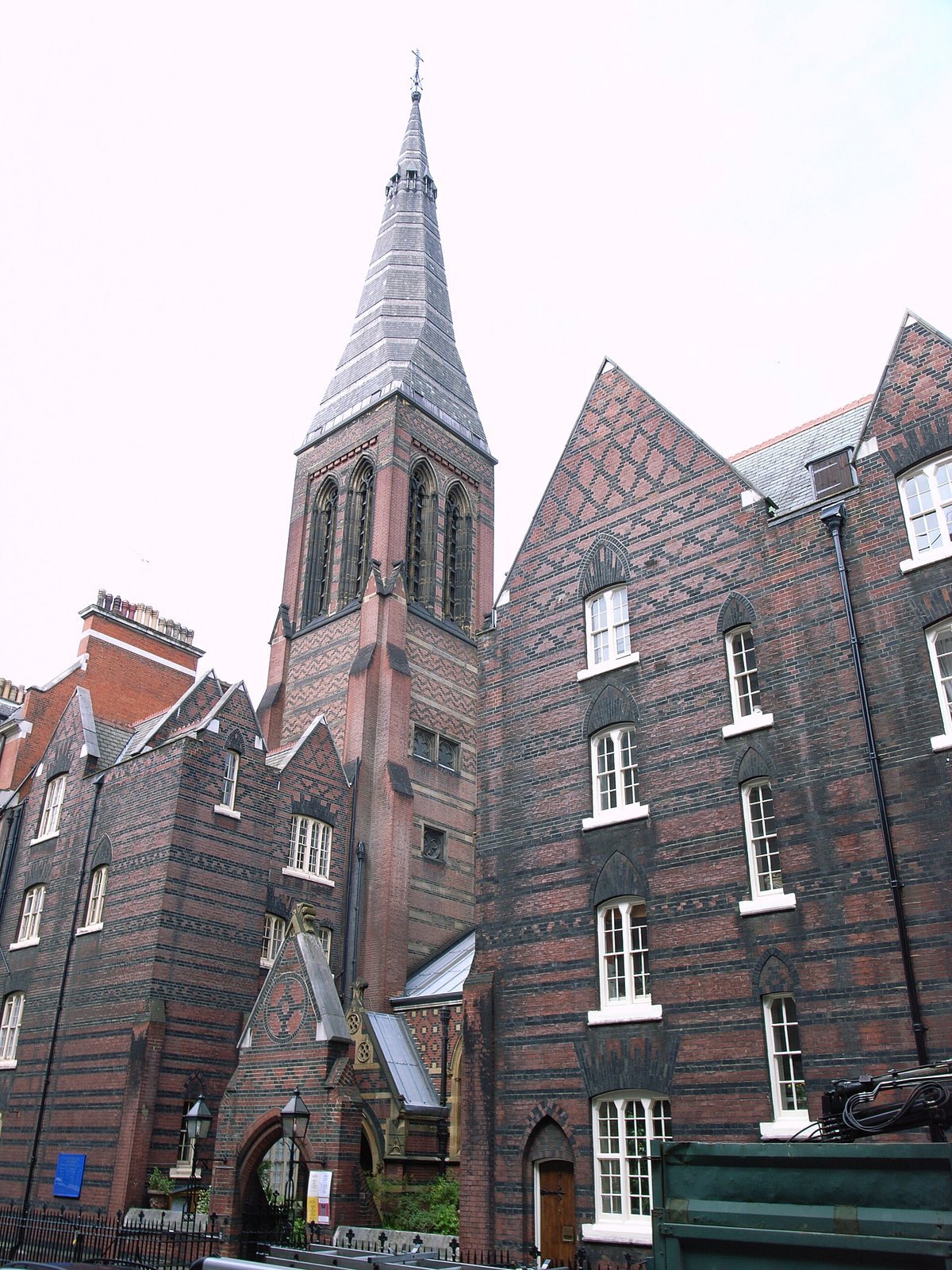
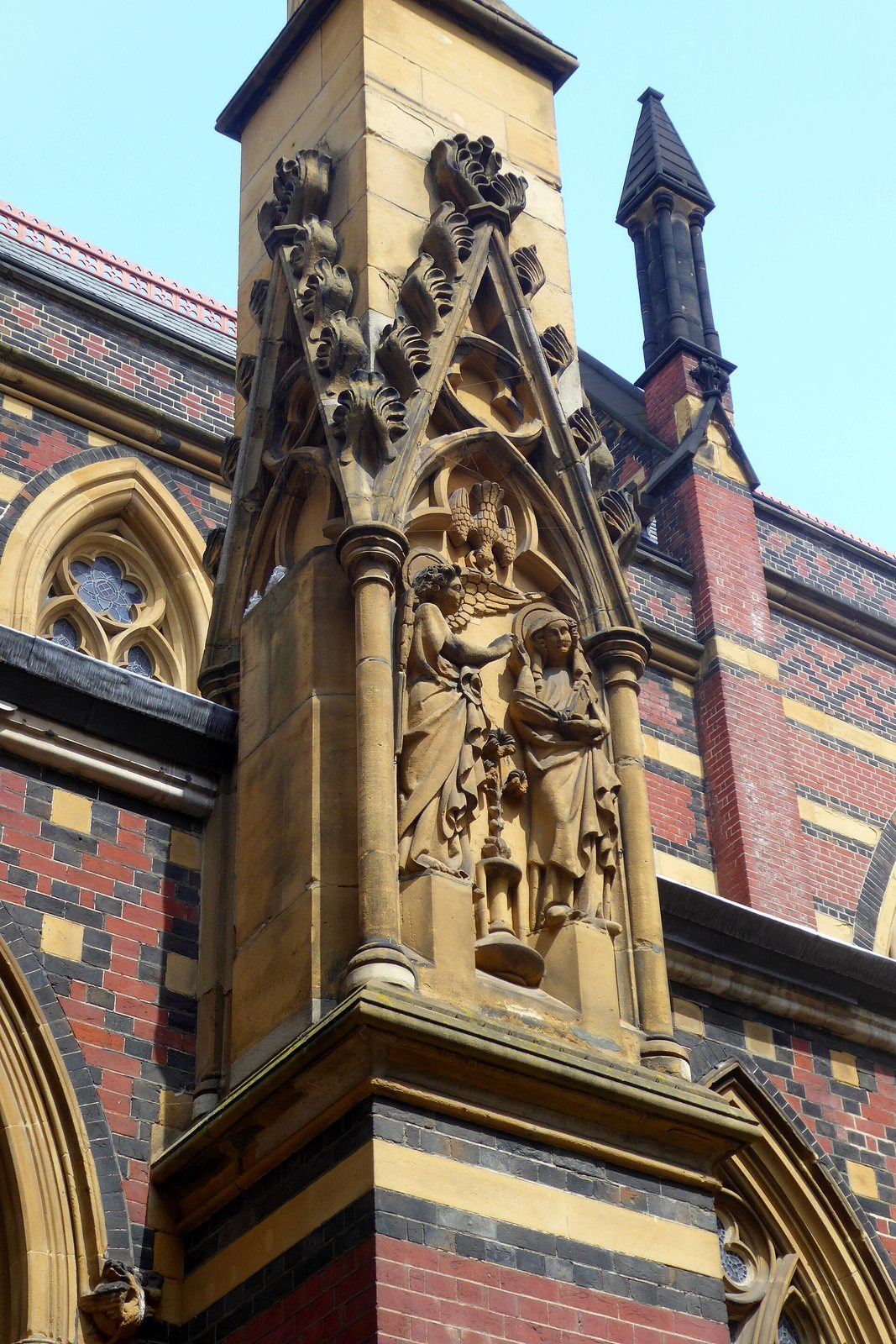
The church forms the rear wing of an enclosed complex, with residential wings along the sides and an entrance portal closing the street-facing boundary. Its tower rises as part of the rear wing and ends in a pointed spire. A gabled porch marks the entrance, set to one side, while a prominent buttress bears a relief of the Annunciation. Red brick, patterned chiefly with black bands that include glazed brick, forms the main exterior and adjoining wings. Light sandstone courses interrupt the brickwork; stone bands and carved details also appear on the gate, church walls and spire. Stone frames the portal and the window tracery, the carved stone patterns within the windows. This use of differently coloured materials as part of the construction, known as structural polychromy, was the first example of its kind in London.
Interior architecture and decoration
Church plan and chancel
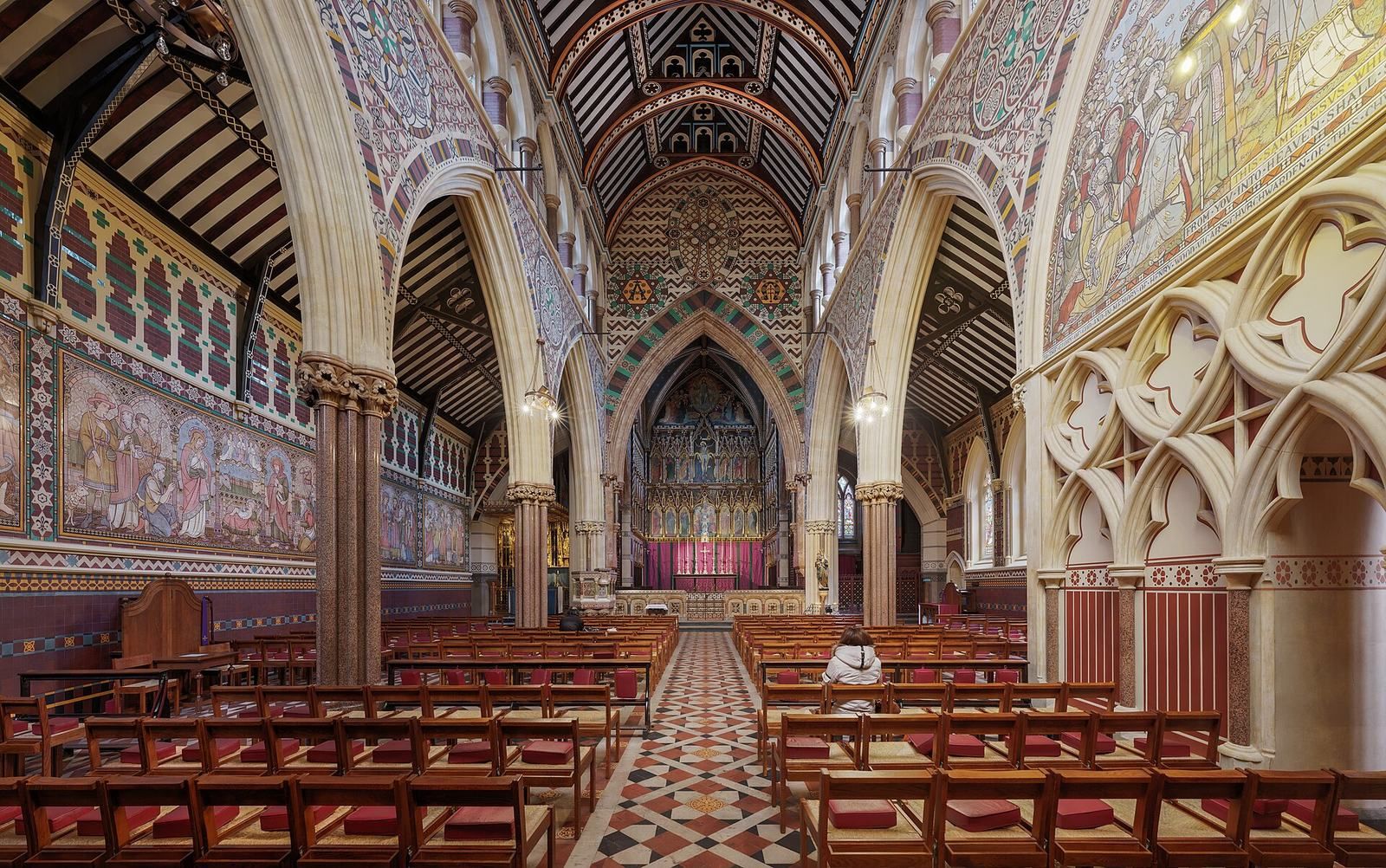
The interior follows a basilican plan, with a central nave flanked by aisles. Broad pointed arches support a low clerestory, the high window level above the main arcade, which has blind arcades of arches applied to a solid wall. An open roof structure spans the church. In the chancel, intersecting ribs support a cross-rib vault, and a series of small ornamental gables shapes the altar wall.
Surfaces and altar decoration
Patterned tiles cover the floor, while geometrically arranged brick, tile and marble decorate the walls. The scheme includes painted tiles and large tile friezes; the ceiling is painted, and the timberwork behind the altar is painted and gilded. At the rear of the chancel, paintings on gilded panels sit within a finely carved, patterned Gothic screen. This decoration is associated with Ninian Comper and restores earlier work by William Dyce. Comper also decorated the Lady Chapel. Butterfield’s ornamental screen behind an altar, or reredos, was moved during the twentieth century to St Catherine’s Church in Wickford.
North-wall tile frieze
A large ceramic frieze installed on the north wall in 1873 was designed by Butterfield, painted by Alexander Gibbs and fired by Henry Poole & Sons. Its scenes include episodes from the Old Testament, a central Nativity and figures of the early Church Fathers.
Windows and glass
Alfred Gérente designed the original windows. His work in the large west window, installed between 1853 and 1858, was replaced by Gibbs’s design in 1877, which drew on the Tree of Jesse window at Wells Cathedral. Michael O’Connor’s clerestory glass dates from 1853. He also designed the east window in the south chancel aisle, showing Christ in Majesty with St Edward the Martyr and St Augustine of Canterbury.
Baptistery and other features
The baptistery occupies the southwest corner and has marble tiling. Its ceiling tiles include a pelican feeding its young, a Christian image associated here with humanity’s fall and redemption. A baptismal font is also part of the church. Near the chancel stands a statue of the Virgin Mary, while painted tiles on the south side depict the Ascension of Jesus.
Organ
Harrison & Harrison built the present organ in 1910–11, incorporating material from an earlier instrument. It has 69 stops across four manuals and a pedal, with exposed pipes behind a stone tracery arcade on the north side of the chancel. The organ was converted to electro-pneumatic action in 1957, using electrical controls and pneumatic mechanisms to operate its valves, and restored in 2002.