Akola Fort: A Historic Riverside Fortification in Maharashtra
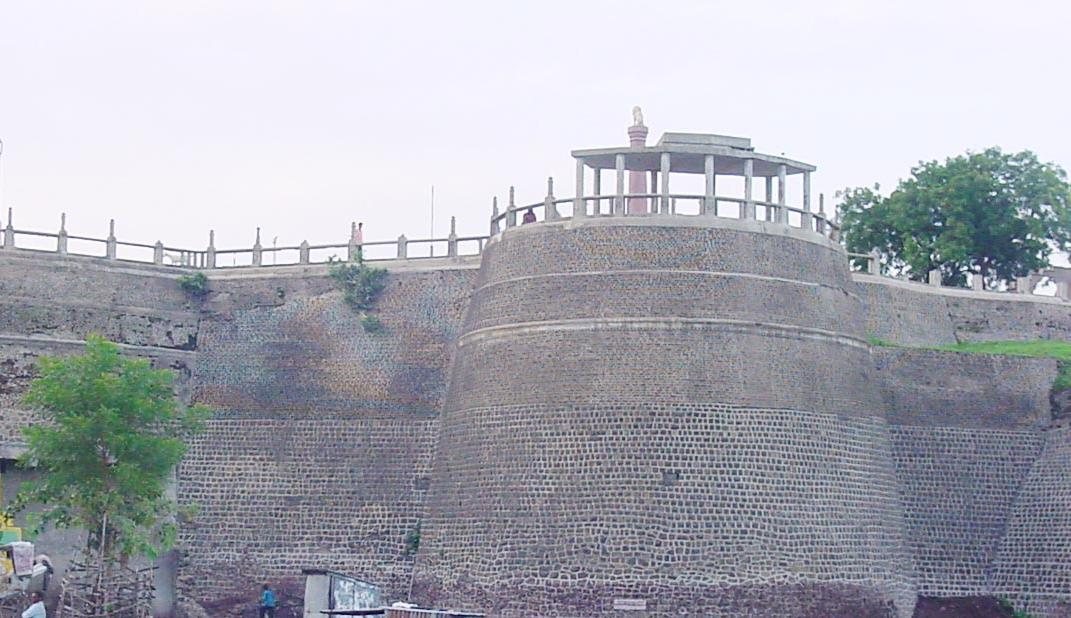
Site at a Glance
- Rating
- 3.9
- Popularity
- Medium
- Country
- India
- Primary era
- Early Modern
- Eras represented
- Medieval, Early Modern
- Civilizations
- Mughal
- Site type
- Military
- Remains
- Fort
On this page15 sections
History
Akola Fort is a riverside fortification in Akola, India, built and rebuilt during the long history of the Berar region, a historic area corresponding broadly to part of present-day Maharashtra. Also called Korbandh Fort and later Asadgadh, it stood near the Morna River and formed part of a major defensive group with Narnala and Akot forts.
Early traditions and conflicting dates
An inscription on the Agarves Gate attributes the fort’s construction in 780 AD to Govind Appaji. It states that the fort was intended to protect the nearby Raj Rajeshwar Temple from Islamic invasion. This account conflicts with the fort’s other dated inscriptions, which associate its major rebuilding with the late seventeenth century.
The fort’s traditional connection with Raj Rajeshwar Temple is linked to the expansion of Islamic rule into the region after the Umayyad conquest of Sindh and Multan in 712, led by Muhammad ibn al-Qasim, an Umayyad general. The temple, dedicated to Shiva, is also known as Berar’s Rajeshwar and is identified as Akola’s oldest Mahadev temple.
Mughal rebuilding
Asad Khan, a Mughal nobleman and minister under Emperor Aurangzeb, attacked and seized the fort in 1695. Rebuilding took place in 1697 during Aurangzeb’s reign, which lasted from 1658 to 1707. An inscription on the Dahi Handa Gate dates this construction to 1114 AH, equivalent to 1697, and connects it with Nawab Asad Khan. The fort was subsequently renamed Asadgadh after him.
The rebuilding was completed in 1698 by Khawja Abdul Latif, according to the inscription at the Eidgah, an open-air Islamic prayer ground used especially for Eid prayers. Its date is given as 1116 AH, equivalent to 1698. Another inscription, on the Fateh Buruj bastion, refers to Asad Khan but associates him with Bahadur Shah I, who succeeded Aurangzeb and ruled from 1707 to 1712. The differing inscriptions preserve competing chronological associations within the fort’s history.
Maratha and British-period history
In 1803, during the Second Anglo-Maratha War, Arthur Wellesley camped at Akola Fort before proceeding to the Battle of Argaon. The conflict, fought from 1803 to 1805, pitted the British East India Company against the Maratha Confederacy. Around 1870, the British dismantled the heavily fortified structure.
A district gazetteer reported in 1910 that the fort’s central hawakhana, an open or airy pavilion-like space, was being used as a school. This later use formed part of the site’s changing history after the dismantling of its principal defenses.
Temple tradition
Raj Rajeshwar Temple remains closely associated with the traditional history of Akola Fort. During the Hindu month of Shravan, a period especially connected with Shiva worship, devotees bring water from distant rivers and pour it over the temple’s Shiva linga, an aniconic representation of Shiva.
Local tradition tells of Raja Akolsingh, who is said to have lived in Korbandh Fort. According to the story, he wrongly suspected his queen of improper conduct during her nightly worship. She then entered the Shiva linga, and the crack visible in it is attributed to her disappearance. The king is said to have continued pouring river water over the linga in the hope that she would return.
Remains
Akola Fort is a riverside stone structure built with lime-based binding material. Its surviving components include gates, a bastion, an Eidgah, and the central hawakhana. The fort is in a dilapidated condition, while its inscriptions preserve evidence of differing traditions about its construction and rebuilding.
Fortification and inscribed structures
Dahi Handa Gate
The Dahi Handa Gate carries an inscription dating construction to 1114 AH, equivalent to 1697. It associates the work with Nawab Asad Khan during the reign of Aurangzeb and provides one of the clearest dated references to the fort’s late seventeenth-century rebuilding.
Agarves Gate
The Agarves Gate bears a Marathi inscription attributing construction in 780 AD to Govind Appaji. It connects the fort with the protection of the nearby Raj Rajeshwar Temple. This early date and explanation differ from the later dates and Mughal associations recorded elsewhere in the structure.
Fateh Buruj
Fateh Buruj is a bastion, meaning a projecting fortification used for defense. Its inscription has no exact date. It names Asad Khan but links him with Bahadur Shah I rather than Aurangzeb, adding another chronological association to the fort’s inscribed history.
Eidgah
The Eidgah contains the inscription that records the completion of rebuilding by Khawja Abdul Latif in 1116 AH, equivalent to 1698. As an open-air prayer ground, it represents a religious component within the rebuilt fort complex.
Central hawakhana
The central hawakhana was an open or airy pavilion-like space within the fort. By 1910, after the British dismantling of the fortifications, it was being used as a school.
Temple and associated bridges
Raj Rajeshwar Temple
Raj Rajeshwar Temple contains the Shiva linga associated with the local story of Raja Akolsingh and his queen. The linga has a visible crack, which devotees traditionally connect with the queen’s disappearance during worship. Hair and cloth once associated with this tradition are no longer present.
Stone and iron bridges
Two bridges are associated with the temple and the surrounding city. The stone bridge is also called the smaller bridge, while the iron bridge is known as the larger bridge. The iron bridge was built during British rule.