Abbey of Santa Croce in Sassovivo: A Benedictine Monastery in Italy
Site at a Glance
- Rating
- 4.5
- Popularity
- Medium
- Country
- Italy
- Primary era
- Medieval
- Eras represented
- Medieval, Early Modern
- Civilizations
- Papal States
- Site type
- Religious
- Remains
- Monastery
On this page12 sections
History
The Abbey of Santa Croce in Sassovivo is a Catholic Benedictine monastery in Italy, founded around 1070 by Benedictine hermits. Benedictines follow a rule for communal monastic life written by the sixth-century monk Benedict of Nursia. The abbey’s Romanesque complex took shape from the late 11th century and was completed in the 14th century.
Foundation and expansion
The monk Mainardo was chiefly responsible for establishing the monastery and may have come from the Benedictine abbey of Santa Maria di Sitria. Its construction developed from a fortified residence that Ugone, a Lombard count of Uppello, gave to Mainardo. A sanctuary used by the ancient Umbrians, an Italic people of central Italy, may have occupied the site earlier.
Donations and grants of land rapidly enlarged the abbey’s reach. By 1138, its possessions stretched from Rome, where they included the church of Santi Quattro Coronati, to Perugia, and from Spoleto to Camerino. In the 13th century, its jurisdiction covered 92 monasteries, 41 churches, and seven hospitals. The number of monasteries under its authority later reached 97. The abbey’s archive also held the Sassovivo charters, documents that help reconstruct the region’s territory and population. They are now kept in the Archiepiscopal Archive of Spoleto.
Decline and changes in authority
The abbey began to decline in the 15th century. In 1467 it was placed in commendam, a practice in which an appointed holder received responsibility for an abbey’s administration or revenues. In 1487 it passed to the Olivetan Benedictines, a congregation within the Benedictine tradition.
The monastery was partly closed during the Napoleonic Wars. In 1860, after the Papal States, territories governed by the pope in central Italy, fell and church property was secularized, the abbey’s possessions were divided among the public domain, the bishopric, and private owners. The complex remains divided among the Diocese of Foligno, the state, and a private family.
Restoration and modern religious life
After the 1832 earthquake, the church was rebuilt in 1851. Major restoration and structural consolidation began in the late 1970s and continued through the 1990s. The 1997 earthquake also damaged the complex, and restoration of the church continued afterward.
After the Second World War, Benedictine monks who had fled Czechoslovakia returned to Sassovivo. Their leader, Father Cirillo Stavel, was born František Stavel; the group remained at the abbey until the late 1950s. In 1979, the Bishop of Foligno entrusted the monastery to the Little Brothers of the Jesus Caritas Community, inspired by the life and writings of Charles de Foucauld. The community’s Little Sisters lived there for a time before moving elsewhere, while its general priory is based at Sassovivo.
The church once held relics of Saint Maron, a fourth-century Syrian-Lebanese hermit regarded as the founder of the Maronite Church, an Eastern Catholic church. The relic was stolen on 25 November 2005. Annual archaeological excavations in the area before the church began in 2014, involving Sapienza University of Rome, the Pontifical Gregorian University, and Eötvös Loránd University in Budapest. The latter university’s physical-anthropology team was led by Professor Ildiko Pap.
Remains
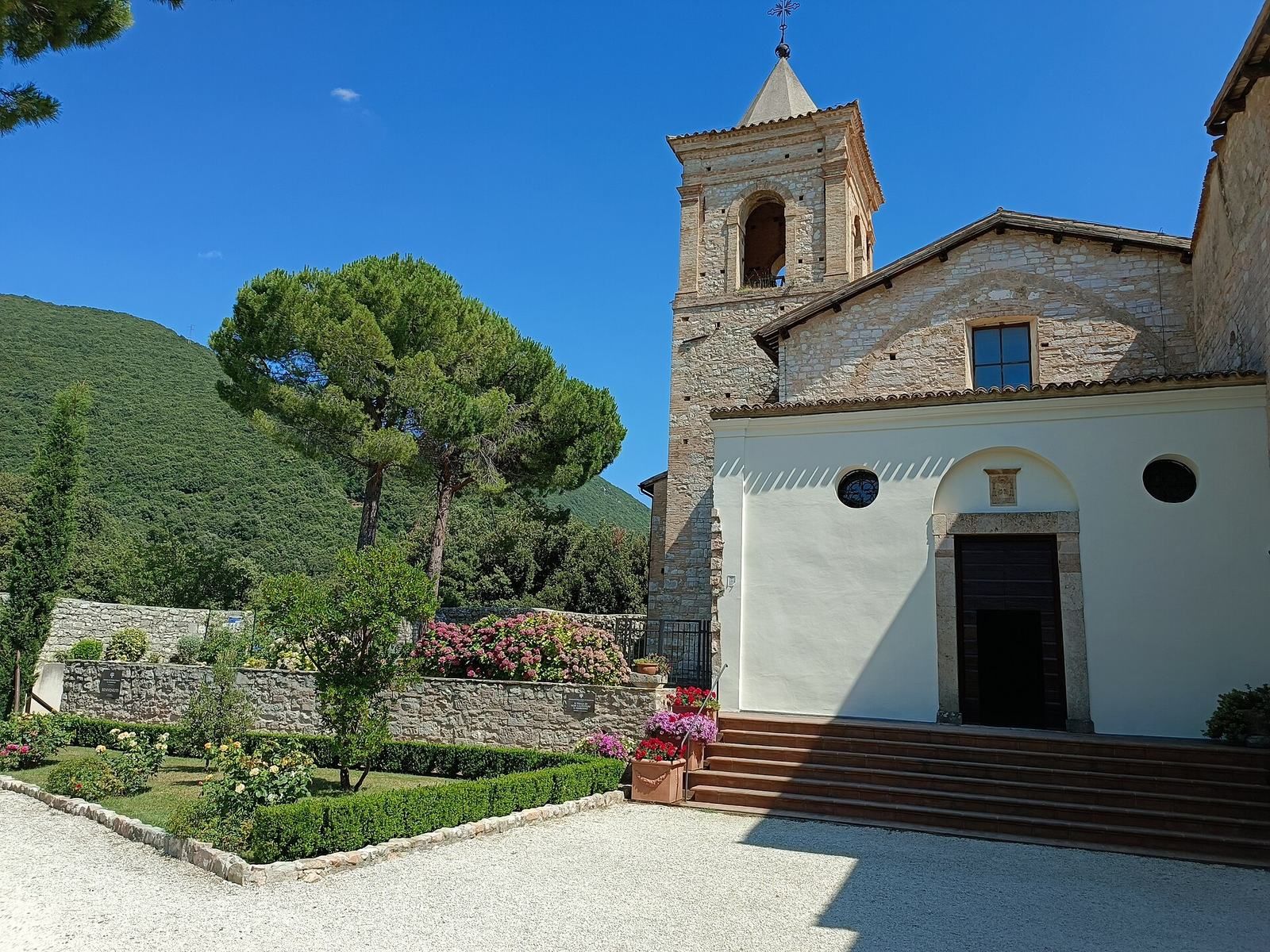
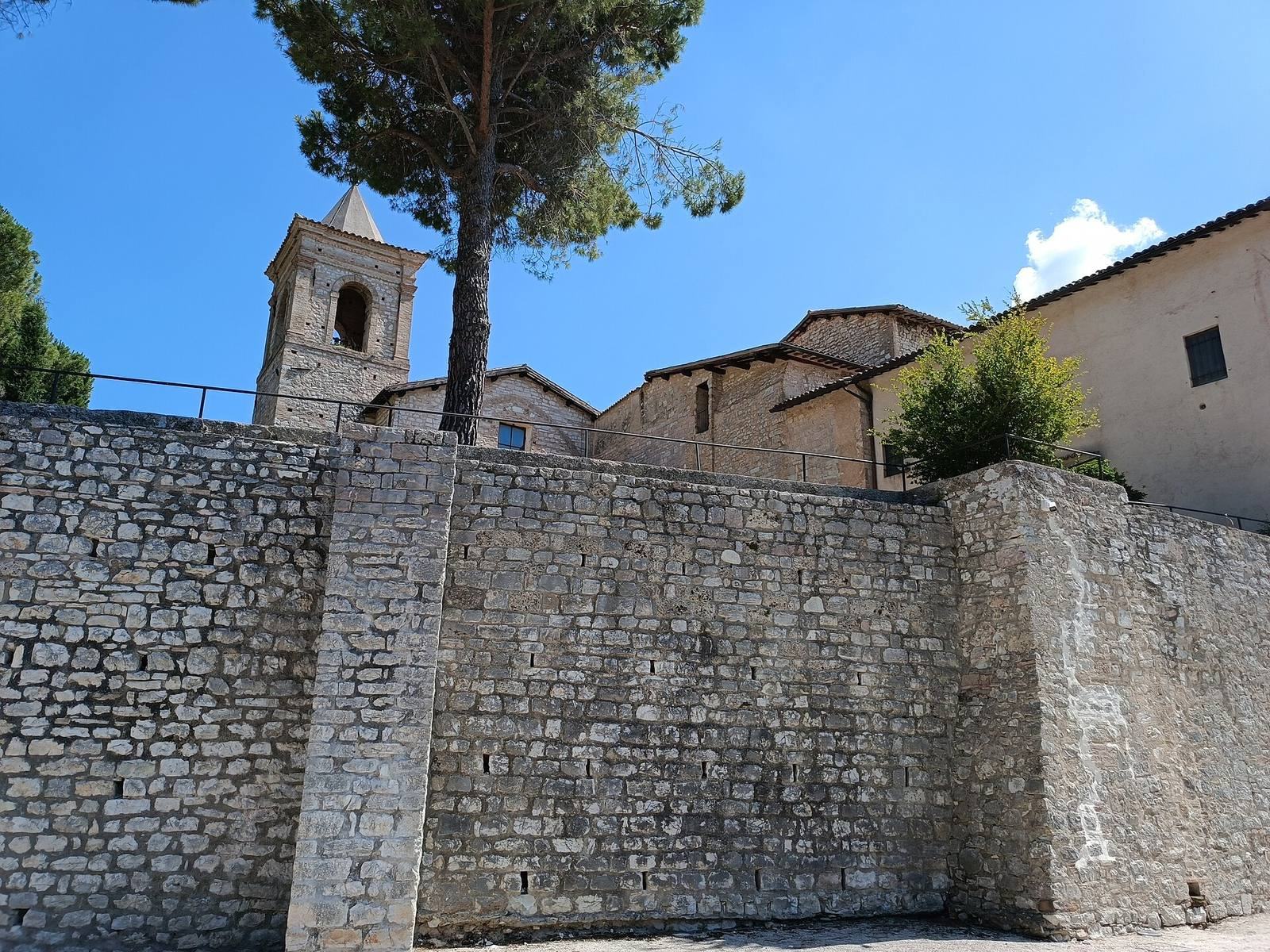
The Romanesque monastery stands about 565 metres above sea level on a rocky spur at the foot of Mount Serrone, overlooking the Valle Umbra and Foligno. Its buildings are surrounded by roughly seven hectares of ancient holm-oak woodland, among the oldest in Umbria. The Passeggiata dell’Abate is a path through the woodland, which also includes juniper and Aleppo pine.
Cloister and monastic buildings
Romanesque cloister
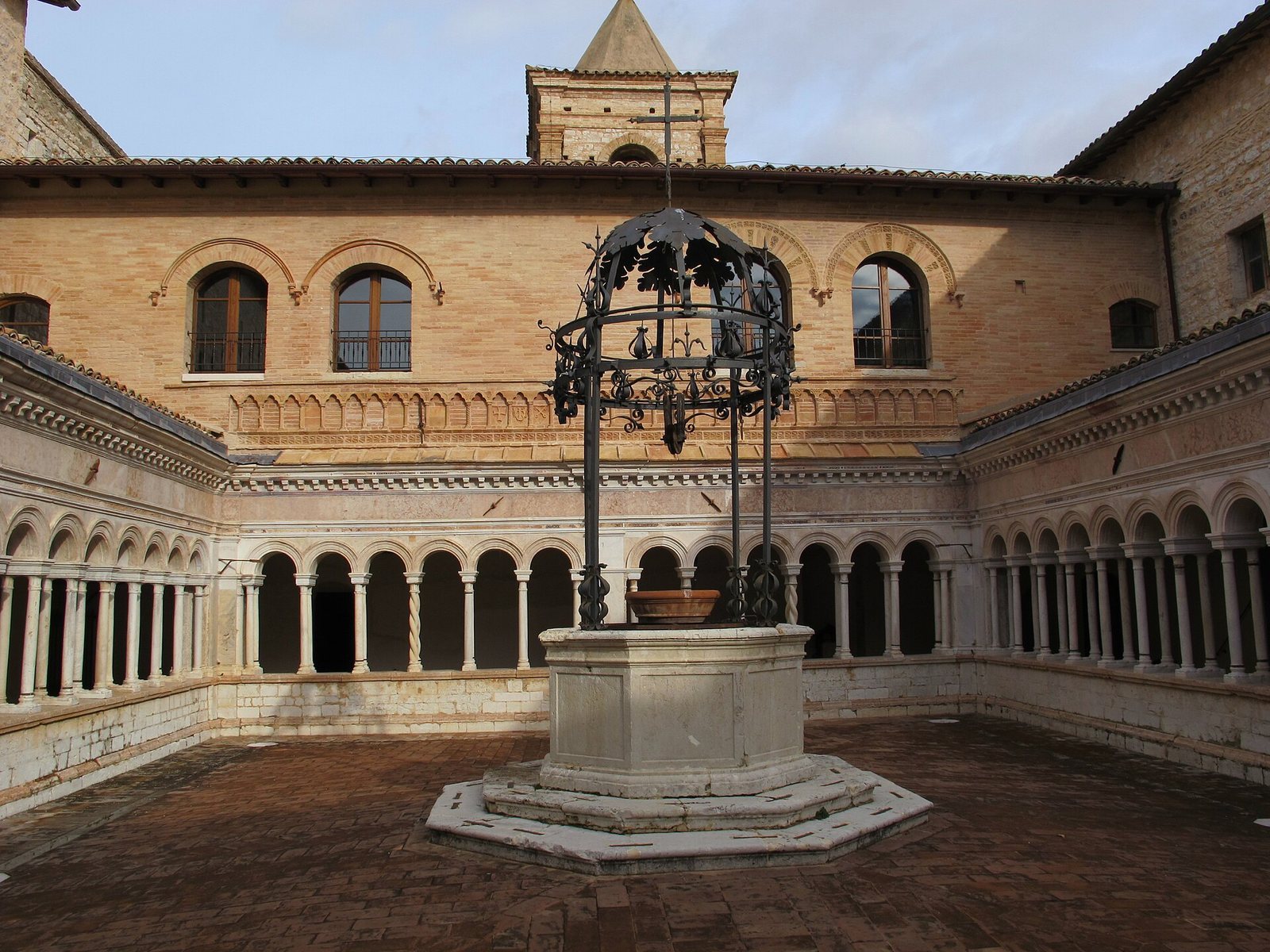
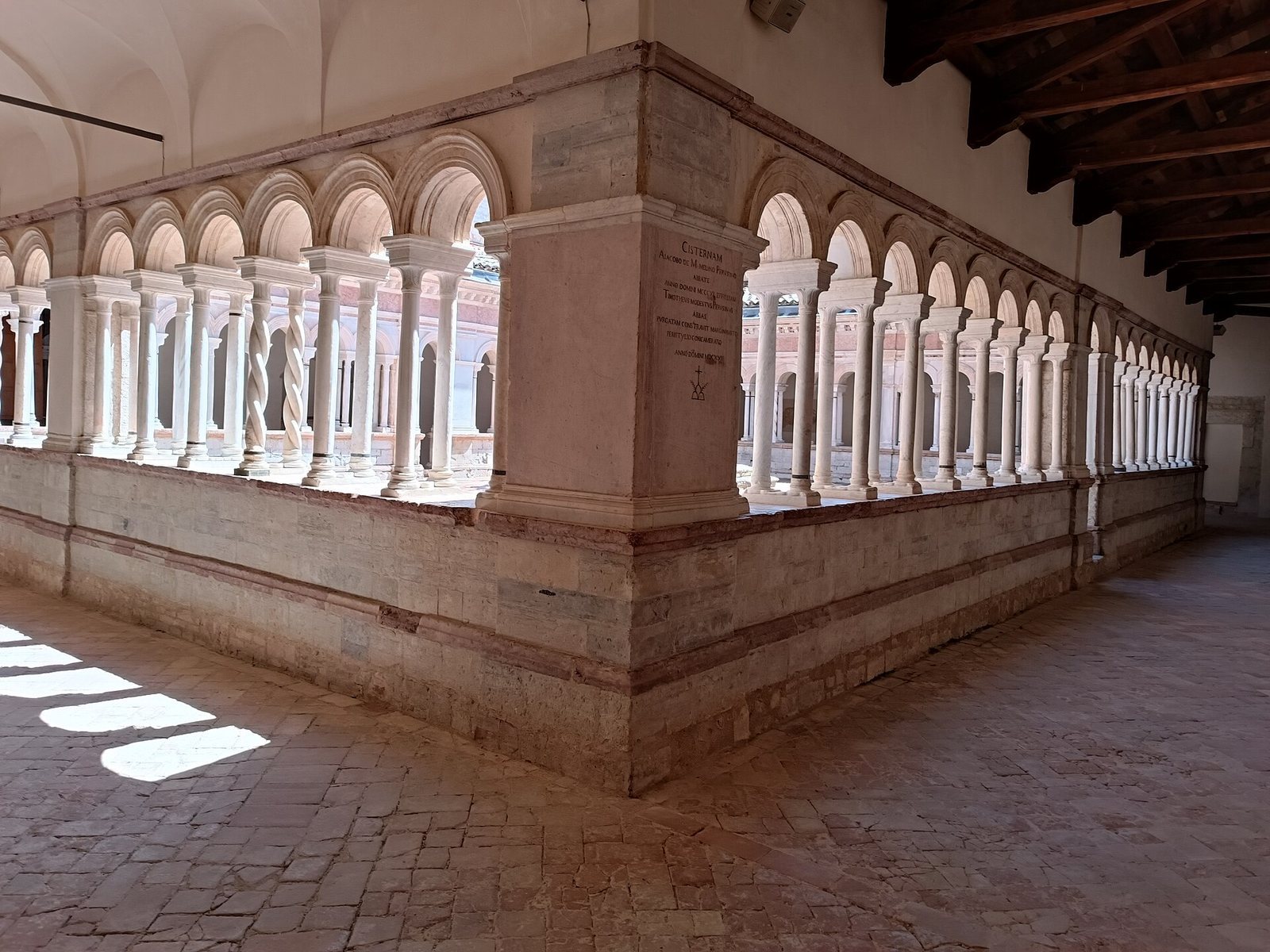
The cloister, a covered walkway enclosing an open court, was completed in 1229 at the commission of Abbot Angelo. Roman marble masons Pietro de Maria and Nicola Vassalletto made its quadrangular structure, which has 58 arches supported by two tiers of 128 columns. Some columns are twisted and others smooth; their capitals carry lily designs. A large cistern was installed in the court in 1340, followed by a well in 1623. On the east side, a 14th-century fresco depicts the Virgin seated on a throne with the Child.
Refectory and dormitory
The refectory, the monastery’s communal dining room, contains a 1595 fresco of the Last Supper by an unknown artist. The dormitory rooms date to the 13th century.
Loggia del Paradiso
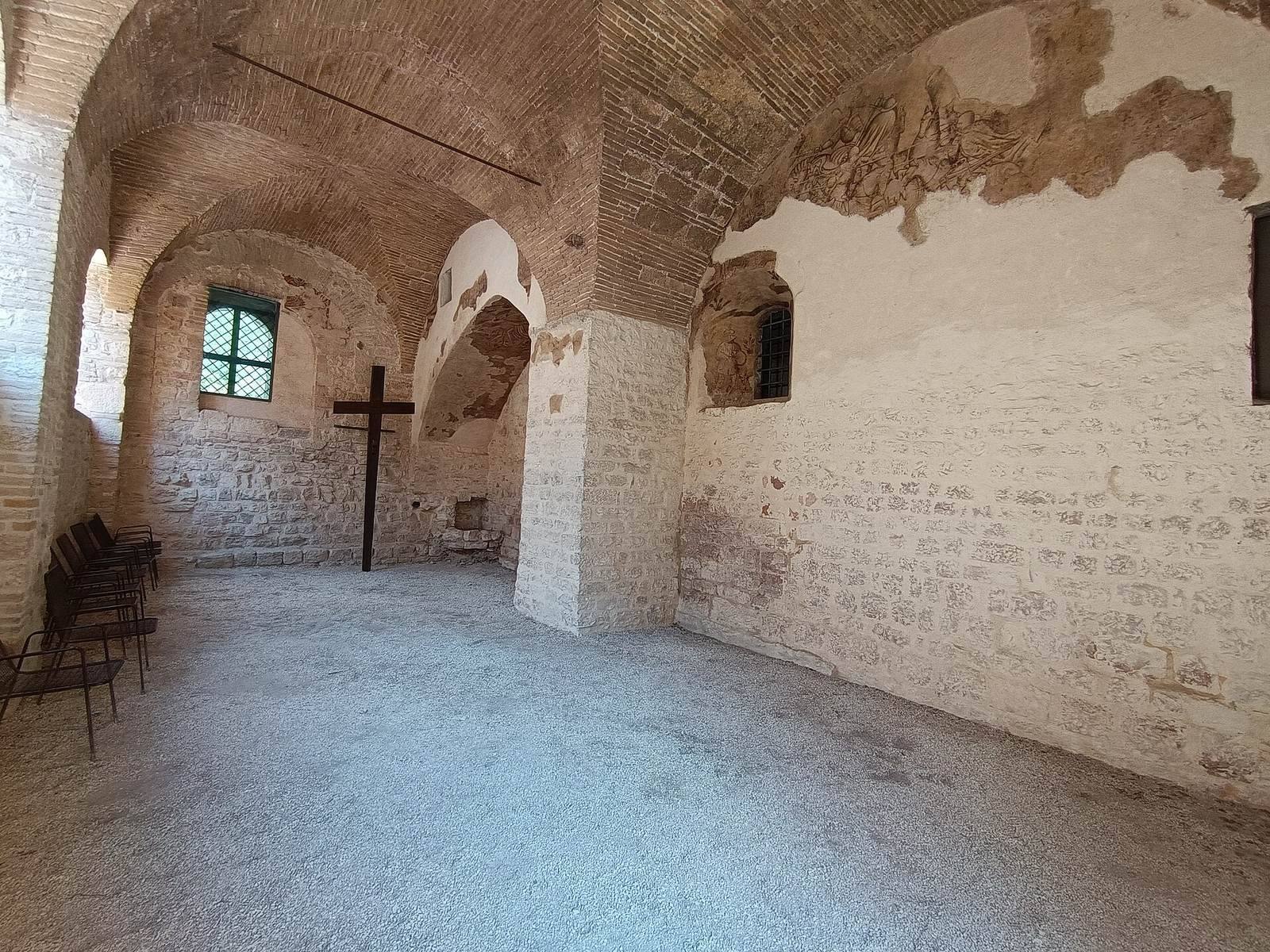
The Loggia del Paradiso, an open-sided gallery, dates to 1442. It preserves fragments of frescoes from the first quarter of the 15th century. An unknown painter from Foligno made them; they were once attributed to Giovanni di Corraduccio or his workshop.
Church and associated sacred structures
Church
The church has a single main hall covered by a barrel vault, a continuous arch-shaped ceiling, and ends in a rounded apse. Fragments of 15th-century frescoes survive inside. Tommaso Nasini painted the altar panel, showing the announcement of the Passion of Jesus Christ, in 1744.
Crypt and Chapel of Blessed Alano
The 11th-century crypt, a chamber associated with a church, is linked to Blessed Alano. In Catholic usage, “Blessed” is a title for a person formally beatified. A short distance from the abbey, the 11th-century Chapel of Blessed Alano is identified as a remnant of Santa Maria della Valle, the first nucleus of Sassovivo.