Abbey of Santa Maria della Sambucina: An Early Cistercian House in Calabria
Site at a Glance
- Popularity
- Medium
- Country
- Italy
- Primary era
- Medieval
- Eras represented
- Medieval
- Civilizations
- Kingdom of Sicily
- Site type
- Religious
- Remains
- Church
On this page7 sections
History
Origins and Cistercian growth
The Abbey of Santa Maria della Sambucina is a former monastery near Luzzi in Calabria, Italy. Its foundation date is uncertain. One widely followed scholarly view places it in 1087, when a Benedictine community led by Sigismondo may have established it; proposed dates of 1140 and 1160 are not securely supported. In 1141, Goffredo of Loritello, a Norman count in southern Italy and cousin of King Roger II of Sicily, granted the abbey to the Cistercians, a monastic order that developed from the Benedictine tradition. They rebuilt it, and Sambucina became an early Cistercian house in the Norman kingdom of Sicily.
The abbey was institutionally affiliated with Clairvaux, a major Cistercian monastery. A local tradition holds that its first Cistercian community came from Casamari. In a 1166 grant, King William II gave the monastery royal land on the west bank of the Crati River. The grant names Abbot Dominicus, who was elected abbot of Montecassino in 1171. The earliest secure evidence specifically identifying Cistercians at Sambucina dates to 1188.
Sambucina became the mother house, or founding community, of numerous Cistercian monasteries. Its daughter houses included Santa Maria di Corazzo in 1157, Santa Maria di Novara in 1168, Santo Spirito in 1172, Santa Maria di Roccadia in 1176, Santa Maria delle Terrate in 1178, Santa Maria de Ligno Crucis in 1183, Santa Maria del Galeso in 1195, Santa Maria di Acquaformosa in 1197, Santa Maria del Sagittario in 1202, Sant’Angelo de Frigillo in 1220, and Santa Maria della Matina in 1221.
Around 1173–74, Joachim of Fiore spent about a year near the abbey. A theologian associated with apocalyptic interpretation, he later became abbot of Santa Maria di Corazzo, founded the monastery of Fiore, and established the Florensian congregation.
Earthquakes, monastic links, and learning
An earthquake severely damaged the abbey in 1184. Cistercians from Casamari helped rebuild it, with the work directed in the 1190s by its fifth abbot, Luke, who later became Archbishop of Cosenza. After another earthquake in 1220, the monks temporarily moved to Santa Maria della Matina and returned to Sambucina for the summer.
In 1217, Abbot John of Sambucina spent six weeks at Eberbach. On his return to Calabria, a group of monks from Eberbach accompanied him. John was reportedly removed by the Cistercian General Chapter for breaking the vow of stability, which bound a monk to remain attached to his monastery. The episode followed Eberbach’s unsuccessful attempt to establish its own daughter house in the Kingdom of Sicily. Abbot Bonus is documented as John’s successor by 1220.
The abbey was also known for a school of arts, where students studied the liberal arts, the foundational subjects of medieval education. Abbot Bernard later became bishop of Cerenzia.
Commendam, damage, and suppression
In 1421, the abbey was placed in commendam, an arrangement that entrusted its administration or revenues to a holder outside the resident monastic community. In 1569, part of the church collapsed and the monastery was damaged. The monks withdrew to Santa Maria della Matina and returned in 1594.
An earthquake in 1731 caused damage that was partly repaired in 1733. A stronger earthquake in 1783 left the complex more severely damaged, and reconstruction begun afterward was interrupted when the abbey was suppressed in 1807 by a decree of Joseph Bonaparte’s government. The conventual buildings were sold to private owners, while the church became a parish church. Restoration took place in 1973.
Remains
Church plan and surviving fabric
The former abbey lies in the Presila Cosentina and western Sila area, about 800 metres above sea level. Its church followed a Bernardine plan, a Cistercian layout associated with practices promoted by Bernard of Clairvaux. It had three aisles, a projecting transept, the crosswise section of the church, and a choir, the area at the east end, with a rectangular termination. Portions of the apse, the church’s sanctuary end, and two supports from the central nave survive from the original 12th-century complex.
West facade and portal
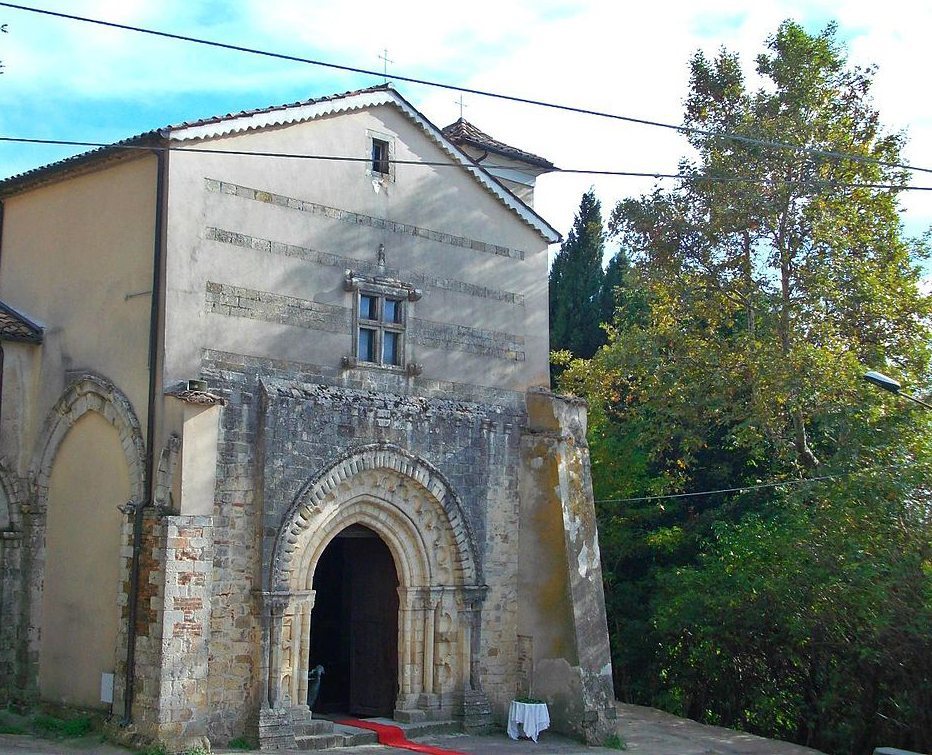
The church was shortened by four structural divisions, leaving its west facade set back from its earlier position. The entrance portal in this recessed facade dates to the 13th or 14th century. An inscription on it records restoration work in 1625.