Argenteuil Abbey: A Benedictine Monastery in France
Site at a Glance
- Popularity
- Medium
- Country
- France
- Primary era
- Medieval
- Eras represented
- Medieval
- Civilizations
- French
- Site type
- Religious
- Remains
- Monastery
On this page16 sections
History
Founding and early medieval community
Argenteuil Abbey was a Benedictine women’s monastery in central Argenteuil, France, founded in the seventh century, traditionally by Ermenric, a wealthy lord of Neustria, and his wife Nummane. Its history became closely associated with a linen tunic believed to have belonged to Christ.
The earliest surviving reference to the monastery dates to 697, when Childebert IV, a king of the Merovingian ruling house, granted it the forest of Cormeilles. The community may also have received daughters of princely families, some of whom might not have taken monastic vows. Tradition holds that Charlemagne, a Carolingian emperor, placed the tunic at the abbey in 803. His daughter Theodrada had become the community’s superior by 814.
A document of 828 stipulated that after Theodrada’s death the abbey would pass to Saint-Denis, unless that monastery gave up its claim. The arrangement placed authority over the transfer with Saint-Denis rather than the king. After Viking raids devastated the monastery, Judith, a daughter of Charles the Bald, succeeded Theodrada. The community was then abandoned for about a century. Around the turn of the tenth and eleventh centuries, Adelaide of Aquitaine, queen and later widow of Hugh Capet, began rebuilding the ruins so that nuns could return.
Heloise and Saint-Denis
Heloise arrived at Argenteuil in 1119 and became prioress in 1129. Abbot Suger of Saint-Denis invoked the 828 provision in a dispute over the monastery. That year, a council at Saint-Germain-des-Prés ordered the women’s community to leave. Some of the nuns went to Notre-Dame de Malenoue, while others followed Heloise to the Paraclete. Argenteuil became a male priory under Saint-Denis and took the name Notre-Dame d’Humilité. Saint-Denis developed farming and wine-growing on the estate.
During enlargement work, the monks uncovered the tunic, which the nuns had concealed during the Viking raids. Louis VII attended its first recorded public display in 1156, an event described in a charter issued by Hugh III, archbishop of Rouen. Pilgrims came to see the garment, though the Hundred Years’ War interrupted the pilgrimages. From the fifteenth century, visitors included Francis I, Henry III and Louis XIII, as well as Marie de’ Medici, Anne of Austria and Cardinal Richelieu.
War, damage and monastic reform
The Hundred Years’ War, plague and raids by the Great Companies, bands of mercenary soldiers active in France, brought hardship to the region. In 1411, the Orléans faction sacked Argenteuil, and the abbey was pillaged and burned. A new parish church was built in 1449. From 1518, the priory’s income was assigned to an appointed holder rather than being administered solely by its resident community. In 1562, French Protestants known as Huguenots, led by the Prince of Condé, took Argenteuil and burned the abbey church.
The priory joined the reforming Congregation of Saint-Maur in 1646. At the time, Pierre du Cambout de Coislin held the prior’s office, having received it as a child; his uncle, Chancellor Pierre Séguier, acted for him. On 21 January 1699, a storm brought the abbey church’s bell tower down onto the choir, the area used for communal worship. Repairs were makeshift. Claude Fleury obtained the priory’s revenues in 1706 under the appointed-holder arrangement. By 1788, only four monks remained, and the priory was united with a stricter reformed branch of the Carmelite order at Charenton-le-Pont.
Suppression and modern history
The deteriorating monastery was sold as national property on 27 September 1790 and used as a stone quarry. In 1916, the Debet and Kornberger engineering company established itself on the site. After the company went bankrupt, the municipality acquired the land in 1984 and carried out preliminary excavations before planned urban development. Excavations begun in 1989 revealed remains of the abbey and earlier occupation. The site received historic-monument protection in 1996. The nearby Saint-Jean chapel had been designated a historic monument in 1945, a measure that helped it survive later redevelopment.
After the Revolution, pilgrimages and formal public displays of the tunic resumed in the nineteenth century, usually at intervals of about fifty years. The last display before 2016 took place in 1984. Another had been anticipated for 2034, but the garment was shown publicly in 2016 in connection with the fiftieth anniversary of the Diocese of Pontoise, the basilica’s 150th anniversary and the Jubilee of Mercy, a special Catholic observance held in 2015–16.
Remains
Abbey layout
Enclosure and grounds
The abbey occupied an enclosed block in central Argenteuil. Rue Notre-Dame bounded it to the north, Rue du 8 Mai 1945, formerly Rue de la Chaussée, to the west, and the Hôtel-Dieu to the east. A branch of the Seine that has since been filled marked the southern edge, where Boulevard Héloïse was later laid out. A perimeter wall, reinforced by small watch turrets on the west and south sides, protected the outer enclosure.
The seventeenth-century arrangement included the prior’s garden in the northeast. To the south stood the former prior’s residence, converted to service buildings, and a large courtyard that opened toward the Seine in the southeast, near the residence of the prior who held the estate’s revenues. The inner enclosure lay to the northwest.
Abbey church
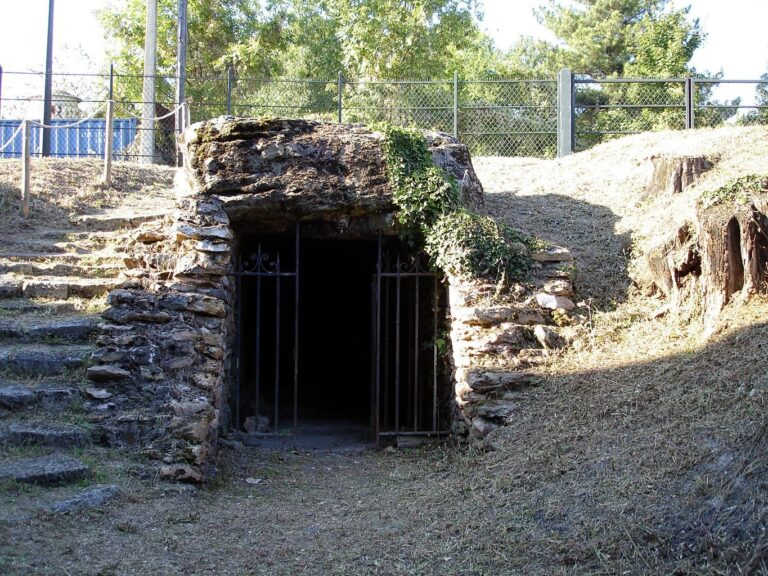
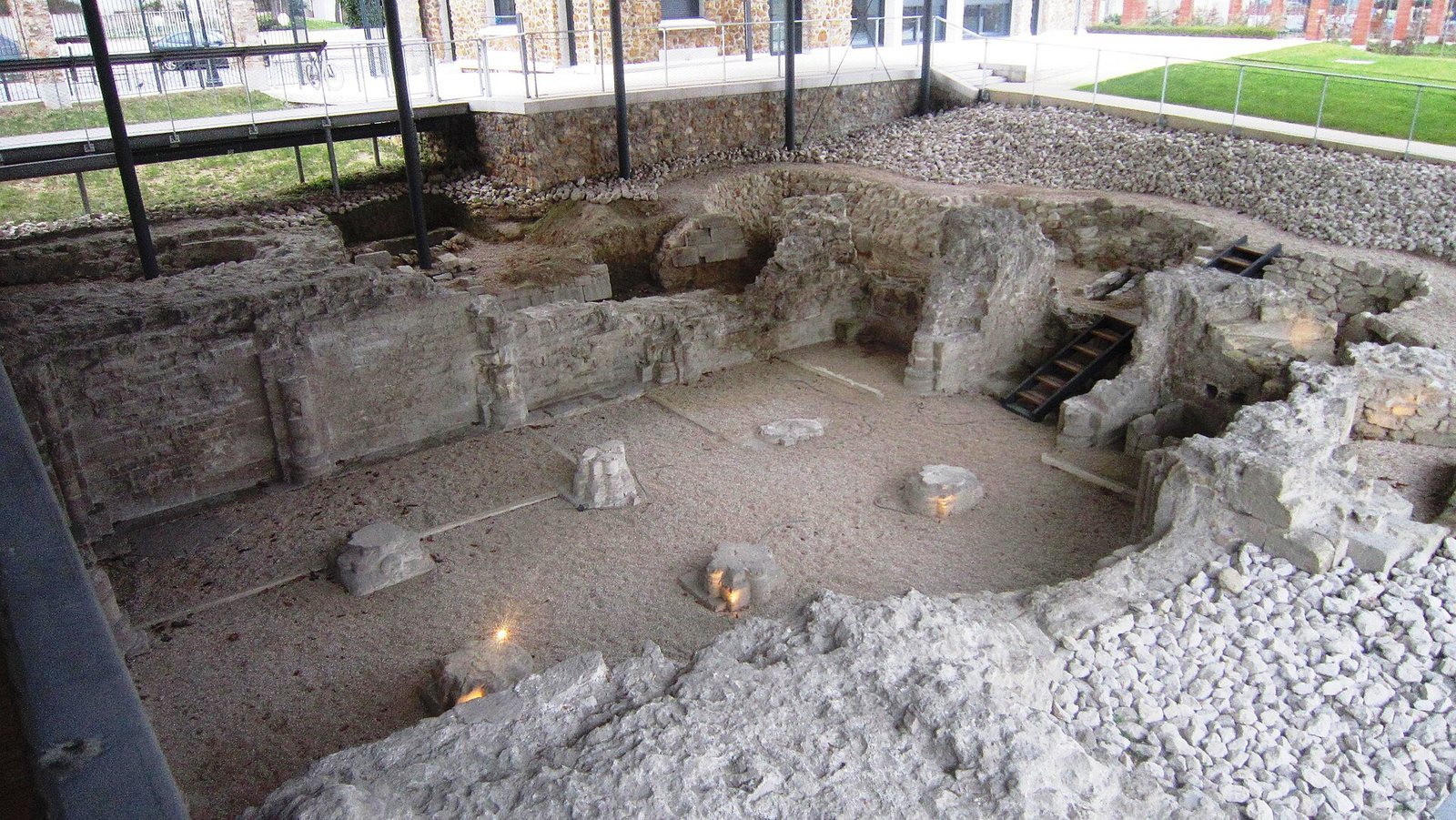
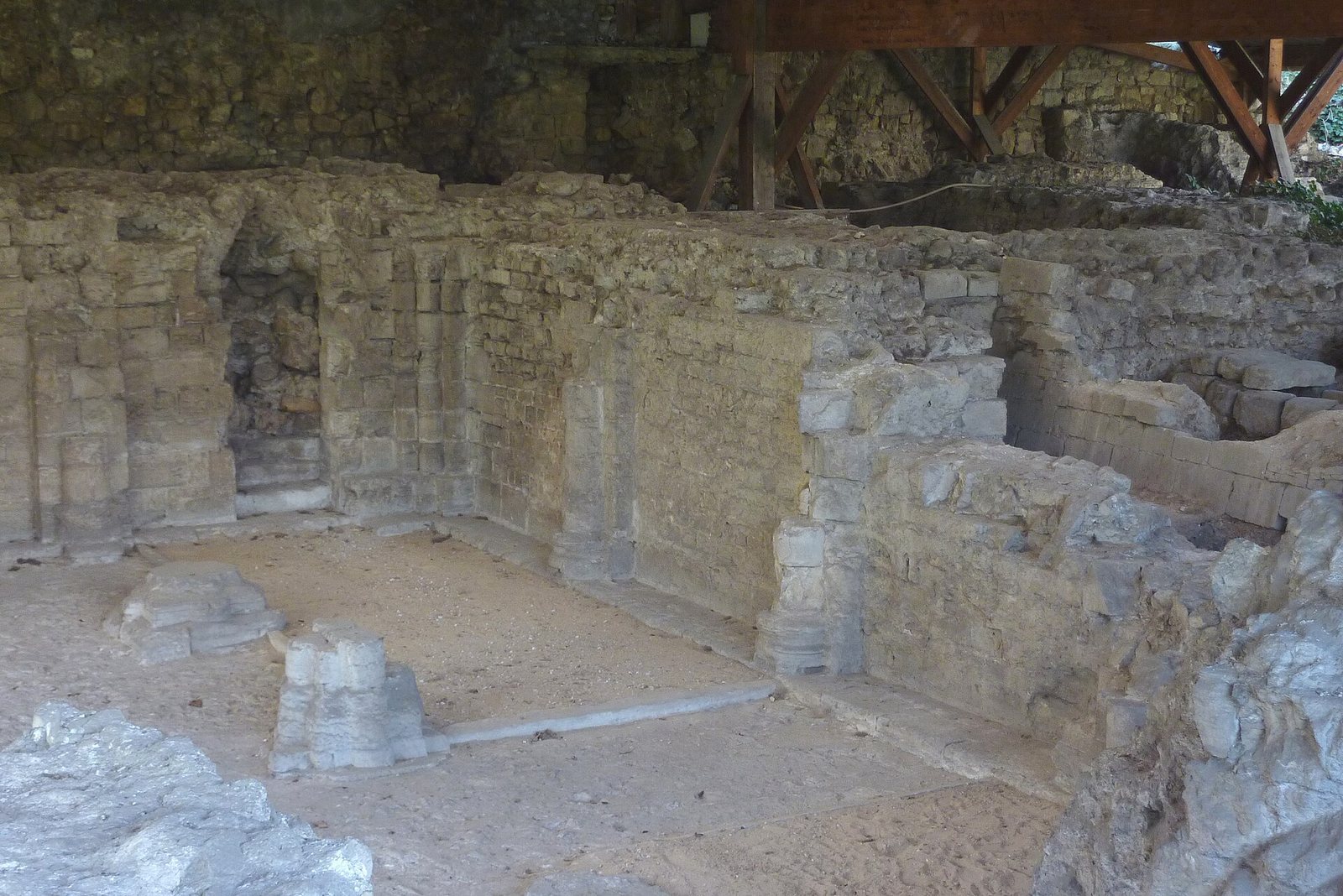
The church faced east and had a basilican plan, with a central hall flanked by two side aisles and joined to a crosswise arm at the east. A porch marked the western entrance, originally flanked by two towers. Foundations at the church’s rounded eastern end extend into the monks’ former kitchen garden, while other foundation lines lie beneath modern buildings. This eastern end forms the visible part of the church foundations.
Cloister and conventual buildings
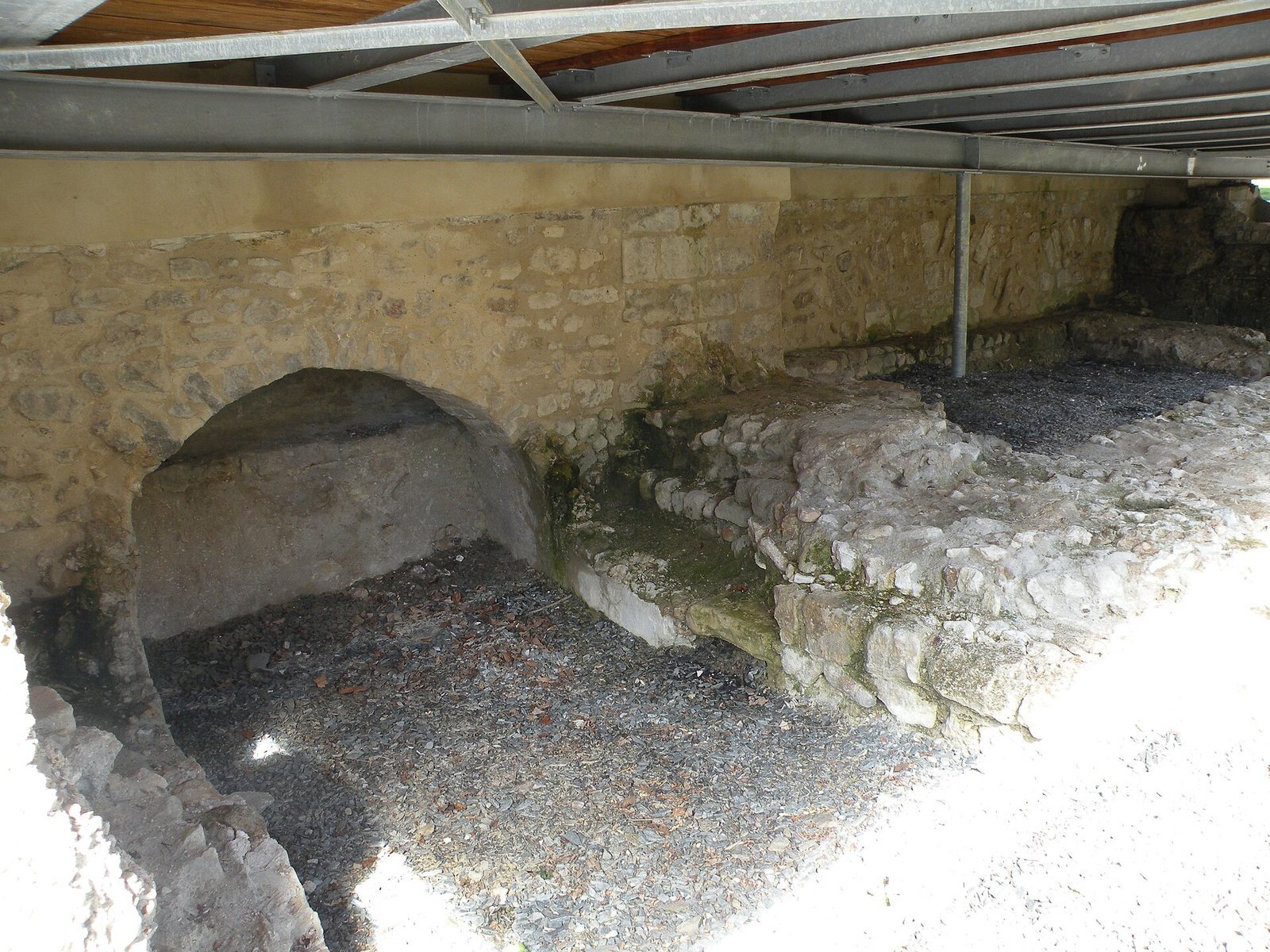
A building extending from the southern arm of the church’s crosswise section housed the chapter house, the monks’ meeting room, and the refectory, or communal dining hall, on the ground floor. A dormitory occupied the upper floor. This building formed the eastern side of the cloister, a covered walkway around a courtyard, which adjoined the south wall of the church’s central hall. Remains of another building bordered the cloister to the west. Traces of the refectory and abbey paving have also been identified. The surviving abbey fabric is attributed to the eleventh or twelfth century.
Archaeology and associated features
Excavated evidence
Excavations revealed a Merovingian cemetery, ceramics and sections of paving alongside remains of the abbey. The excavated area is incorporated into a landscaped park that includes two growing areas devoted to vines and fig trees, plants associated with Argenteuil’s agricultural history.
Saint-Jean chapel
Saint-Jean chapel stands a few metres beyond the enclosure’s northwest corner, across Rue Notre-Dame. It depended on the abbey, although it remained outside the enclosure until the seventeenth century. In the sixteenth century, a lay winegrower received the chapel and converted it into a cellar. The building survives after restoration.
Architectural fragments
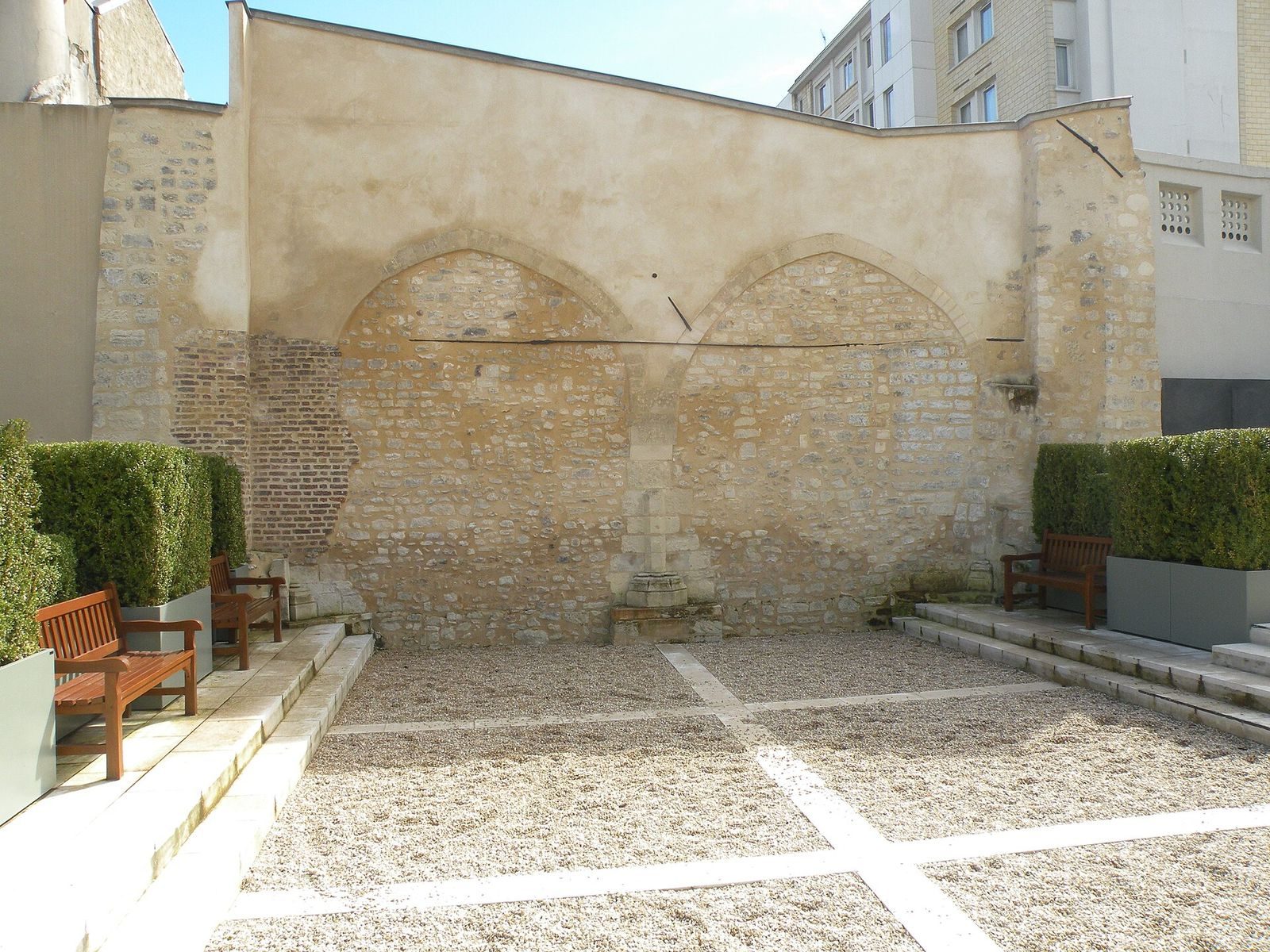
A chapter-house fragment measuring 13.5 by 4.7 metres was removed during demolition in 1855 and placed in the Cluny Museum’s garden in Paris. The chapter-house façade was displayed in the gardens of the Cluny baths until 1947, when the fragment was returned to Argenteuil for a proposed local museum. It was subsequently kept in poor conditions and condemned for disposal in 1963. Other salvaged architectural pieces, including the abbey church’s damaged tympanum, the decorative panel above a doorway, entered the Cluny Museum’s collections.
The tunic
The linen tunic attributed to Christ is dated to the first or second century. Tradition says that the Virgin Mary wove it. It is now kept in the Basilica of Saint-Denys in Argenteuil.
Virgin and Child statue
A wooden statue of the Virgin and Child, possibly from the abbey, dates to the boundary between the seventeenth and eighteenth centuries. It is lightly varnished, sculpted on its front and sides, and has a flat back. Standing 122 centimetres high, it is displayed on the left pillar at the entrance to the choir of the Basilica of Saint-Denys.