Vallombrosa Abbey: Mother House of the Vallombrosan Congregation in Italy


Site at a Glance
- Rating
- 4.6
- Popularity
- Medium
- Country
- Italy
- Primary era
- Early Modern
- External website
- Open
- Eras represented
- Medieval, Early Modern
- Civilizations
- Grand Duchy of Tuscany, Republic of Florence
- Site type
- Religious
- Remains
- Monastery
On this page17 sections
History
Vallombrosa Abbey is a Roman Catholic Benedictine monastery in Italy, in Vallombrosa within the comune of Reggello, Tuscany. Dedicated to the Assumption of Mary, it became the mother house of the Vallombrosan Congregation, a Benedictine reform movement shaped by communal discipline and evangelical poverty.
Giovanni Gualberto and the Foundation
The community began through the initiative of Giovanni Gualberto, an eleventh-century Florentine religious reformer and founder of the Vallombrosan tradition. In 1036, he withdrew with several followers to Acquabella on the Pratomagno. Their reform stressed shared monastic life, evangelical poverty, and opposition to simony, the buying or selling of ecclesiastical offices or spiritual privileges. It also became involved in the Investiture Conflict, the medieval struggle between papal and secular rulers over the appointment of bishops and other church officials.
The first record associated with Vallombrosa concerns a donation made by the cleric Alberto to the community. Before a permanent stone building was available, the monks worshipped in a wooden oratory. Its stone altar was consecrated in 1038 by the Bishop of Paderborn. On 3 July 1039, Abbess Itta of Sant’Ellero donated the land occupied by the community. Cardinal Humbert of Silva Candida consecrated the completed stone church on 9 July 1058, with a small monastery intended to stand beside it.
Vallombrosa’s religious importance extended beyond its immediate community. On 7 October 1096, Pope Urban II addressed the Vallombrosan congregation at the abbey while seeking religious support for the First Crusade. He specifically urged the provision of knights.
Medieval Expansion
As the Vallombrosan community grew, its first buildings could no longer meet its needs. A larger church and monastery were begun in 1224, and construction ended in 1230. The bell tower belongs to this same phase. The church’s basic medieval arrangement survived even though later rebuilding substantially changed its appearance.
Major expansion followed in the second half of the fifteenth century under Abbot Francesco Altoviti. The works completed in 1476 included the great cloister, sacristy, rear tower, refectory, and kitchen. His successor, Abbot Biagio Milanesi, enlarged the library and developed the abbey’s artistic holdings. These included a Perugino altarpiece for the high altar, a panel by Raffaellino del Garbo, and a terracotta work connected with the workshop of Luca della Robbia.
The abbey’s Renaissance patronage also shaped its later collections. Perugino’s Assumption of the Virgin, dated 1500 and containing portraits of Biagio Milanesi and the monk Baldassarre, is now in Florence’s Galleria dell’Accademia. Andrea del Sarto’s Dossal of the Four Saints, commissioned by Abbot Giovanni Maria Canigiani and dated about 1528–1529, is held by the Uffizi.
Rebuilding in the Early Modern Period
The Mascherone Cloister was built in 1584–1585 to designs by Alfonso Parigi. Vallombrosa then underwent repeated rebuilding after a long series of fires. During the seventeenth century, with further improvements in the early eighteenth century, the complex acquired the unified and sumptuous appearance that largely survives today.
In 1634, Abbot Averardo Niccolini commissioned Gherardo Silvani to rebuild the novitiate. The structure later incorporated the principal facade. When the church portico collapsed in 1644, Abbot Guglielmo Rasi designed and built the loggia that replaced it. The church was then modernized in both structure and decoration. In 1695, the old apse was demolished to make way for a new choir, and the Chapel of Giovanni Gualberto was built beside it, both according to designs by Michele Domenico Magni. The sequence of improvements culminated in 1755 with the Chapel of the Ten Blessed, also known as the Chapel of the Sacrament.
Between 1729 and 1733, under Abbot Giovanni Aurelio Casari, the church walls were plastered, classical altars were installed, and the interior was redecorated with paintings celebrating Vallombrosan saints. This campaign gave the nave much of its eighteenth-century character. Further decoration followed in 1779–1781, when Giuseppe Fabbrini and Antonio Donati frescoed the vaults and cupola.
Suppression, Secularization, and Return
The abbey’s artistic heritage was severely reduced during the Napoleonic suppression of monasteries in 1808. Its property was later confiscated by the state under the House of Savoy in 1867, when the monastery was secularized. The National Forestry Institute was established in the complex, partly through the influence of George Perkins Marsh, an American diplomat and environmental writer whose work influenced modern conservation thought.
The Vallombrosan monks regained possession of the monastery in 1949. Pope Pius XII raised the church to the rank of minor basilica in November 1950. This title is a special papal honor for a church’s religious, historical, or pastoral importance and is distinct from the architectural use of the word “basilica.” Vallombrosa Abbey is also an Italian national monument.
A tradition associates the abbey with John Milton because of his reference to Vallombrosa’s autumnal leaves in Paradise Lost. The alleged visit or stay is considered unlikely. A plaque installed during the Fascist era helped preserve the tradition and contributed to later literary interest in the abbey.
The Museum of Sacred Art opened in the former guesthouse in 2006. It brought together works removed from Vallombrosa during earlier confiscations or transfers, including paintings, textiles, and goldsmiths’ work. The museum preserves part of the monastery’s artistic history, while other former holdings remain in Florence museums.
Remains
Complex and Church Exterior
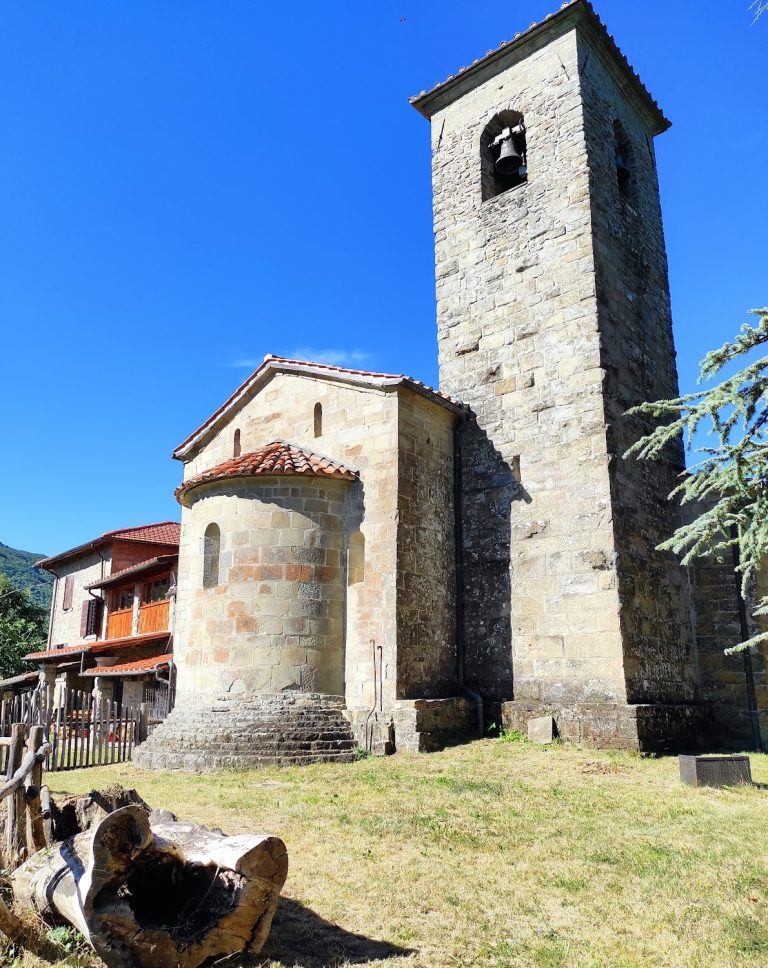
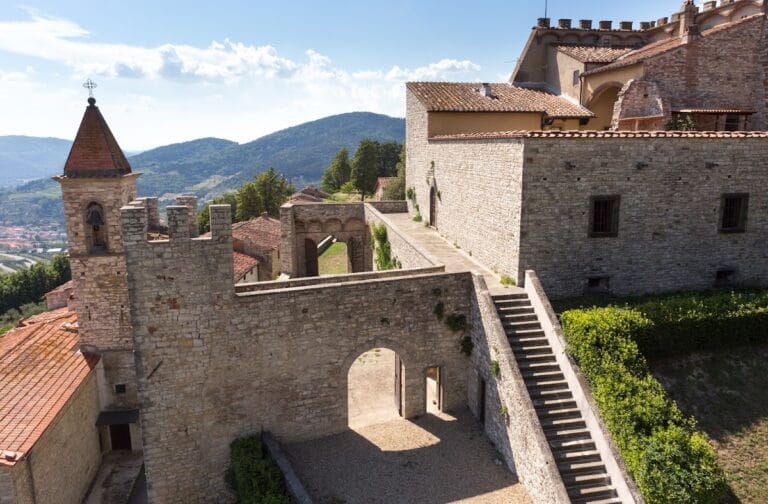
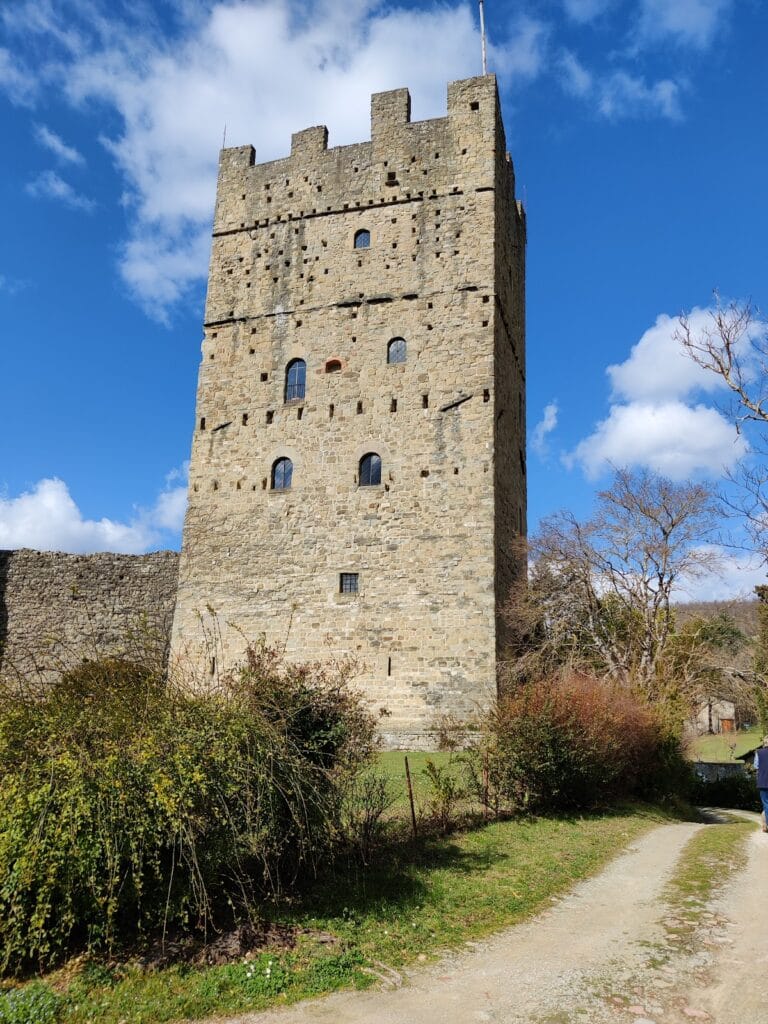
Vallombrosa is a large walled complex set among beech and fir forests. A broad forecourt, landscaped as a garden, leads to the buildings through a gate dated 1773. Fishing ponds dug in the eighteenth century also survive within the grounds. The exterior combines medieval towers with later rebuilding, including the twelfth-century bell tower of the church and the fifteenth-century tower behind the monastery.
Facade and Portico
The principal facade was built between 1637 and 1647 from designs by Gherardo Silvani associated with Alfonso Parigi. Its regular window sequence is framed by raised side wings containing large cross-shaped windows. A rusticated portal forms the main entrance. In front of it, a small courtyard precedes the church facade.
The entrance portico has three arches ending in two lateral Serlian openings, a central arch flanked by two lower and narrower openings. It was built after the earlier loggia collapsed in 1644. Above the central arch, a niche contains Bastiano Salvini’s 1632 statue of Giovanni Gualberto. The facade also bears Medici and Vallombrosan coats of arms. The Vallombrosan emblem shows a monk’s arm holding a tau-shaped staff, a T-shaped symbol associated with the congregation.
Medieval Church Structure
The church retains the basic structure completed in 1230. It has a long single nave ending in a transept, creating the T-shaped plan characteristic of Vallombrosan churches. Small areas still reveal the earlier stone facing, while most of the medieval appearance was altered by later campaigns. A fifteenth-century screen separating the public part of the church from the monastic area is embedded in the counterfacade. Its inscription names Biagio Milanesi as patron and gives the date 1487.
The original roof structure was replaced in the sixteenth century by three low, flattened pavilion vaults. Between 1729 and 1733, the stone walls were plastered and classical altars made of pietra serena, a gray Tuscan sandstone, were installed. The nave was redecorated with works by Antonio Puglieschi, Niccolò Lapi, Agostino Veracini, Niccolò Nannetti, and Ignazio Hugford.
Altars, Vaults, and Choir
The right altar is dedicated to Atto, a former abbot of Vallombrosa who later became bishop of Pistoia. It contains Agostino Veracini’s 1733 painting of Atto receiving the relics of Saint James the Apostle. The left altar honors Pietro Igneo, cardinal bishop of Albano, and has Antonio Puglieschi’s 1730 painting of Gregory VII choosing Pietro Igneo as cardinal.
Four large canvases flank the altars. On the right wall are Niccolò Lapi’s Martyrdom of Blessed Tesauro Beccaria and Niccolò Nannetti’s Gregory VII Excommunicating Emperor Henry IV, both from 1732. On the left are Ignazio Hugford’s Pietro Igneo Excommunicating the Canons of Lucca and Agostino Veracini’s Pietro Igneo Crossing the Fire, both from 1730.
Fabbrini and Donati frescoed the vaults and cupola in 1779–1781. Three architectural-perspective openings appear in the nave vaults, including a scene of Esther and Ahasuerus. The cupola shows the Glory of the Virgin Mary in a late Baroque style.
The former Chapel of the Lay Brothers now serves as the Baptistery and is the first chapel on the left of the entrance. It contains Cesare Dandini’s Conversion of Saul, painted in 1646–1647 and restored in 2019. Alessandro Rosi’s Martyrdom of Saint Sebastian and Lorenzo Lippi’s Trinity, both painted in 1665, were moved with their altars to the two ends of the transept in 1701.
Behind the high altar stands a wooden choir made by Francesco di Nanni da Poggibonsi in 1444–1446 for the Vallombrosan church of San Pancrazio. It was transferred to Vallombrosa in 1574. Six paintings by Ignazio Hugford, showing episodes from Vallombrosan history, decorate the choir walls. The rear wall displays Volterrano’s Assumption, painted about 1669 and transferred from the Vallombrosan church of San Bartolomeo in Pistoia. It replaced Perugino’s Vallombrosa Altarpiece, which was confiscated by Napoleonic troops, returned, and later placed in Florence’s Galleria dell’Accademia. Grand Duke Ferdinand III of Tuscany presented Volterrano’s painting to Vallombrosa in 1818.
Chapel of Giovanni Gualberto
The Chapel of Giovanni Gualberto was built between 1695 and 1700 to the left of the choir. Alessandro Gherardini’s ceiling fresco shows the Virgin Mary and Giovanni Gualberto among angels, while Carlo Marcellini provided the sculpture. The scagliola altar, a polished composite material made to imitate colored stone or marble, was made by Enrico Hugford and carries Antonio Franchi’s Giovanni Gualberto in Prayer, painted in 1699–1700.
Other paintings in the chapel include Francesco Botti’s 1701 scene of Giovanni Gualberto freeing a monk from the flames of purgatory and Alessandro Gherardini’s depiction of Giovanni Gualberto and the massacre of San Salvi. A votive lamp burns before the high altar. Italian forestry personnel offer its oil annually by region and present it to the abbey on 12 July, the anniversary of Giovanni Gualberto’s death.
Monastic Buildings
Renaissance Sacristy
The Renaissance sacristy was built on Francesco Altoviti’s initiative and incorporates surviving parts of the Romanesque church. It contains Raffaellino del Garbo’s 1508 panel of Giovanni Gualberto and other saints. A large glazed terracotta altarpiece from Andrea della Robbia’s workshop shows the Virgin and Child with Giovanni Gualberto, Blessed Humility, Abbot Biagio Milanesi, and his brother. Luigi Sabatelli’s Saint Bernard, Bishop of Parma, Attacked by Heretics is also preserved there.
Meridiana Cloister and Chapter Hall
The cloistered monastery is organized around the fifteenth-century Meridiana Cloister, named for its sundial and built under Francesco Altoviti. His coat of arms appears on the carved corbels supporting the groin-vaulted portico. The cloister leads to a fifteenth-century chapter hall, now used as a conference room.
Refectory and Kitchen
The anterefectory contains a stone basin dated 1606 and a glazed terracotta altarpiece attributed to Santi Buglioni. The altarpiece depicts the Virgin and Child with Saints James and Giovanni Gualberto. Mario Francesconi’s 1998 cycle of three triptychs, devoted to Mystery, Life, and Death, is also displayed there. The room overlooks the refectory and kitchen.
The fifteenth-century refectory has eighteenth-century paintings by Ignazio Hugford. A Last Supper occupies the rear wall, Vallombrosan saints appear at the sides, and an Assumption dated 1745 decorates the ceiling. A chimney and hood divide the kitchen into an older room retaining its original appearance and a second room dating from the seventeenth century.
Mascherone Cloister and Library
The smaller Mascherone Cloister was built in the late sixteenth century. Its name comes from a basin decorated with a lion’s head. Alfonso Parigi designed the rear loggia in 1589 and also designed the library in 1584. The library was modernized in the early nineteenth century in the Neoclassical style. It contains nineteenth-century shelves, an octagonal inlaid table by Antonio Moschini, and Donato Arsenio Mascagni’s 1609 painting of Matilda of Canossa giving a donation to Saint Bernard degli Uberti.
Museum and Former Artistic Holdings
The Museum of Sacred Art occupies the former guesthouse. Its displays include the Altoviti Set, a varied group of textiles and tapestries produced in the second half of the fifteenth century from designs by several partly unidentified artists. Francesco Altoviti initiated the set, and Biagio Milanesi probably completed it.
The museum also displays a painting of the Virgin and Child with Saints Biagio, Giovanni Gualberto, Benedict, and Abbot Anthony, dated about 1485. It was formerly attributed to Sebastiano Mainardi, but restoration led to its reassignment to Domenico Ghirlandaio and workshop assistants. The head of Saint Biagio has been identified as a portrait of Biagio Milanesi, who commissioned the work.
A reliquary arm of Giovanni Gualberto, made in 1500 by the Florentine goldsmith Paolo Sogliano, is among the museum’s preserved works. Together with the textiles, paintings, and metalwork, it represents the artistic and devotional heritage that remained associated with Vallombrosa after earlier confiscations and transfers.
Nearby sites