St Remigius’ Church, Bonn: A Franciscan Gothic Church


Site at a Glance
- Rating
- 4.6
- Popularity
- Low
- Country
- Germany
- Primary era
- Medieval
- External website
- Open
- Eras represented
- Medieval, Early Modern, Modern
- Civilizations
- Holy Roman Empire
- Site type
- Religious
- Remains
- Church
On this page16 sections
History
St Remigius’ Church is a Gothic church in Bonn, Germany, founded by the Franciscan Order in 1274–1275. Its construction followed the arrival of Franciscan friars invited to Bonn by Archbishop Engelbert II of Falkenburg of Cologne, and the building became part of the Franciscan Province of Cologne, known as Colonia. The church developed as a major religious foundation near Bonn’s market square and remained connected with Franciscan pastoral work for much of its history.
Early churches and Franciscan foundation
A church dedicated to Saint Remigius was already recorded in Bonn on 9 June 795. An early medieval donation charter called the saint Remidius. This earlier building stood on the site now known as Remigiusplatz. Lightning destroyed it in 1800, after which it was demolished.
The present church began after friars from the Cologne convent established a Franciscan community in Bonn under Archbishop Siegfried of Westerburg. The first construction phase was completed around 1317, and the church, including its choir, was probably placed under the patronage of Saint Louis of Toulouse in 1318. Saint Louis was a Franciscan-associated bishop and saint of the late thirteenth century. Further building phases continued, and the church was not fully completed until the end of the fourteenth century.
The monastery surrounding the church contained a chapter house, workshops, a bakery, a summer refectory, and facilities for brewing and slaughter. These buildings were arranged around a cloister. The monastery was secularized and dissolved in 1803, ending the original institutional setting of the church.
Baroque rebuilding and the Beethoven family
In 1620, under Archbishop Ferdinand of Bavaria, an eastern apse was added to the north aisle. Ferdinand donated its high altar, made by Franz von Gaugrelen and consecrated in 1644. During the Baroque period, the church also acquired eight further altars.
St Remigius became closely associated with the Beethoven family. Johann van Beethoven and Maria Magdalena Keverich married there on 12 November 1767. Their son Ludwig van Beethoven, the German composer and pianist born in Bonn in 1770, was baptized at the church on 17 December 1770. When he was twelve, he substituted for the principal organist during a morning Mass and was appointed assistant organist the following year.
War, fire, and nineteenth-century reconstruction
The siege of Bonn in 1689 caused severe damage. Brandenburg troops set fire to the roof and roof turret, and almost all the original interior furnishings were destroyed. A carved Marian chandelier and a half-length figure of the Virgin Mary survived. The Franciscans repaired the roof and restored the interior between 1738 and 1748.
On 13 March 1888, a fire in the monastery complex destroyed the church roof, the roofs of the former monastery buildings, the cloister roofs, and the bells installed in the roof turret. Johannes Richter and Carl Hupe directed a Neo-Gothic rebuilding and redesign from 1889 to 1891. The work introduced new painted decoration and altered the furnishings. The Baroque high altar was removed in 1889, while new altar paintings were produced in the Late Nazarene style, a nineteenth-century movement favoring spiritually serious religious art inspired by earlier Christian painting. Stained-glass windows were made by the Cologne-Lindenthal firm Schneiders and Schmolz.
In the 1930s, a stair tower was added to the north aisle. The burgher houses demolished for this project were replaced by a row of shops built by the city.
Destruction and postwar changes
Near the end of the Second World War, the church suffered extensive damage. The north aisle roof burned out, a vault in the south aisle collapsed, nearly all the windows shattered, the sacristy roof fell in, and cracks spread through the masonry. The Baroque organ became unusable, while the other monastery buildings were left in ruins.
Postwar rebuilding directed by Bonn architect Toni Kleefisch made the church usable again after approximately five years. Parts of the Neo-Gothic west facade were incorporated, while the replacement roof turret was smaller and less ornamented than the version modeled in 1900. Restoration of the cloister began in 1955. A monastery wing was then completely redesigned, together with a parish and youth center and a chapel built above the sacristy and glazed toward the choir.
From 1957 to 2007, the church again served as a monastery church under the care of the Franciscan Minorites. In 2006, the independent parish of St Remigius merged with the parish of St Martin. The church and monastery complex became the seat of the Catholic University Community of Bonn, and its vocal ensemble moved there from the Name of Jesus Church. In 2007, the Chemin Neuf Community assumed pastoral care at St Remigius and responsibility for university chaplaincy. The church is now a subsidiary church of the Münster parish and is also used by the Catholic University Community. It is protected as an architectural monument.
During World Youth Day in Cologne in 2005, St Remigius served as one of Bonn’s two spiritual centers. This experience inspired Bonn students to establish the evening prayer event Nightfever, first held at the church on 29 October 2005 and later adopted in many other cities as an evangelization initiative.
Remains
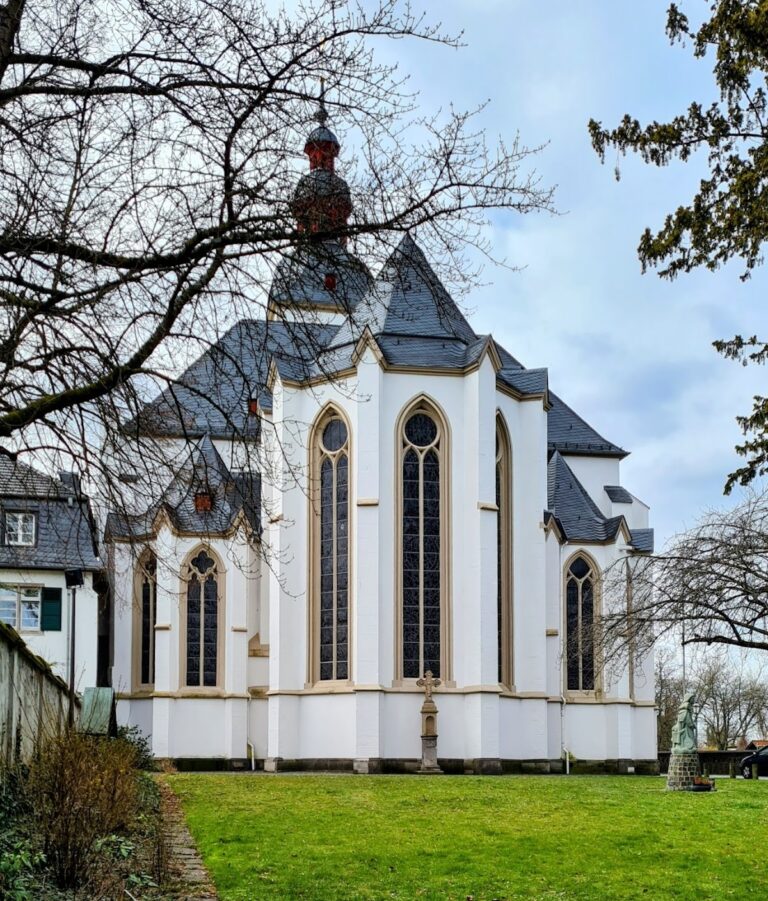
St Remigius is a three-aisled Gothic pillar basilica built from locally obtained tuff. A basilica has a higher central nave above lower side aisles, while a pillar basilica uses substantial supports rather than classical columns. The church follows the form of a mendicant-order church, reflecting the Franciscan emphasis on communal poverty, preaching, and urban pastoral work. Its vertical silhouette is completed by a roof turret rising from the ridge of the central nave.
Layout and exterior
The church stands on Brüdergasse near Bonn’s market square. The former monastery ensemble extends to the south, and a small square lies before the main entrance at the monumental west facade. The monastery precinct includes an extensive garden containing a child-care facility.
The central nave is unusually high and carries a steep monopitch roof. Pointed-arch windows and buttresses articulate the choir and the sides of the west facade. Along the long sides, the supports are concealed within the aisle walls. Inside, those walls are divided by pointed-arch niches and rectangular wall piers. Plain round pillars without ornamental capitals support the central nave. Differences in the stone framework of the windows and in the pillar bases reveal several construction phases, although their sequence is not recorded.
West facade
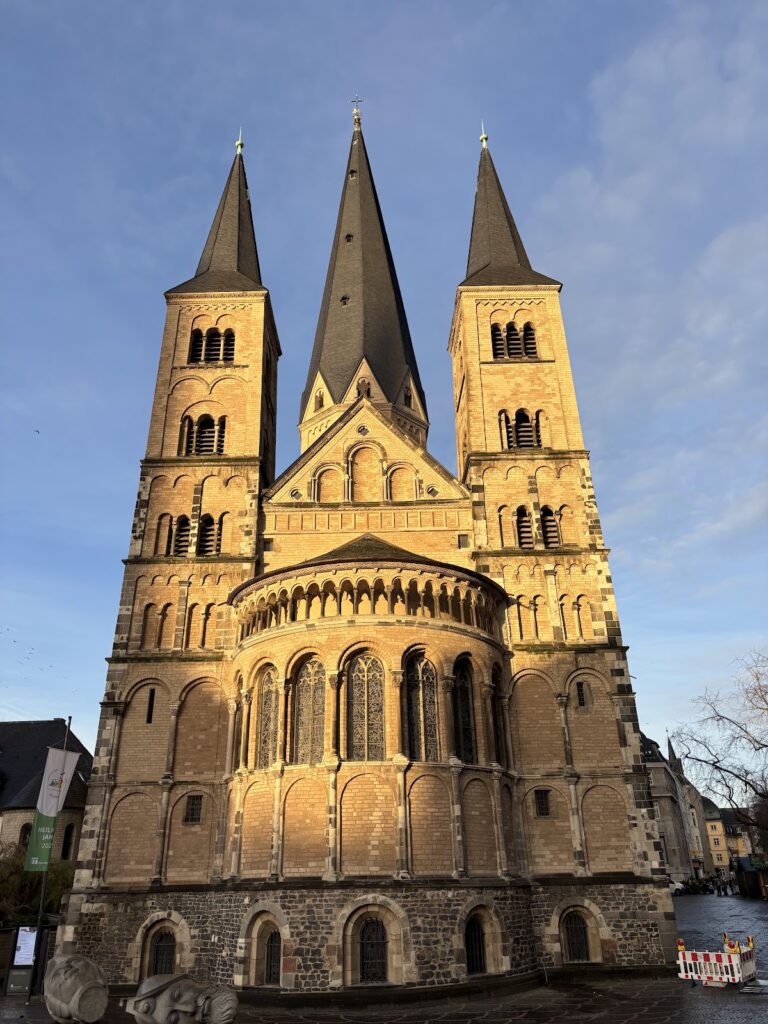
The west facade is dominated by a large niche enclosing the portal and a narrow central pointed-arch window. Above the double-leaf portal is a sculpted stone group of Saint Anthony signed by P. Welter. The pointed gable contains a rose window inserted during the 1889 rebuilding, replacing three earlier small pointed-arch windows. The choir windows have three-light tracery, while the tall, narrow west window has four-light tracery. Tracery is the patterned stone framework that divides Gothic windows.
Choir and aisle structures
The choir ends in five sides of an octagonal plan. Its apse contains choir stalls, a niche with a depositarium, a recess for storing or placing liturgical objects, and a piscina, a small liturgical basin. Quatrefoil tracery decorates the pointed gable above these features.
North aisle apse
The eastern apse of the north aisle was added in 1620 and has a Romanesque-influenced form. Its high altar was donated by Archbishop Ferdinand of Bavaria and consecrated in 1644. The north aisle also contains a marble Rococo baptismal font from around 1740. Its curved wooden cover is crowned by a dove representing the Holy Spirit.
Altars and devotional furnishings
The Baroque church had a high altar and eight additional altars. A winged altar consecrated in 1858, donated by the Art Association for the Rhineland and Westphalia, later replaced the removed high altar. In the eastern bay of the south aisle, an altar complex devoted to “The Church” was painted between 1882 and 1893 in the Nazarene style. Franz Ittenbach, Karl Müller, and Franz Müller contributed works for the Saint Anne and Marian altars.
Nazarene paintings
The Nazarene altar paintings were removed from their frames in 1942 and taken to Friesenhagen for protection from wartime damage. They returned to Bonn between 1949 and 1951 in plain frames, but were removed again and stored in poor conditions during the 1957–1961 renovation. After restoration, they returned to the church and were reconsecrated during a service on 25 March 2000.
Marian sculptures and surviving furnishings
A Marian chandelier donated in 1626 by the widow of Hofrat Arnold Heufft survived the destruction of 1689. It once hung from the choir vault and carried two carved figures of the Virgin Mary. The chandelier was removed in 1748 to improve the view of the altar. The figures are attributed either to Christian Rodt or to Jeremias Geisselbrunn. One Madonna is now in the double church at Bonn-Schwarzrheindorf and the other in the Schnütgen Museum in Cologne, although the route by which they left St Remigius is unknown.
A further half-length Marian statue stands on a pillar against the east wall, on the left side of the central nave. Comparisons with Geisselbrunn’s surviving high altar in the Jesuit church of St Mary of the Assumption in Cologne have led specialists to conclude that the figure originally crowned the St Remigius high altar dismantled in 1898.
An altar in the western bay of the south aisle contains an eighteenth-century painting by Hein Gernot of the miracle-working woman of Kevelaer. A large wrought-iron wall candelabrum with Rocaille decoration hangs beside the choir on the southern arcade pier. Rocaille is an eighteenth-century ornamental style based on asymmetrical shell-like forms.
Interior fittings and organ
The Baroque pulpit from the beginning of the eighteenth century has survived almost unchanged. Its octagonal, dark-stained wooden basket contains statuettes of the Evangelists, with copies replacing two stolen figures. Traces of earlier colored decoration remain, and its elaborate sounding board is crowned by a gilded cross set on a sphere.
The central-nave pews date from around 1750 and are relatively plain apart from their carved ends. Older pews in the aisles have acanthus-leaf decoration. Confessionals probably brought into the church in the mid-eighteenth century also survive and were restored after 1945. The floor was renewed in the late 1980s with marble slabs decorated with Baroque motifs. An epitaph in the south aisle commemorates parish priest Wilhelm Reinkens, who strongly supported the Neo-Gothic furnishings of the 1880s.
Organs
The original Baroque organ had 33 registers and was once the largest organ in Bonn. It was destroyed during the wartime bombardment of 1944. Its console had already been replaced during an earlier renovation, and the old console was given to the Beethoven House in Bonn in 1905.
Organ builder Johannes Klais of Bonn supplied the replacement organ installed on the gallery in 1957. It is a slider-chest instrument with 33 stops on three manuals and pedal. Its key action is mechanical and its stop action electrical. The organ has couplers I/II, III/II, III/I, I/P, II/P, and III/P, with III/I added in 2006, as well as two free combinations.
Bells and cloister
The earliest documented peal consisted of two bronze bells. The larger was cast by Gottfried Dinckelmeyer in 1751 and the smaller by Edmund Peppin in 1727. They were given to the Kreuzbergkirche in 1849, when three replacement bells were cast by Christian Claren. Those bells were destroyed in the 1888 fire.
A five-bell peal supplied by the French foundry Goussel-François arrived in April 1890. Tuned to B-flat, C, D, E-flat, and F, the bells were named Maria, Joseph, Remigius, Antonius, and Michael. They were surrendered for wartime metal collection during the First World War. A four-bell peal installed in 1924 was later lost during the Second World War. In 1954, Petit and Gebr. Edelbrock produced four replacement bells in the same disposition as the 1924 peal, with pitches coordinated with those of Bonn Minster Basilica.
In the cloister, grave slabs that had lain on the church floor for decades were hung on the walls from about 1985. A small chapel in the cloister passage contains a late-Baroque Vesper image, a devotional representation of the dead Christ held by the Virgin Mary. At the center of the cloister stands a life-size stone statue of the Virgin Mary made in the late nineteenth century and placed on a Neo-Gothic pedestal.