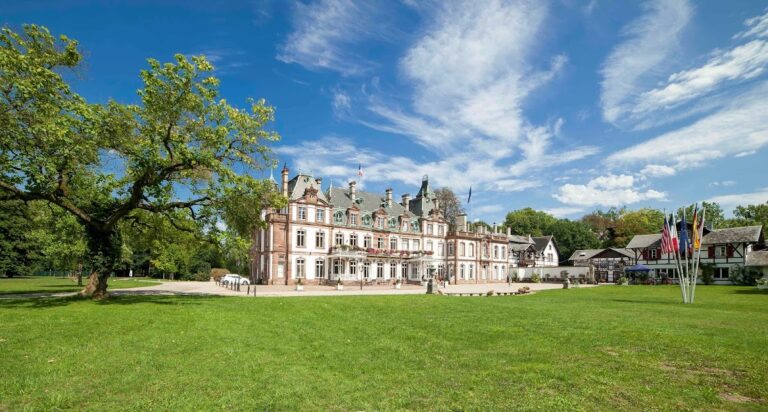
Saint Thomas Church, Strasbourg: A Historic Lutheran Church in France


Site at a Glance
- Rating
- 4.5
- Popularity
- Medium
- Country
- France
- Primary era
- Medieval
- External website
- Open
- Eras represented
- Medieval, Early Modern, Modern
- Civilizations
- French, Holy Roman Empire
- Site type
- Religious
- Remains
- Church
On this page18 sections
History
Saint Thomas Church is a historic Lutheran church in Strasbourg, France, whose present Romanesque and Gothic building was begun in 1196 and completed in 1521. Its origins reach back to a place of worship dedicated to the apostle Thomas by the sixth century, and its later history connects the church with Strasbourg’s medieval religious institutions, the Reformation, and the development of Protestant life in Alsace.
Early foundations and medieval rebuilding
A Benedictine convent and church were founded on the site around 600. Saint Florent, bishop of Strasbourg, who died in 693, was buried there. In the ninth century, Bishop Adeloch, who held office from 817 to 822, ordered a new church and an adjoining school. The church’s possessions and revenues were administered by a collegiate chapter, a community of clergy responsible for a church and its endowments. In 1031, the monastery was converted into a collegiate institution.
Fire repeatedly interrupted the site’s development. The church and school were destroyed in 1007, apparently after a lightning strike, and another catastrophic destruction followed when lightning struck the church in 1144. Construction of the present building began at the façade in 1196. The work proceeded in several campaigns, with the choir and transept, including the crossing tower, built around 1270–1280. The nave followed as a hall church by about 1330, and the late-Gothic chapels along the south aisle brought the building campaign to completion in 1521.
Reformation and Lutheran institution
The Reformation, the sixteenth-century movement that challenged the authority and practices of the Western Catholic Church and led to the formation of Protestant churches, reached Strasbourg in the 1520s. The first vernacular Lutheran service at Saint Thomas was celebrated in 1524, when Communion was distributed in both kinds. The church was assigned to Lutheran worship during the same year, while its collegiate chapter continued as a Lutheran institution.
From 1529, the chapter helped organize Protestant life in Strasbourg. Endowments that had formerly supported the institution were used for pastors and university professors, while the chapter continued to administer the École Saint-Thomas, Foyer Jean Sturm, and the Protestant Seminary. Martin Bucer, a leading Strasbourg reformer who sought to reconcile differing Protestant positions, served as pastor at Saint Thomas and pursued theological work and travel across Europe.
The Peace of Westphalia in 1648 ended the Thirty Years’ War and transferred much of Alsace to France. Marc Otto, a canon of the Saint Thomas chapter, was among the signatories. The settlement also affirmed that no territorial lord could compel another person to convert. When Strasbourg Cathedral returned to Catholic worship in 1681, Saint Thomas became the principal Lutheran church of Strasbourg and the main Protestant church of the region. It consequently became known as the “Protestant Cathedral” of Alsace.
From the eighteenth century to the present
Johann Reinhard Kugler became a canon of Saint Thomas in 1770. During the French Revolution, Christophe-Guillaume Koch obtained the decree of 17 August 1790 that exempted Protestant properties from the sale of national property. Revenues from property secularized during the Reformation were directed toward public purposes, especially schools. French Protestantism was reorganized under Napoleon I through the Organic Articles of 8 April 1802. The later annexation of Alsace-Lorraine by the German Empire in 1871 nevertheless left the church’s Protestant institutional arrangements in place.
Saint Thomas was an important center of the late-nineteenth-century liturgical revival. From 1888, Friedrich Spitta tested new forms of worship there and founded the Akademischer Kirchenchor. Julius Smend began preaching regularly at the church in 1893, and the Gesangbuch für Elsaß-Lothringen was developed there between 1894 and 1899.
Albert Schweitzer served as vicar at Saint Thomas and directed the nearby Protestant Seminary. He designed the choir organ in 1906 and opposed a proposal to convert the historic Silbermann organ into a Romantic symphonic instrument. That alteration was eventually carried out in 1927 while Schweitzer was in Gabon. Later changes reflected the congregation’s changing size and the church’s wider cultural role. A congregation of about 3,000 members at the beginning of the twentieth century had fallen to approximately 900–1,000 by the restoration of 1987. Benches were cleared from the south aisle, which became exhibition space, while new seating allowed concerts and new lighting emphasized the Gothic architecture.
The Union of Protestant Churches of Alsace and Lorraine was formally celebrated at Saint Thomas on 7 May 2006. The chapter continues to oversee Foyer Jean Sturm and remains responsible for the Protestant Seminary in the neighboring Baroque building. Two Lutheran services are held each Sunday, one in German and one in French. The church has been protected as a French monument historique, a legal heritage status for buildings and objects judged to possess historical or architectural importance, since 1862.
Remains
Plan and medieval architecture
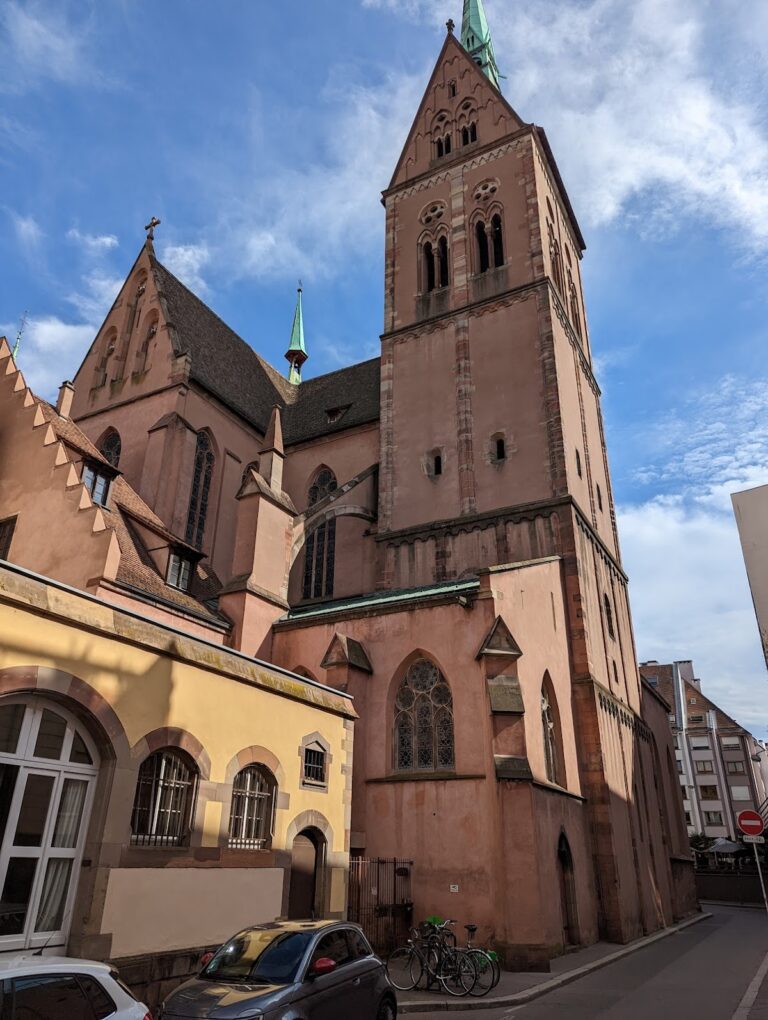
Saint Thomas is a five-aisled hall church, meaning that the nave and aisles are approximately equal in height and form a unified interior space rather than a tall central nave flanked by lower aisles. It measures approximately 65 metres internally from east to west, 30 metres in width, and 22 metres in height. Beneath the late-Gothic crossing cupola, the interior rises to about 30 metres. Galleries are attached to the outer side aisles, and separate late-Gothic chapels stand on both sides of the choir apse.
The building has two bell towers. A square tower rises above the main entrance, while a hexagonal tower stands over the crossing, the point where the nave and transept intersect. The earlier fabric combines the heavy masonry and rounded arches of the late Romanesque period with early-Gothic details. The eastern transept retains Romanesque elements, while the crossing tower joins squat Romanesque proportions and round-arch friezes with early-Gothic windows. The later construction campaign culminated in the late-Gothic chapels along the south aisle.
West façade
The west façade contains early-Gothic openings in the lower bell chamber. These include paired openings with additional circular openings above them, round central supports, and capitals shaped comparatively like chalices. The rose window has fine ring-based tracery, the stone framework that divides a Gothic window into geometric compartments. Around the portal, a slightly pointed enclosing arch frames two sharply pointed lancet windows with single-stone supports, together with further pointed arches integrated into the masonry. A small pointed-arch window above the door repeats the rose’s tracery. The façade’s early tracery is considered unusually advanced for its period and is compared with early work at Chartres and Soissons and with the choir-ambulatory chapels of Reims Cathedral.
Funerary monuments and sculpture
Adeloch sarcophagus
In the southeastern part of the church stands the richly carved Romanesque sarcophagus of Bishop Adeloch. Made around 1130 and attributed to the Master of the Eschau Cloister, it is carved from pink local sandstone. Vine ornament, arcades, and motifs derived from the ninth century cover its surfaces. A kneeling Adeloch appears before the blessing Christ and an angel, while four small lions support the sarcophagus. Its lid carries an inscription dated 830. The sarcophagus received protection as a historic object in 1991.
Mausoleum of Maurice of Saxe
The late-Baroque mausoleum of Marshal Hermann Maurice of Saxe was erected in 1776 and designed by the Parisian sculptor Jean-Baptiste Pigalle. Its theatrical composition combines expressive figures and agitated drapery with the upright figure of the marshal at the center. Maurice of Saxe was a Lutheran marshal who died at Chambord in 1750. Because of his confession and German ancestry, he was not permitted burial in the Basilica of Saint-Denis. The transfer of his remains and the monument’s public inauguration represented the first public recognition of French Protestantism after the revocation of the Edict of Nantes.
Other memorials and sculpture
A Renaissance tomb slab dated 1510 commemorates Nikolaus Roeder von Tiersberg and shows a realistically decomposing corpse. Roeder had donated the life-size Mount of Olives sculptural group of 1498, now installed in Strasbourg Cathedral. The church also contains two works by the Neoclassical sculptor Landolin Ohmacht, including one dedicated to Jean-Frédéric Oberlin. Together with the Adeloch sarcophagus and the mausoleum, these works form part of a group of funerary monuments dating from approximately 1130 to 1850.
Paintings, windows, and furnishings
Medieval painting and stained glass
A large late-Gothic wall painting of Saint Michael defeating the dragon is probably attributable to the fifteenth-century Alsatian painter Jost Haller. It was uncovered during restoration in 1885. The image recalls a chapel dedicated to Saint Michael that was built in 1290 and destroyed during fourteenth-century enlargement works.
The rose in the façade depicts the apparition to Saint Thomas and is the only medieval leaded-glass window in the church whose glazing has been retained throughout its fields. Probably made around 1250, it consists of an eight-lobed circular opening surrounded by sixteen large medallions arranged in two circles, with sixteen intervening panels. A hurricane-force storm caused most of the glazing to be replaced with white glass in 1822. The central colored and painted section survived. The panel showing Saint Thomas’s incredulity was partly restored, especially the apostle and the lower part of Christ. Pereyra recolored the surrounding vegetal motifs in 1842, and later work altered them in 1871, 1873, and 1906. Other modern panels made for the rose are kept in the Protestant Seminary.
Choir windows and furnishings
The upper sections of the large nave windows contain elaborate architectural and vegetal motifs. New contemporary stained glass was designed and installed in the choir by Gérard Lardeur after the previously blocked windows were reopened in 1985. Its symbolism of light gives particular emphasis to the mausoleum of Marshal Maurice of Saxe. Three brass chandeliers hang in the principal nave; they date from the first half of the nineteenth century.
The baptismal font probably dates from the late fifteenth century. Its octagonal shape and a band of vegetal and interlaced relief decoration support that dating. After a period outside the church, it was placed on a new base beside the altar around 1975.
Bells and organs
Bell peal
From the French Revolution until 2009, the church had two bells. One was a 3.6-ton bourdon, a large bass bell, cast in 1783 by Strasbourg founder Matthieu Edel. The other, known as the Vater-Unser bell, dates from 1810. Four additional bells were cast by the Bachert foundry of Karlsruhe on 29 May 2009 and inaugurated on 6 September of that year. Weighing 2,075, 1,549, 1,094, and 728 kilograms, they joined the older bells to form a six-bell peal sounding the notes A2, C-sharp3, E3, F-sharp3, G-sharp3, and A3.
A medieval tradition requires the church bells to ring five minutes before those of Strasbourg Cathedral. The newer bells were tuned approximately to the cathedral’s peal so that neither group would overpower the other. The bells and their towers remain part of the church’s continuing Lutheran identity.
Silbermann organ
Johann Andreas Silbermann built the principal organ in 1741. Wolfgang Amadeus Mozart played it during his visit to Strasbourg in 1778 and praised its tone. Wetzel altered or restored the instrument in 1836, followed by work from Dalstein and Haerpfer in 1908, Schwenkedel in 1927 and 1943, and Muhleisen in 1955. An association dedicated to the organ was founded in 1964, and Alfred Kern restored it in 1979, arranging it in approximate fidelity to its original form.
The historic console could not remain in its former position after the rearrangement and was installed in the northwest side aisle. The organ now has 38 stops on three manuals and pedal. It retains its original French temperament, with a pitch of G at 404 hertz rather than the modern A at 440 hertz. The instrumental section was protected in 1971 and the case in 1973.
Choir organ
Fritz Haerpfer of the Haerpfer-Dalstein firm built the choir organ from Albert Schweitzer’s plans. Designed in 1905 and installed in 1906, it was intended to improve accompaniment for the parish choir and uses pneumatic action. Its connection with Schweitzer complements the historic Silbermann organ and preserves two distinct phases of the church’s musical history.
Nearby sites