Kollegiatstift Neumünster, Würzburg: A Collegiate Foundation and Church


Site at a Glance
- Rating
- 4.7
- Popularity
- Low
- Country
- Germany
- Primary era
- Medieval
- External website
- Open
- Eras represented
- Medieval, Early Modern, Modern
- Civilizations
- Carolingian, Holy Roman Empire
- Site type
- Religious
- Remains
- Church
On this page13 sections
History
Kollegiatstift Neumünster is a former collegiate foundation and church in Würzburg, Germany, developed as a Romanesque basilica between the eleventh and thirteenth centuries and later transformed in the Baroque period. Dedicated to Saint John the Evangelist and Saint John the Baptist, it stands on a site associated with the Franconian apostles Kilian, Kolonat, and Totnan, the seventh-century Christian missionaries regarded as the principal saints of Würzburg and Franconia.
Early memorial church
A memorial church, traditionally known as the first Salvator Cathedral, was probably established here during the episcopate of Megingaud of Würzburg, who held office from 754 to February 769. It commemorated the alleged place where Kilian, Kolonat, and Totnan suffered martyrdom. Bishop Burkard, Megingaud’s predecessor, was buried at the site, and Megingaud was later buried there as well.
Megingaud died on 26 September 783 at Neustadt Abbey on the Main. His sandstone sarcophagus cover, made from stone quarried in the Neustadt area, is preserved in the Neumünster crypt. Its long monumental inscription is identified as the oldest post-Roman monumental inscription in Franconia and the longest Frankish epitaph.
Foundation and Romanesque rebuilding
Around 1057, Bishop Adalbero of Würzburg founded the collegiate foundation of Neumünster with the support of Queen Richeza of Poland and the Counts of Rothenburg-Comburg. A collegiate foundation was a religious institution served by a chapter of canons rather than monks living under a monastic rule. The foundation was dedicated to John the Evangelist.
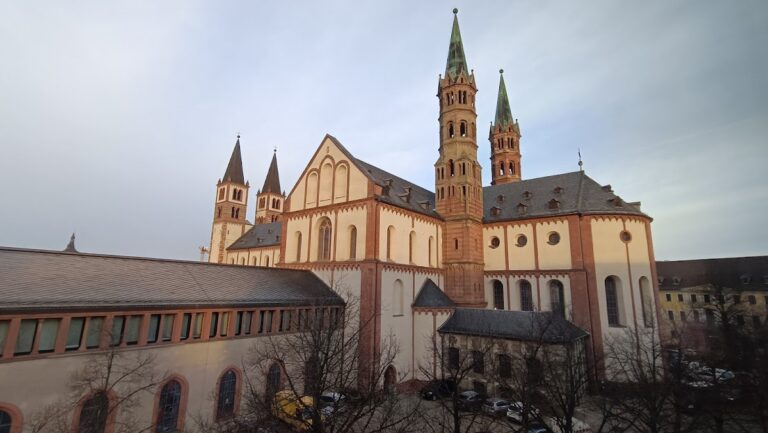
The church developed into a three-aisled Romanesque basilica between the eleventh and thirteenth centuries. Its medieval design included a double choir, meaning choir spaces at both ends of the main axis, together with two transepts, the cross-arms that intersect the nave. The tower was built around 1230, and construction was completed around 1250. The building originally had a flat ceiling.
Baroque transformation
Renaissance alterations preceded the addition of vaults in the early seventeenth century. Between 1711 and 1716, during the episcopate of Prince-Bishop Johann Philipp II of Greiffenclau zu Vollraths, the western end was rebuilt with a dome and a Baroque façade. The Romanesque nave was remodelled, and the interior continued to be redesigned throughout the eighteenth century.
Joseph Greissing directed the rebuilding. The extent of Johann Dientzenhofer’s influence on the façade remains disputed because his name does not occur in the building records or foundation document. Greissing and the stoneworker Valentino Pezzani are identified in those records. Roman and northern Italian Baroque buildings served as artistic models, while Greiffenclau maintained a direct connection with Rome through a statue he commissioned for San Giovanni in Laterano.
Secularization and parish status
In 1803, secularization in Bavaria transferred the collegiate foundation and its property into state and private ownership. The foundation was dissolved, and the church became state property. It was temporarily used as a munitions depot, which led the Cross Brotherhood to move its principal church to the Marienkapelle in 1808. The brotherhood returned to Neumünster in 1821, while the canons’ property was privatized two years after the dissolution.
A separate church foundation for Neumünster was approved in 1883. A subsidiary church district was created in 1901, and in 1907 an independent parish was established under Bishop Ferdinand Schlör, separating it from the cathedral parish. Neumünster became a Catholic parish church in 1908.
War damage and reconstruction
The bombing and fire in Würzburg on 16 March 1945 severely damaged the church. The western altars, the Rococo pulpit, many paintings, and Tilman Riemenschneider’s busts of the Franconian apostles were destroyed. Copies of the apostle busts made by Heinz Schiestl around 1910 were later installed behind the main altar.
After reconstruction, Neumünster served as the episcopal church of the Diocese of Würzburg from 1950 until the cathedral reopened in 1967. It again served temporarily as the bishop’s church during work on the cathedral in 2011 and 2012. A two-year interior renovation and reconfiguration was completed in 2009. The western Kilian Crypt was redesigned for the Kilian jubilee in 1989, and since 1982 it has contained the urn of Georg Häfner, a Catholic priest and martyr beatified in 2011.
Remains
Church architecture and western façade
Neumünster retains the basic form of a three-aisled Romanesque basilica with a double choir and two transepts, overlaid by the later western dome, façade, vaulting, and interior decoration. The dome, built between 1711 and 1716, rises above the alleged burial place of the Franconian apostles. The façade, completed between 1712 and 1716, is faced with red sandstone from the former Schloss quarry between Leinach and Erlabrunn, which operated until 1977.
The frieze of the main entablature, the horizontal architectural assembly above the supporting wall or columns, carries the inscription “ANNO MDCCXVI POSUIT / JOANNES PHILIPPUS EPISCOPUS / HERBIPOLENSIS F.O.D.” The gable frieze bears a dedication to the holy martyrs Kilian and his companions as patrons of the country.
Jakob van der Auwera made the statues of John the Evangelist and John the Baptist beside the entrance, as well as the relief glorifying Mary in the segmental pediment. Balthasar Esterbauer created the upper-storey sculpture, including Christ as Savior and the diocesan patrons. Totnan and Kolonat stand at the outer ends of the attic, while Kilian and Burkard occupy higher positions on the balustrade, a parapet formed from a row of small supporting posts.
Baroque interior and furnishings
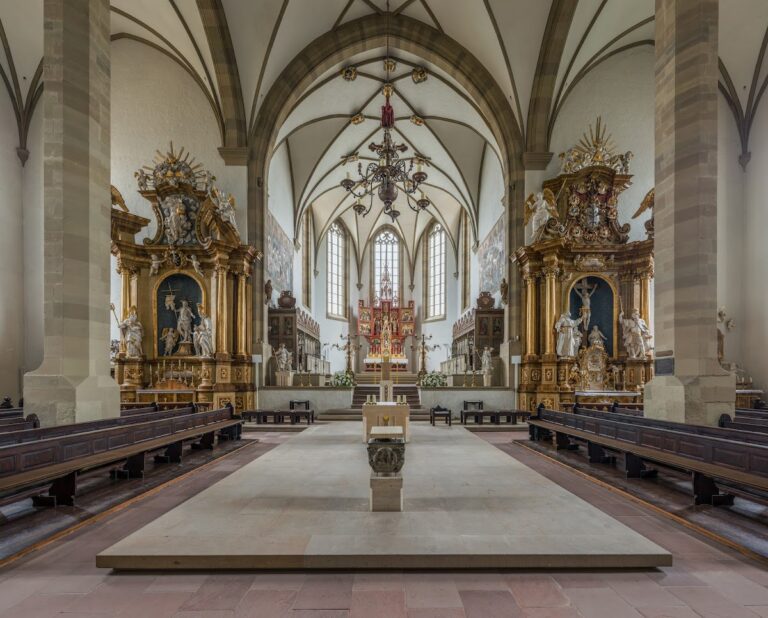
The interior received stucco and plaster inlay by Dominikus Zimmermann, including decoration for the Boniface altar. Johann Baptist Zimmermann painted ceiling frescoes and oil paintings in 1732, and Nikolaus Stuber added frescoes in 1736. Much of this decoration was destroyed in 1945 and subsequently copied in large part. The main altar and Johann Baptist Zimmermann’s painting John on Patmos, made in 1724, survived. Other altar paintings by Anton Clemens Lünenschloß, Giovanni Conca, and Joseph Scheubel were destroyed in the wartime fire.
The Zimmermann brothers made the main altar in 1721, and Johann Georg Winterstein remodelled it in a Classical style in 1778. Johann Peter Alexander Wagner made the Baroque or late-Rococo altars dedicated to Saint Thecla and Saint Michael. The altars dedicated to the Virgin Mary and the Apostles Peter and Paul date from the 1720s and are attributed to Balthasar Esterbauer. Winterstein made the transept choir stalls in 1780 and 1781.
In 2009, two Classical side altars by Johann Peter Alexander Wagner were installed beneath the dome. Formerly in the adjacent cathedral, they are dedicated to John the Baptist and Saint Stephen. Eight brightly coloured paintings by Thomas Lange in the high central nave depict episodes and miracles from the Gospel of John, adding modern works to the Baroque interior.
Earlier works of art
Important pre-Baroque works include the Riemenschneider Madonna of 1493 and Tilman Riemenschneider’s tomb monument for Johannes Trithemius, a late-medieval and early-modern churchman, scholar, and abbot. The monument was transferred from Saint James of the Scots. A fourteenth-century Gothic plague cross and a late-Gothic crucifix dating from approximately 1470 to 1510 also remain in the church.
Kilian Crypt
The western Kilian Crypt is a vaulted space beneath the church, reached by stairs from the interior and directly from the street. Since 1989 it has contained a shrine made by Heinrich Gerhard Bücker for the relics of Kilian, Kolonat, and Totnan. A reliquary is a container made to house the remains of a saint or other sacred figure. Bücker also created the Stations of the Cross for the crypt. The shrine was produced in 1985 and installed as part of the 1989 redesign.
Two stone sarcophagi from the eighth century stand in the crypt. The red-sandstone cover of Megingaud’s sarcophagus bears the monumental inscription associated with the earliest post-Roman inscription in Franconia, while the rest of the sarcophagus is considerably later. The crypt also contains the graves of Bishop Matthias Ehrenfried and Bishop Karl Ebert. Against its eastern wall stands an eighth-century tomb monument associated with Kilian, above which hangs Michael Triegel’s Christ Triumphant, painted in 1993.
A spring in the crypt marks the alleged place where the apostles’ remains were found. It is still present and is regarded as miraculous.
Lusam Garden and former cloister
The Lusam Garden occupies the site of the former collegiate cloister and cemetery north of the church. Its surviving northern wing belongs to the Romanesque cloister and dates from approximately 1170. Sixteen arcades remain, several of them carrying Romanesque carvings that include reliefs of Christ in Majesty and Saint Kilian.
The garden also contains Fried Heuler’s memorial to Walther von der Vogelweide, a prominent medieval German lyric poet and minstrel who was probably buried there. The memorial has four depressions for bird feed and water, reflecting the traditional interpretation of the poet’s epitaph.
Organs and bells
The main organ on the western gallery was built in 1949 by the Klais organ-building company of Bonn. It has three manuals, electric action and stops, and was slightly altered during the 2009 renovation. Its distinctive feature is the transmission of the 32-foot Bourdon from the pedal to the main division.
Franz Heissler built a one-manual crypt organ in 2009, with a case designed by Jacques Gassmann. The tower contains five bells cast in 1952 by the Albert Junker foundry in Brilon. The earlier bells were melted down or destroyed in the bombing of 1945.
Nearby sites