Marienkirche, Würzburg: A Romanesque Marian Church and Episcopal Memorial


Site at a Glance
- Rating
- 4.6
- Popularity
- Low
- Country
- Germany
- Primary era
- Medieval
- External website
- Open
- Eras represented
- Medieval, Early Modern
- Civilizations
- Holy Roman Empire
- Site type
- Religious
- Remains
- Church
On this page9 sections
History
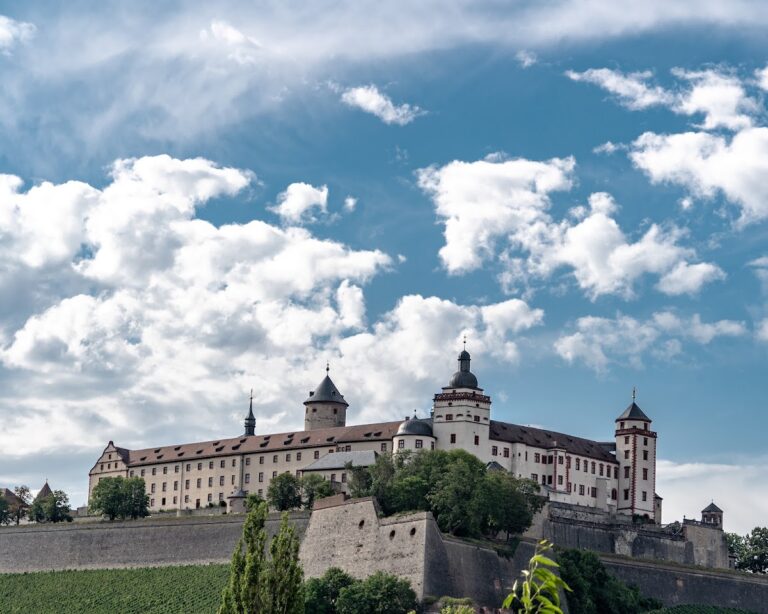
Marienkirche, Würzburg, is a Roman Catholic church in Germany, located within the inner courtyard of Marienberg Fortress. Dedicated to the Virgin Mary, it developed from a small Christian church founded around 706 and is regarded as Würzburg’s oldest church and the oldest surviving part of the fortress complex.
Early episcopal church
Duke Hedan II founded the original church around 706 and dedicated it to Mary. When the Diocese of Würzburg was established in 742, the church served as its cathedral and episcopal church, meaning the principal church of the bishop’s see. This role continued until 788, when the relics of the Christian martyrs Kilian, Kolonat, and Totnan were transferred to Würzburg Cathedral. The three martyrs were traditionally associated with the early evangelization of Franconia.
Tradition holds that the church became a parish church of St. Burchard’s Abbey in 983. Burchard, Würzburg’s first bishop, was the patron of the abbey. Under Bishop Heinrich I, a replacement church was built on the site at the beginning of the eleventh century. It may have incorporated stones or other material from the earlier building. The church later became a Marian pilgrimage church.
Fortress court church
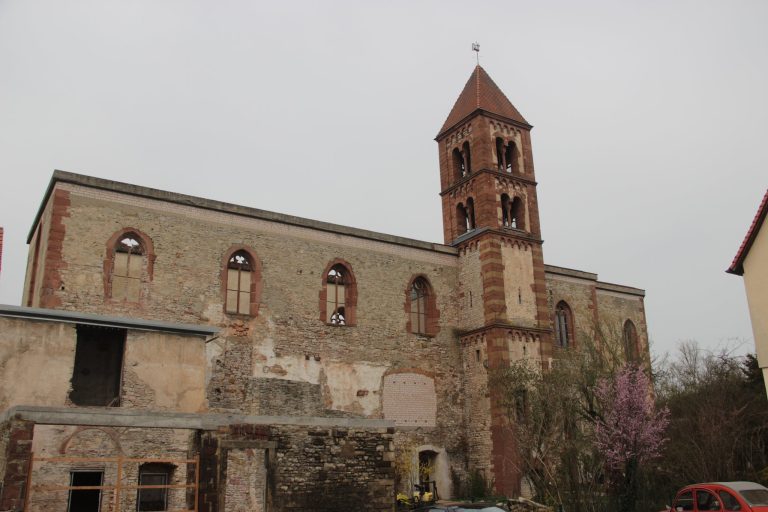
Around 1200, under Bishop Konrad von Querfurt, Marienkirche became the court church attached to the Würzburg princes after their court moved to the fortress. Konrad commissioned alterations that included raising the building’s upper cylindrical section and enlarging its windows. The church’s basic form remained Romanesque, while later work introduced Gothic and Renaissance elements.
The church also served a funerary purpose for Würzburg’s prince-bishops. From the thirteenth century until the end of the sixteenth century, their hearts were buried at Ebrach Abbey, their entrails at Marienkirche, and their bodies in Würzburg Cathedral. This arrangement made the church a traditional burial place within the episcopal complex.
Rebuilding after the 1600 fire
A fire in 1600 led Prince-Bishop Julius Echter von Mespelbrunn to rebuild the church. The high choir was enlarged, a balustrade was added, and a lantern containing the bells was placed above the dome. The interior was remodeled with Renaissance plasterwork and stucco. A sculpted projection of the choir, probably made around 1600 by Sebastian Götz of Zizers in Graubünden, displayed twelve reliefs of Caesar heads. The projection was demolished in 1814, although five of its reliefs survive in the Fürstenbaumuseum.
Marienkirche has remained dedicated to the Virgin Mary and serves as the patronal church of Franconia, whose feast is observed on 1 May. Its long history connects the early diocese, the medieval fortress court, and the later residence of the Würzburg prince-bishops.
Remains
The church stands on the elevated ground later known as Marienberg, within the inner courtyard of the fortress. Its central building retains a primarily Romanesque structure with an upper cylindrical section. The form reflects the early eleventh-century rebuilding, while the raised cylinder and enlarged windows belong to the alterations carried out around 1200. Renaissance and early Baroque influences appear in the later rebuilding and decoration.
Central building and entrance
Dome, choir, and bell lantern
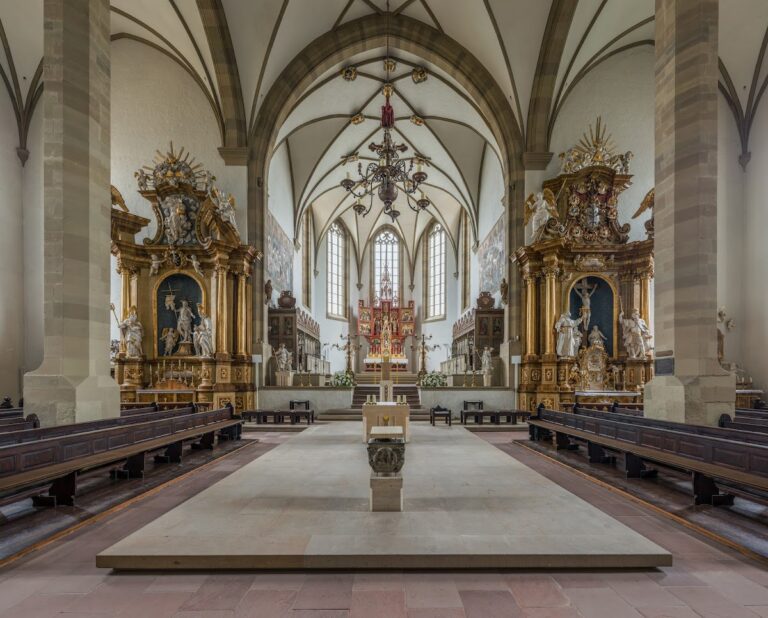
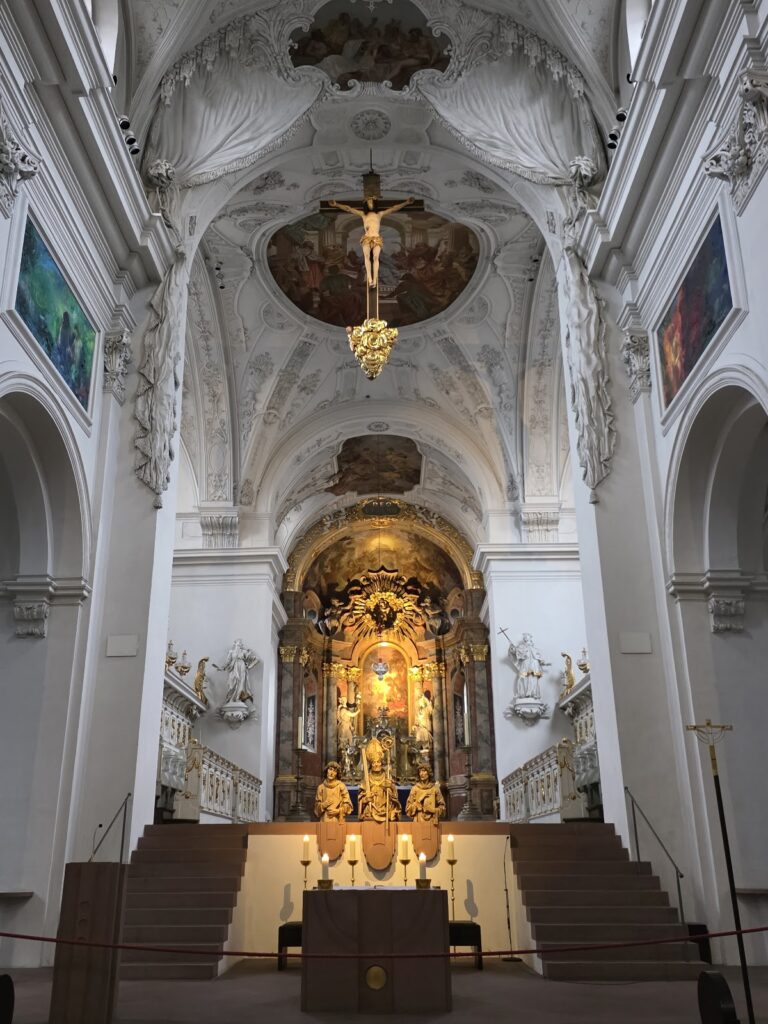
The central area is covered by a hemispherical roof fitted with a lantern, a roofed structure rising above the dome and used here as a bell structure. The high choir was extended after the 1600 fire, and the building received a balustrade during the same rebuilding. Inside, Renaissance stucco and plasterwork cover the remodeled interior.
Renaissance portal
The ornamental entrance portal is built of red sandstone and dates from Julius Echter’s rebuilding. It carries his richly decorated coat of arms and includes sculptural figures of Saint Peter and Saint Paul, the Annunciation, and the bishops Kilian and Burchard of Würzburg. A statue of Mary crowns the portal. Its Renaissance design already incorporates early Baroque influence.
Burial memorials and surviving sculpture
Twenty grave slabs remain in the central church building, each bearing reliefs of Würzburg bishops. They include Albrecht II von Hohenlohe, who died in 1372; Gerhard von Schwarzburg, bishop from 1440 to 1443; Rudolf II von Scherenberg, 1466–1495; Lorenz von Bibra, 1495–1519; Konrad II von Thüngen, 1519–1540; Konrad III von Bibra, 1540–1544; Friedrich von Wirsberg, 1558–1573; Julius Echter von Mespelbrunn, 1573–1617; Melchior Zobel von Giebelstadt, 1544–1558; Johann Hartmann von Rosenbach, 1609–1675; Peter Philipp von Dernbach, known as Graul, 1675–1683; Konrad Wilhelm von Wernau, 1683–1684; Johann Gottfried von Guttenberg, 1684–1698; Johann Philipp von Greifenclau zu Vollraths, 1699–1719; Johann Philipp Franz von Schönborn, 1719–1724; Christoph Franz von Hutten, 1724–1729; Anselm Franz von Ingelheim, 1746–1749; Karl Philipp von Greiffenclau zu Vollraths, 1749–1754; and Adam Friedrich von Seinsheim, 1755–1779.
The former choir projection contained twelve reliefs showing Caesar heads, sculpted representations of Roman emperors. Five of these reliefs survive in the Fürstenbaumuseum, preserving part of the sculptural program that was removed from the church in 1814.