St. Thomas Church: Leipzig’s Lutheran Parish Church and Bach’s Musical Home


Site at a Glance
- Rating
- 4.7
- Popularity
- Medium
- Country
- Germany
- Primary era
- Medieval
- External website
- Open
- Eras represented
- Medieval, Early Modern, Modern
- Civilizations
- Electorate of Saxony, German, Holy Roman Empire, Margraviate of Meissen
- Site type
- Religious
- Remains
- Church
On this page21 sections
History
St. Thomas Church is a Lutheran parish church in Leipzig, Germany, dedicated to St. Thomas and belonging to the Evangelical-Lutheran Church of Saxony. Its origins reach back to a Romanesque church generally dated to about 1160, when Margrave Otto the Rich of Meissen granted town privileges to the castle settlement of Libzi. The church later became the collegiate church of an Augustinian monastery and was rebuilt as a late-Gothic hall church, a form in which the nave and side aisles create a broadly unified interior.
Romanesque church and Augustinian monastery
Archaeological excavations revealed foundations beneath the present choir and crossing belonging to the earlier Romanesque building. The church is first documented in 1212. Between 1212 and 1222, the market church was rebuilt as the collegiate church of a new monastery founded by Margrave Dietrich of Meissen. Augustinian canons were members of a religious community following the rule of St. Augustine, while a collegiate church served the community and its clerical institutions. The Romanesque monastery church was completed in 1222.
The minnesinger Heinrich von Morungen is traditionally believed to have brought a relic of St. Thomas from India and presented it to the monastery when he entered the religious community in 1217. The Thomanerchor, the boys’ choir historically attached to St. Thomas Church, was founded in 1212, probably in connection with the monastery. Its first documentary mention dates from 1254. The choir’s director, the Thomaskantor, combines musical leadership with responsibility for its liturgical music, an office later held by numerous prominent composers and musicians.
Medieval expansion and the late-Gothic rebuilding
During the late thirteenth century, a bell tower was added at the southern end of the church. Around 1355, the Romanesque choir was enlarged and given a Gothic vault. In 1391, the church of Sommerfeld was transferred from the Kreuzkloster in Meissen to St. Thomas. The monastery also had an institutional connection with the University of Leipzig. The charter founding the university was signed in the monastery refectory in 1409, and for a long period university professors were drawn from the monastery’s monks.
Leipzig’s prosperity following the discovery of silver in the Ore Mountains financed a major rebuilding campaign. The Romanesque nave was demolished in 1482 and replaced between 1482 and 1496 by the present late-Gothic hall church. Thilo von Trotha, Bishop of Merseburg, reconsecrated the building on 10 April 1496. The rebuilding also involved the city wall, which was moved about 10 metres to provide space for the enlarged nave.
Reformation and early modern changes
St. Thomas Church remained Roman Catholic during the early Reformation disputes, including the 1519 Leipzig debate between Martin Luther, the principal reformer associated with the rise of Lutheran Protestantism, and Johann Eck, a Catholic theologian. After the death of Duke George of Saxony, the church became Lutheran. Luther preached there at Pentecost in 1539, and the Augustinian community was dissolved. The convent buildings were demolished in 1541.
Renaissance galleries were added in 1570 and 1571 under the direction of Hieronymus Lotter. Baroque renovations in 1720 and 1721 introduced a Baroque altar, stucco decoration, and a pulpit. Chapels and a long northern porch with stairways were constructed during the seventeenth and eighteenth centuries and later removed. In 1789, Wolfgang Amadeus Mozart played the church organ during a visit to Leipzig.
Bach and Leipzig’s musical tradition
Johann Sebastian Bach served as Thomaskantor and music director from 1723 until his death on 28 July 1750. He taught at the affiliated school, and many of his cantatas and Passions were first performed at St. Thomas Church. Eleven of his children were baptized there. The church’s musical history also includes the baptism of Richard Wagner in 1813 and of Karl Liebknecht in 1871. Karl Marx and Friedrich Engels were recorded as Liebknecht’s written baptismal sponsors.
After Bach’s death, his music fell into relative public neglect before Felix Mendelssohn Bartholdy helped revive interest in it through performances, including the 1829 revival of the St. Matthew Passion. St. Thomas Church later hosted premieres of Mendelssohn’s works, including Lobgesang. Its musical identity continues through the Thomanerchor, church services, and performances involving the Gewandhaus Orchestra.
Military use, nineteenth-century alteration, and wartime damage
During the Napoleonic occupation, St. Thomas Church was used as a French military supply or munitions depot from 1806 to 1808. During the Battle of Leipzig in 1813, a major conflict during the Napoleonic Wars, it served as a military hospital for as many as 1,500 wounded people. Religious use resumed in 1815.
The church passed from municipal ownership to the self-administration of the parish in 1869. Extensive historicizing alterations followed for about thirty years. The Gothic Revival renovation of 1884 to 1889 removed most Gothic and Renaissance facade elements and almost all Baroque interior furnishings, including much of the furnishing known from Bach’s period. Constantin Lipsius designed the west facade and the Neo-Gothic altar installed in 1888. The renovation also added four corner pinnacles and the north-side Apostles’ Portal.
The Leipzig air raid of 4 December 1943 damaged St. Thomas Church, including its tower, whose roof collapsed. Much of the surrounding urban fabric was destroyed, and further postwar facade alterations included the application of a uniform coat of plaster. During the Nazi era, the church office cooperated with government officials in identifying parishioners of Sinti and Romani heritage. Some of those parishioners were subsequently killed in concentration camps.
Restoration and continuing commemoration
Repairs and restoration in 1961 to 1964 sought to emphasize the building’s late-Gothic hall-church character. Further restoration followed German reunification, and the work was largely completed around 28 July 2000, the 250th anniversary of Bach’s death. A new organ, known as the Woehl Bach organ, was installed at the same time. Air pollution had damaged exterior stonework, statuary, and interior Gothic paintings, while insects and moisture affected the roof structure. St. Thomas Church was listed in the World Monuments Watch in 2000, and subsequent repairs addressed these conditions.
The remains believed to be Bach’s were transferred to St. Thomas Church in 1949 from the ruined St. John’s Church. They had been exhumed in 1894 and identified by the anatomist Wilhelm His as very probably Bach’s, then placed in a stone sarcophagus beneath St. John’s Church in 1900. The identification remains disputed, and no DNA comparison with the securely identified remains of Bach’s son Carl Philipp Emanuel has been made. The grave was inaugurated in St. Thomas Church on 28 July 1950, the bicentenary of Bach’s death, and moved within the choir during the 1961 to 1964 interior renovation.
The historic bells underwent restoration in 2020 and 2021. Four new bells bearing texts from Bach’s motets were added, and the upper steel bell frame was replaced by a wooden one. The enlarged peal was inaugurated on Reformation Day in 2021.
Remains
Layout and late-Gothic structure
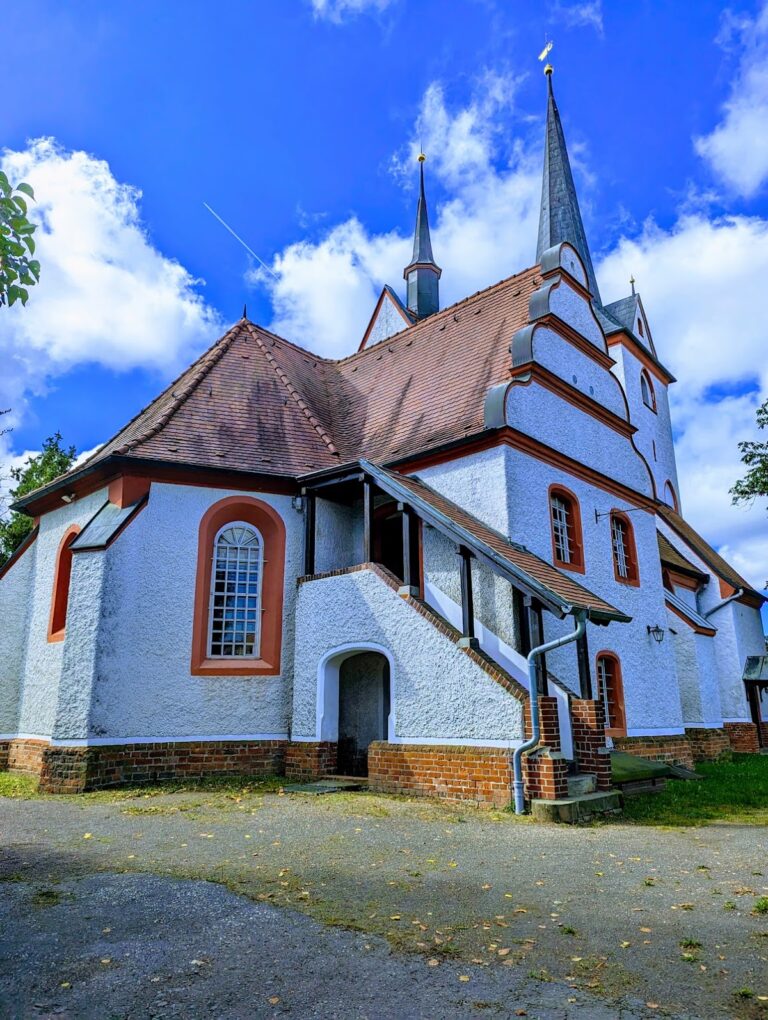
St. Thomas Church is a three-aisled late-Gothic hall church measuring 76 metres in total length. Its nave is 50 metres long, 25 metres wide, and approximately 18 metres high. The choir angles slightly northward in relation to the nave and ends in a polygonal apse. Thomaskirchhof surrounds the church on the north, east, and south sides, while the west side formerly adjoined the city wall. The wall was moved during the late-fifteenth-century enlargement to make room for the rebuilt nave.
The nave roof has an unusually steep pitch of about 63 degrees and rises to a ridge approximately 45 metres above ground level. Its seven-level roof structure covers about 2,520 square metres. Inside, a colored net-rib vault, whose intersecting ribs form a network pattern, is supported by simple white-plastered octagonal piers. The ribs are made of Rochlitz porphyry tuff and contrast with the whitewashed surfaces. The side aisles rise to about one-third of the height of the central space.
Tower and galleries
Tower
The 68-metre tower stands east of the nave near the apse and is shifted slightly southward. Its lowest level dates from before 1355. The tower has a square lower section and an octagonal upper section. The upper structure, including the Welsch dome and lantern, was rebuilt in 1537 and had reached its later completed form by 1702. A three-storey apartment for the tower keeper occupied the tower from 1533 to 1917.
Galleries
Galleries built in 1570 and 1571 surround the nave on three sides. Their parapets are made of Rochlitz porphyry and their columns are articulated. In 1632, two wooden musicians’ galleries were added beside the main organ on the west gallery, one for town musicians and one for instrumentalists. The Thomanerchor singers stood between them. Other wooden structures included family chapels, a princely gallery from 1684, and another gallery. Together, these additions provided about 2,000 seats during Bach’s period. Many were removed during the 1880s renovation, while the 1684 princely gallery was transferred to the Leipzig City History Museum.
Altars, pulpit, font, and memorials
Pulpit and baptismal font
The present pulpit was designed in 1885 during the Gothic Revival and moved one bay eastward from the position of its predecessor. Its limestone parapet is carved with the four Evangelists. The wooden sounding board was removed in 1961 and restored in 2000. The baptismal font, made of marble and alabaster by Franz Döteber, is generally dated to 1614 and 1615, although another dating assigns it to 1555. Biblical scenes decorate the font, which was restored in 2009. Its cover was destroyed during the Second World War.
Altars and crucifixes
A carved altarpiece with a predella, the lower section of an altarpiece, and four wings was installed around 1500. Valentin Silbermann and Michael Treuding added fixed wings and an upper section in 1587. The altarpiece was moved to the cemetery church in 1722 and is now in Luther Church in Plauen.
The Baroque Portico, also called the Born Altar, stood in St. Thomas Church from 1721 to 1888. It was named after its patron, Jacob Born. Giovanni Maria Fossati and Paul Heermann were among its principal artists, and Augustus the Strong donated its marble. After removal, much of its architectural structure was reused in the new St. John’s Church, where it was destroyed when that building burned in 1943.
Constantin Lipsius designed the Neo-Gothic Jesus Altar in 1888 according to a theological program by Superintendent Oskar Pank. Its reliefs depict scenes from the life of Christ, including a central Last Supper relief by Oskar Rassau. The altar was moved to the south sacristy in the 1960s, restored with a new altar table, and returned to the chancel in 2016. A simple sandstone altar base made by Werner Hempel was dedicated in 1964 for a late-Gothic winged altarpiece. A fifteenth-century Gothic altarpiece from the former University Church of St. Paul stood at St. Thomas for several decades after being rescued from that church’s demolition in 1968. It returned to the Paulinum in 2014 and was replaced by the Neo-Gothic Jesus Altar.
A crucifix in the chancel arch from the first half of the sixteenth century uses real hair and a crown made from genuine thorns. It came from Altenburg Castle Church and has hung at St. Thomas since 1968. A second crucifix opposite the pulpit was made by Caspar Friedrich Löbelt during Bach’s period.
Tombs and epitaphs
The church contains numerous tomb slabs and epitaphs, commemorative monuments or inscriptions for deceased people. They include the late-Gothic tomb slab of Nickel Pflugk, who died in 1482, and the slab of the knight Hermann von Harras of Lichtenwalde, who died in 1451. The latter is mounted beneath the south gallery beside the side entrance. An epitaph for the councillor Daniel Leicher, dated 1612, hangs in the northern crossing. Portraits of Leipzig superintendents surround the choir, with the oldest dating from 1614.
Windows and exterior monuments
The church originally had simple ornamental glazing. Colored windows were installed in the choir and on the south side after 1889. The choir windows by Alexander Linnemann depict the history of Christ. The south windows commemorate the dead of the First World War and depict Gustavus Adolphus of Sweden, Johann Sebastian Bach, Martin Luther with Elector Frederick the Wise and Philipp Melanchthon, and Emperor Wilhelm I. A window dedicated to Felix Mendelssohn Bartholdy, whose installation had been delayed by antisemitic opposition, was added in 1997.
Hans Gottfried von Stockhausen designed the war-damaged Thomas Window, installed in 2000, and David Schnell created the Peace Window added in 2009. Several windows, including the west rose window and valuable late-nineteenth-century glazing, were smashed with paving stones during the New Year’s night attack of 2019 to 2020. Two Bach monuments stand outside the church. Carl Seffner’s monument was installed beside the side entrance in 1908, while an earlier monument created with Mendelssohn’s support in 1843 stands before the main entrance. A memorial plaque to Johann Adam Hiller is attached to the church’s northwest corner.
Organs and bells
Organs
The Romantic Sauer organ on the west gallery was built by Wilhelm Sauer in 1889 with 63 stops and enlarged to 88 stops in 1908. It has three manuals and pedals. Its pneumatic action and Romantic design were restored in phases between 1988 and 1993 and again by 2005, when the 1908 tonal configuration was restored.
A Schuke organ with three manuals and 47 stops was installed on the north gallery in 1966 and 1967. It was dismantled in 1999, and some of its components were reused in a later Schuke organ in Fürstenwalde Cathedral. Gerald Woehl’s Bach organ was built in 1999 and 2000 for the north gallery opposite the Bach Window. It has four manuals, pedals, 61 stops, and approximately 5,000 pipes. Its design draws on eighteenth-century central German organ-building traditions, permits ordinary and Baroque tuning, and uses a case inspired by the organ of the former University Church of St. Paul on which Bach played. The instrument includes tremulants, a glockenspiel, two cymbelstern devices, and a bird-call device. A Woehl chest organ for basso continuo has been present since 2006.
Bells
The two bell chambers contain eight bells with a combined weight of 10.8 metric tons. The 1477 Gloriosa, cast by Theodericus Reinhard, is the largest and most valuable. It weighs about 5.2 metric tons, has a diameter of 204 centimetres, and bears incised drawings by Nikolaus Eisenberg. It is rung only on major solemnities. Other historic bells include a 1574 bell by Wolf Hilliger, the 1634 Mönchs- or Beichtglocke by Jakob König, and the 1585 prayer bell by Christophorus Gros.
A separate clock bell hangs in the tower lantern and strikes the quarters. The Schilling foundry in Apolda cast it after the model of its 1539 predecessor. In 2020, the two largest bells received straight wooden yokes, new clappers, cleaning, and new ringing mechanisms. These changes formed part of the restoration that also replaced the upper steel bell frame with a wooden one.
Bach’s grave
Bach’s grave lies in the choir beneath a bronze cover. The associated remains were transferred from the former St. John’s Church and remain identified only as probably those of Bach.