Basilica of Santa Maria Novella: Dominican Church and Renaissance Landmark in Florence


Site at a Glance
- Rating
- 4.7
- Popularity
- Very High
- Country
- Italy
- Primary era
- Medieval
- External website
- Open
- Eras represented
- Medieval, Early Modern, Modern
- Civilizations
- Grand Duchy of Tuscany, Republic of Florence
- Site type
- Religious
- Remains
- Monastery
On this page25 sections
History
The Basilica of Santa Maria Novella is a Catholic Dominican church in Italy, in Florence, built and developed by the Dominican order from the thirteenth century within a Gothic architectural tradition. Its adjoining convent became a major center of preaching and learning, functioning by the early fourteenth century as a studium generale, a high-level medieval school that attracted students and scholars from beyond the local community.
From Santa Maria delle Vigne to a Dominican basilica
Twelve Dominicans arrived in Florence from Bologna in 1219, followed by Giovanni of Salerno. In 1221, the community received the oratory of Santa Maria delle Vigne, an earlier church situated outside Florence’s walls among agricultural fields. The building had belonged to the cathedral canons and had been consecrated either in 1049 or, more probably, in 1094.
The Florentine Dominican community decided in 1242 to replace the earlier church with a larger one. From 1246 onward, the pope granted indulgences to people who contributed financially to the project. The foundation-stone ceremony took place in the Gondi Chapel on 18 October 1279, although construction had already begun. The church was completed around the middle of the fourteenth century and formally consecrated in 1420 by Pope Martin V.
The building project has been attributed uncertainly to the Dominican friars Sisto da Firenze and Ristoro da Campi, with Jacopo Passavanti also involved in the construction. Jacopo Talenti and Benci di Cione Dami were responsible for the campanile and much of the adjoining convent. The complex became a principal center of the Dominican order in Florence. Remigio of Florence taught there, and Dante Alighieri was associated with the convent and is traditionally thought to have attended some of Remigio’s lectures. Remigio was buried at Santa Maria Novella.
Patronage and the Renaissance façade
The convent’s intellectual and religious role continued to shape the complex during the fifteenth century. Sessions of the Council of Basel, Ferrara, Florence, and Rome were held in the convent from 1439. The council’s presence reinforced the need to complete the unfinished façade, while wealthy Florentine families financed the church and acquired funerary chapels within it.
Giovanni di Paolo Rucellai commissioned Leon Battista Alberti, a Renaissance architect, theorist, and humanist, to complete the façade. Work began in 1458 and combined the existing Gothic lower section with a Renaissance upper section. The principal work was finished in 1470, although the right-hand scroll was not faced with marble until 1920. Alberti’s design integrated classical proportion with the medieval structure and made the façade an influential work of Renaissance architecture.
Reform, alteration, and later uses
Between 1565 and 1571, Giorgio Vasari remodeled the church for Cosimo I de’ Medici. Vasari, a Florentine painter, architect, and art historian, removed the original choir enclosure, installed new side altars, and shortened the Gothic lancet windows. Giovanni Antonio Dosio built the Gaddi Chapel between 1575 and 1577, and Enrico Romoli carried out further alterations between 1858 and 1860.
The basilica and convent historically accommodated numerous confraternities, including those of Saint Anne, the Caponi, Black and White Saint Benedict, the Nocentino, the Bechella, the Archangel Raphael or Nativity of La Scala, and the Compagnia della Pura. The piazza hosted Cosimo I’s annual Palio dei Cocchi chariot race from 1563 until the late nineteenth century. Two obelisks marked the course in imitation of the Circus Maximus, with bronze tortoise supports made by Giambologna in 1608.
The former convent later acquired several institutional uses. The Grand Cloister became the seat of the Carabinieri school, while the former refectory housed the Fiorentina Libertas gymnastics association from 1880. Part of the former dormitory is occupied by the Dominican library, which holds more than 40,000 volumes and is the present home of the periodical Memorie Domenicane, founded in 1884. The former convent pharmacy, the Officina profumo-farmaceutica di Santa Maria Novella, has operated continuously since the seventeenth century and is described as Europe’s oldest pharmacy.
Modern status and conservation
Pope Benedict XV elevated Santa Maria Novella to the rank of minor basilica in October 1919. The church and convent form part of the Historic Centre of Florence, which was inscribed as a UNESCO World Heritage Site in 1982.
Major restoration took place in 1999 in preparation for the 2000 Jubilee. The façade was restored between April 2006 and March 2008, while further conservation campaigns addressed artworks damaged by the 1966 Florence flood.
Remains
Façade and exterior setting
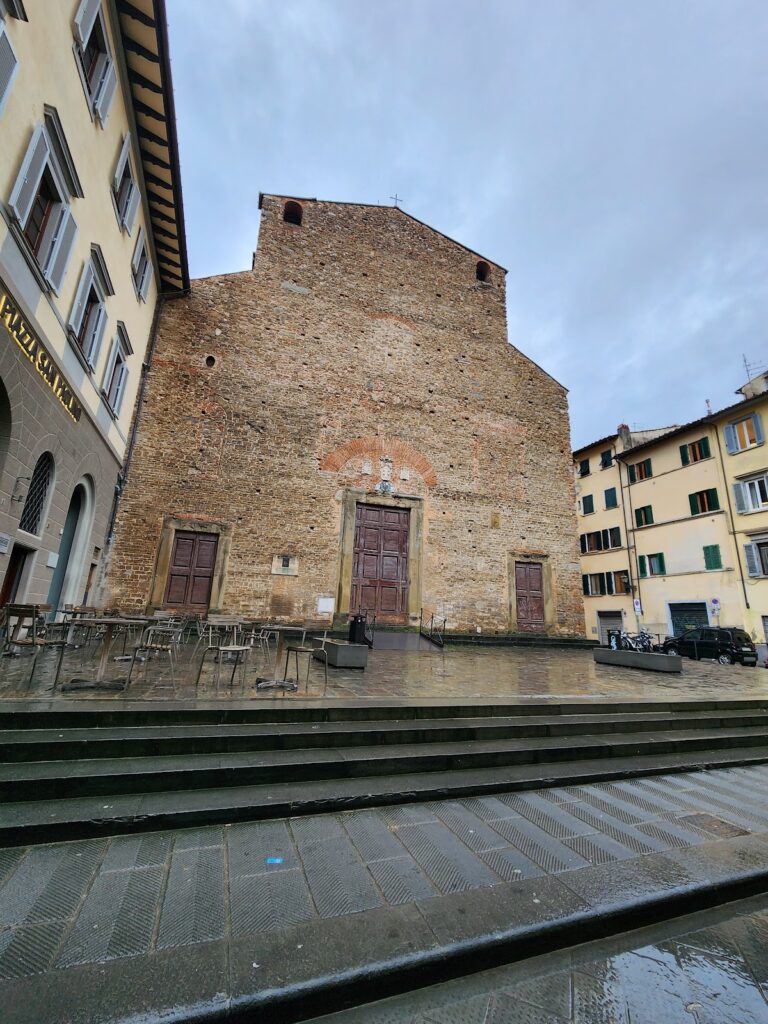
The surviving façade presents a medieval lower section faced with white marble and green Prato serpentine, together with Alberti’s Renaissance completion above. The lower part, dating from around 1350, contains six funerary arches, two Gothic side portals, geometric marble inlay, and blind round arches. Its large upper oculus has been open since 1367.
Alberti’s marble composition
Alberti’s upper design includes a classical central portal, four Corinthian columns, a broad inlaid frieze, a three-part composition, a pediment, and two large S-shaped scrolls. The scrolls conceal the difference in height between the central nave and the lower aisles. The marble decoration follows geometric proportions and modular relationships. The base equals the façade’s height, forming a square; the lower section corresponds to half of that square, while the upper section between the scrolls corresponds to a quarter. The central portal is one and a half times as high as it is wide.
Symbols, paintings, and instruments
The pediment contains a flaming solar disk with the face of the Christ Child. It is identified with the emblem of the Santa Maria Novella district and with the triumph of light over darkness. Its diameter is half that of the rose window and equal to the circles within the scrolls. The upper architrave carries an inscription commemorating Giovanni Rucellai, son of Paolo, and the symbolic completion date 1470. Rucellai’s heraldic device, showing sails with wind-filled rigging, appears on the marble frieze and corner piers.
Ulisse Ciocchi painted the lunettes above the portals between 1616 and 1618. The central lunette shows Thomas Aquinas praying before the Crucifix, together with Rucellai heraldry and the Corpus Christi procession. The side lunettes depict Aaron with the manna and Melchizedek with the loaves.
Two scientific instruments installed on the façade between 1572 and 1574 were made by the Dominican astronomer and grand-ducal cartographer Ignazio Danti. A bronze armillary sphere, a model of the celestial sphere used for astronomical measurement, stands on the left, while a marble astronomical quadrant with a gnomon stands on the right. A gnomon is a projecting element that casts a shadow to indicate the sun’s position and time. Danti also installed a circular aperture and a meridian line inside the church, although that work was not completed after the death of Cosimo I.
Funerary arches
The façade and adjoining cemetery contain avelli, arched funerary niches built into the church and cemetery enclosure. The third arch along the church’s right wall contains the burial of Domenico Ghirlandaio. Other arches once held paintings of saints, most of which have been lost.
Church plan and interior structure
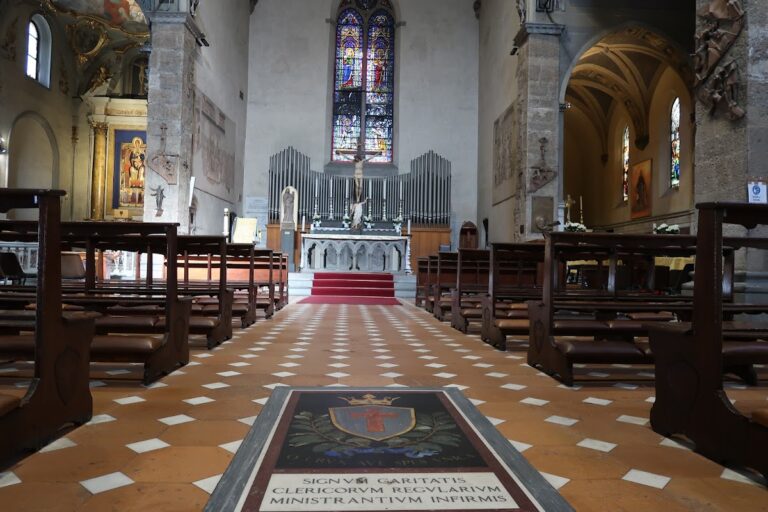
The church is approximately 99.20 metres long and 28.20 to 28.30 metres wide, while the transept reaches approximately 61.54 metres. Its plan is T-shaped, or like a Latin cross, with a flat-ended eastern termination, three aisles, six bays, and a short transept. The bays narrow toward the altar, from about 15 metres near the façade to 11.50 metres near the altar, producing an architectural impression of greater length.
Gothic framework
The interior uses Gothic Cistercian forms, including compound piers made from several attached shafts or profiles, pointed arches, and ribbed quadripartite vaults. The ribs and arches are painted black and white. The broad, high central nave and the progressively narrowing spacing of the aisle piers create a trompe-l’oeil effect in which the nave appears longer than its actual dimensions.
Later interior changes
Originally, a choir screen separated the clergy’s presbytery from the longitudinal nave. Vasari removed it during the remodeling of 1565 to 1571, when the lancet windows were shortened to make room for side altars. Numerous funerary slabs formerly covered the floor. Those that survived the nineteenth-century reorganization were selected and placed partly between the side piers. The main altar was rebuilt in a Neo-Gothic style, and the windows and side altars were rearranged.
Crucifix and stained glass
Giotto’s painted wooden Crucifix, dated around 1290, returned in 2001 to the rear of the central nave after twelve years of restoration. It hangs about 4.5 metres above the floor, slightly inclined forward, from a suspended metal structure connected to a winch that allows it to be lowered.
The stained glass dates mainly from the fourteenth and fifteenth centuries. Windows in the Strozzi Chapel depicting the Madonna and Child, Saint John, and Saint Philip were designed by Filippino Lippi. The façade rose window shows the Coronation of the Virgin surrounded by dancing angels and prophets. The design is based on a cartoon attributed to Andrea di Bonaiuto and dated 1365 to 1367, and includes the donor Tebaldino de’ Ricci.
Works behind the façade
The rear of the façade contains a detached Nativity fresco from the circle of Sandro Botticelli, an Annunciation on canvas by Santi di Tito, and a fourteenth-century fresco by an unknown artist combining the Annunciation, Nativity, Adoration of the Magi, and Baptism of Christ.
Paintings, chapels, and liturgical furnishings
Central nave and pulpit
Masaccio’s Holy Trinity, dated around 1427 to 1428, occupies the left aisle. Its monumental illusionistic architecture uses linear perspective and a realistic low viewpoint. The kneeling patrons are members of the Lenzi family, and the inscription on the sarcophagus is a memento mori, a reminder of death. A recent restoration indicated possible collaboration by Filippo Brunelleschi in the perspective design.
The Rucellai pulpit on the penultimate pier of the left aisle was commissioned in 1443 and designed by Filippo Brunelleschi. Its four relief panels, made by Brunelleschi’s adopted son and pupil Andrea Cavalcanti, depict episodes from the life of the Virgin. The panels were gilded in the eighteenth century.
Tornabuoni Chapel
The Tornabuoni Chapel, also called the Cappella Maggiore, stands behind the main altar. Domenico Ghirlandaio painted its major fresco cycle for Giovanni Tornabuoni between 1485 and 1490. The scenes depict the lives of the Virgin and Saint John the Baptist and include contemporary Florentine settings and portraits of patrons and citizens. Alessandro Agolanti made the polychrome windows in 1492 from Ghirlandaio’s designs, while Giambologna made the bronze Crucifix on the main altar.
Filippo Strozzi and Bardi chapels
The Filippo Strozzi Chapel contains Filippino Lippi’s fresco cycle, completed before 1502, with scenes from the lives of the Apostle Philip and Saint John the Evangelist. Benedetto da Maiano made Filippo Strozzi’s tomb between 1491 and 1495.
The Bardi Chapel, dedicated to Saint Gregory, passed to the Bardi di Vernio family in 1335. Its frescoes are attributed variously to Dalmasio Scannabecchi, the so-called Pseudo-Dalmasio, or another Bolognese painter. Giorgio Vasari’s Madonna of the Rosary dates from 1568.
Rucellai and Gondi chapels
The raised Rucellai Chapel contains Nino Pisano’s marble Madonna and Child, damaged fresco fragments attributed to the Master of Saint Cecilia, and Giuliano Bugiardini’s Martyrdom of Saint Catherine of Alexandria. The former Rucellai Madonna is now in the Uffizi.
The Gondi Chapel contains Filippo Brunelleschi’s painted wooden Crucifix. Its vaults preserve some of the church’s oldest frescoes, attributed to fourteenth-century Greek-Byzantine craftsmen. The present stained glass dates from the twentieth century.
Strozzi Chapel of Mantua
The Strozzi Chapel of Mantua contains frescoes by Nardo di Cione dating from 1350 to 1357. Their arrangement follows Dante’s Divine Comedy. Andrea Orcagna’s Redeemer with the Madonna and Saints stands on the main altar.
Sacristy and Della Pura Chapel
The sacristy was built around 1380 as the Chapel of the Annunciation in memory of Mainardo Cavalcanti. It was extensively remodeled between the sixteenth and eighteenth centuries and contains works by Giovanni della Robbia, Gioacchino Fortini, Bernardo Buontalenti, and Maso di Bartolomeo.
The Della Pura Chapel was reconstructed by the Ricasoli in 1474 to house a fourteenth-century image regarded as miraculous. Its present appearance is Neo-Classical, following nineteenth-century work by Gaetano Baccani.
Campanile and convent complex
Campanile
Jacopo Talenti built the campanile in 1332 and 1333 over foundations dating from the mid-thirteenth century. More than 68 metres high, it combines Romanesque features with a steep Gothic spire. Five bells were cast in 1764 by Alessandro Tognozzi Moreni, except for the smallest, which was made by Rafanelli.
Cloisters and former convent buildings
The Green Cloister, Spanish Chapel, former refectory, Cloister of the Dead, Grand Cloister, and Papal Chapel preserve extensive medieval and Renaissance architecture, frescoes, sculpture, liturgical objects, and manuscripts. Artists represented across the complex include Paolo Uccello, Andrea di Bonaiuto, Bernardo Daddi, Nardo di Cione, Filippino Lippi, Domenico Ghirlandaio, Pontormo, Ridolfo del Ghirlandaio, Alessandro Allori, Santi di Tito, Bernardino Poccetti, and Ludovico Cigoli.
Several works formerly associated with Santa Maria Novella are now elsewhere. They include Duccio’s Rucellai Madonna, Agnolo Gaddi’s Madonna Enthroned with Child and Saints, Giovanni del Biondo’s Annunciation and Saints, Botticelli’s Adoration of the Magi, and Ghirlandaio’s dispersed Tornabuoni Altarpiece.