Orahovica Monastery: A Serbian Orthodox Monastery in Croatia


Site at a Glance
- Rating
- 5
- Popularity
- Very Low
- Country
- Croatia
- Primary era
- Early Modern
- Eras represented
- Early Modern
- Civilizations
- Habsburg, Ottoman
- Site type
- Religious
- Remains
- Monastery
On this page8 sections
History
Orahovica Monastery is a Serbian Orthodox monastery in Croatia, belonging to the Slavonian Diocese of the Serbian Orthodox Church. Its foundation is traditionally attributed to the Serbian nobleman Despot Vuk Branković in the fifteenth century, while its earliest documentary evidence dates from 1579 or 1583. The monastery church, built in the sixteenth century in the Morava School tradition, became the center of a major religious and cultural institution in Slavonia.
Early records and Ottoman rule
The monastery appeared in the 1579 Ottoman census of the Požega Sanjak, an administrative district of the Ottoman Empire, under the name Remeta. That name was associated with a settlement of hermit monks. The institution was also linked to the nearby village of Duzluk, while the name Orahovica eventually became predominant. The monastery’s name was also connected with the nearby mountain summit Orahovica, now called Sokolovina.
During the sixteenth and seventeenth centuries, when the area was under Ottoman rule, Orahovica served as the seat of the Požega Diocese. A diocese is an ecclesiastical territory governed by a bishop. The diocese covered the Požega and Pakrac areas after the Serbian Patriarchate was restored in 1557, and it formed part of that higher ecclesiastical jurisdiction.
Orahovica was a center of worship, manuscript copying, and bookbinding. Its original monastic biography was completed in 1594, and manuscripts continued to be copied there for many years. The calligrapher Matek produced a copy of the Parenesis of Saint Ephrem the Syrian, an exhortatory religious text by the fourth-century Syriac Christian theologian and hymnographer Saint Ephrem. In the eighteenth century, the monastery housed 50 hieromonks, or monks ordained as priests, and 12 deacons, and it also provided education for young theologians.
Destruction and restoration after Ottoman withdrawal
As Ottoman control withdrew from Slavonia in 1687, the monastery was burned and the surrounding Serbian settlements were devastated. Twenty-eight nearby villages were completely destroyed, while 23 surviving villages contained only 280 families. The monks were killed or taken into slavery. Two survivors, Isaiah and Orest, later returned and began rebuilding the monastery, assisted by monks from the Liplje and Stuplje monasteries in Bosnia.
Normal monastic life resumed in 1705 with the arrival of Bishop Sofronije Podgoričanin. From 1688, efforts had been made to spread Uniatism, meaning attempts to bring Orthodox Christians into communion with the Roman Catholic Church while retaining elements of Eastern religious practice. Bishop Longin Rajić and his brother Jov Rajić were associated with these efforts, but Patriarch Arsenije III Crnojević intervened, and local Serbian resistance prevented the monastery and its surrounding population from being brought into the union.
Patriarch Arsenije III visited Orahovica in 1693 during this period of pressure on its Orthodox identity. Holy Roman Emperor Charles VI recognized the monastery’s legal rights by charter in 1726. Patriarch Arsenije IV assigned it revenues from designated villages on 31 March 1742, and Metropolitan Nenadović confirmed related village revenues in a document of 1758. These measures supported the monastery as political and religious authorities sought to promote the conversion of the local Orthodox population, sometimes by elevating Serbian leaders to counts and granting them large estates.
The church was renewed in 1650, and the monastery underwent further renovation in 1757 and 1758. A new residence building was erected on the southern side between 1775 and 1777. An earthquake damaged the complex in 1804, and repairs were not completed until 1835 under the administration of Aleksandar Ličinić. The monastery received comprehensive restoration in 1938.
War, persecution, and the loss of monastic residence
During the interwar period, some visitors secretly scraped pigment from the eyes of saints in the frescoes because they believed the pigment cured trachoma. This practice caused substantial damage to the painted images.
In the First World War, Austro-Hungarian authorities converted the monastery into a prison for Serbian priests. During the Second World War, the brotherhood left because of danger and persecution. The monastery became a detention camp where Serbs from nearby villages were confined and abused, while Ustasha and Home Guard forces used the complex as a stronghold and successively occupied its residential buildings.
Before leaving in 1941, the superior Teofan Dragutinović hid the most valuable items from the monastery library. Museum specialists from Zagreb found and removed them during that summer. They remained in Zagreb until 1983, when they were returned to the Slavonian bishopric. Partisans burned the monastery in 1943.
The complex was left in very poor condition after the war. Reconstruction began in 1952, and the superior Milutin Amidžić revived monastic life during the difficult postwar period without state assistance. The monastery was damaged again during the wars accompanying the breakup of Yugoslavia, and its last two monks departed in 1991. It has remained without a resident monastic community, although renewal work continues. The complex is entered in the Croatian Register of Cultural Goods as the Complex of the Monastery with the Church of Saint Nicholas, under registration number Z-370.
Orahovica continues to host major annual gatherings on the Feast of the Translation of the Relics of Saint Nicholas on 22 May and the Feast of the Transfiguration on 19 August. Relics of Saint Anastasia are preserved at the monastery.
Remains
Church of Saint Nicholas
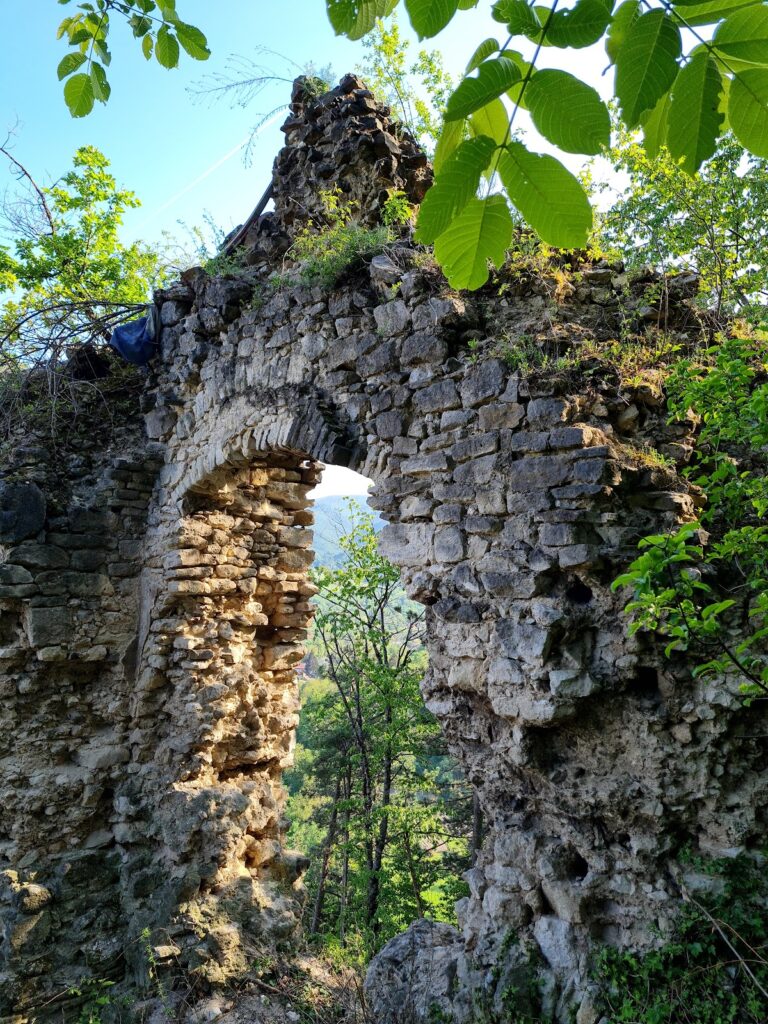
The monastery stands south of Orahovica near Duzluk, on the northern slopes and foothills of the Papuk and Krndija mountain ranges. The nearby ruins of the old town of Ružica form part of the setting associated with the monastery. The church of Saint Nicholas dates from the sixteenth century, with construction placed around 1592 to 1594. A new church was built and painted in 1594, and the building was subsequently enlarged and restored.
The church has a three-lobed, cross-ended plan and is described as the only example of Morava School architecture in Slavonia. The Morava School was a late medieval Serbian architectural and artistic tradition known for distinctive church plans and decoration. Archaeological test excavations indicate the possible existence of an earlier sacred building on the site, while tradition holds that the present church replaced an older wooden church.
Part of the church’s wall painting survives. Its columns carry a painted genealogy of the Nemanjić family, the medieval Serbian ruling dynasty that established and supported major Serbian political and Orthodox religious institutions. The frescoes and icons were damaged when pigment was removed during the interwar period. A new iconostasis, the screen separating the sanctuary from the main worship space in an Eastern Orthodox church, was installed in 1607. Further renewal of the church took place in 1650 and in 1757 and 1758.
Monastic courtyard and buildings
Several buildings are arranged around the church. Residential wings extend along the northern and southern sides of the courtyard, while a refectory wing closes it on the western side. A tower-belfry rises in the northeastern part of the courtyard and was built in 1735. The southern residential building, or konak, a lodging building within a monastic complex, was constructed between 1775 and 1777.
The residential buildings were burned during the Second World War. The complex was subsequently restored and reconstructed, following the earlier cycles of renewal that had shaped the monastery after the Ottoman period and after the earthquake of 1804.
Library, treasury, and relics
The monastery’s library and treasury contained valuable religious and historical objects. A large gold cross donated by Patriarch Arsenije III Crnojević was recorded in the treasury in 1938. The treasury also preserved a mitre belonging to Bishop Vasilije Rajić, who died in 1714. Relics of Saint Anastasia remain kept at the monastery.