Saints Isidoroi Church: A Medieval Orthodox Chapel in Athens


Site at a Glance
- Rating
- 4.8
- Popularity
- Medium
- Country
- Greece
- Primary era
- Modern
- External website
- Open
- Eras represented
- Early Modern, Modern
- Civilizations
- Greek, Ottoman
- Site type
- Religious
- Remains
- Church
On this page11 sections
History
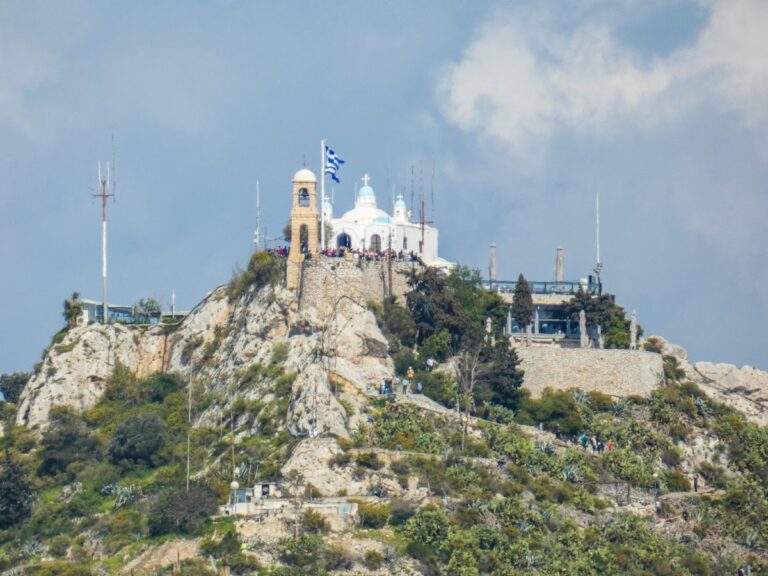
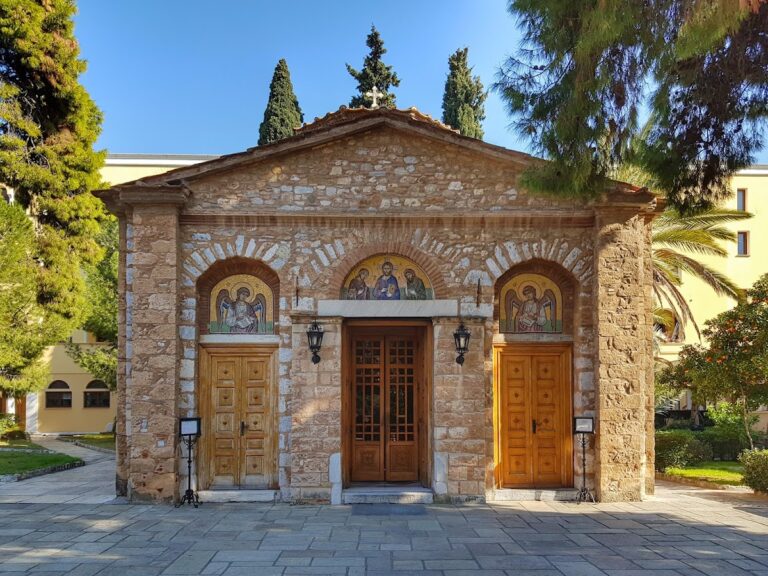
Saints Isidoroi church is a medieval Christian church in Greece, situated on the southwestern slope of Mount Lycabettus in Athens. Its setting is associated with Christian activity from late antiquity, while the present church was founded in the sixteenth century and later developed as an Orthodox place of worship and pilgrimage.
Early Christian and ascetic traditions
The cave beneath the site is traditionally linked with Saint Aristides of Athens, an early Christian apologist and martyr who is said to have lived there and prayed during the second century. The site is also associated with Saints Basil the Great and Gregory the Theologian, fourth-century bishops and theologians who studied at the philosophical school of Athens. According to tradition, the cave was then the only structure at the location, and the two men built a temporary hut for lodging and study.
Earlier Christian activity is also connected with a space arranged as a church dedicated to Holy Zion, a Christian designation associated with Zion in Jerusalem. Christian burials reportedly took place around it until the end of the fourth century. They included a newly baptized child, several women, and a bishop named Clematius.
A steep cavity below the church is traditionally identified as the refuge of an ascetic during the Ottoman period, the centuries when Greece was under Ottoman rule. Local tradition relates that bones found there belonged to an ascetic who had an icon of Saints Isidoroi with him. This discovery is said to have led to the construction of a church dedicated to the two saints.
The church from the sixteenth century
A church was founded at the site in the sixteenth century. In the following century it served as a hermitage, a small religious retreat for ascetics. Two elderly holy men reportedly lived there, one said to have been a carpenter and the other an icon painter. Many people were said to have seen them, heard them identify themselves, and associated them with numerous miracles.
The cave continued to attract religious associations. Saint Gerasimos of Kefalonia is linked with the site in 1579, and Saint Philothei in 1589. Later traditions connect it with Saint Nectarios, who died in 1920, Saint Nicholas Planas, who died in 1932, Saint Philotheos Zervakos, who died in 1980, and Saint Porphyrios the Kapsokalyvite, who died in 1991.
After Athens became the capital of Greece in 1834, the city had relatively few churches, and Athenians came to Saints Isidoroi for worship. On Sunday, 7 June 1859, university students and other young Athenians held a prayer service there for the success of the Franco-Sardinian campaign. The gathering took place despite the neutrality adopted by the Miaoulis government and the prohibition of the event. The government was associated with Andreas Miaoulis, a Greek naval commander and political leader.
Fire, rebuilding, and later development
The church burned down in 1930 because of negligence by its sacristan. It was rebuilt from its foundations in 1931, larger than before. Local residents contributed to the rebuilding, and the engineer K. Kottakis also paid expenses connected with the work.
From 1937, local support brought a period of renewed development. The iconostasis, a screen separating the sanctuary from the nave in an Eastern Christian church, was installed along with the lectern, bishop’s throne, and other interior furnishings. An annual procession of the sacred icon of Saints Isidoroi was also established.
During the German-Italian occupation, the church was closed and Italian forces looted sacred objects. The losses included Gospels, censers, icons, chalices, and chandeliers, as well as the silver covering from the icon of Saints Isidoroi. Regular worship resumed after liberation.
Conservation began in March 2001 after rainwater penetrated the building and caused deterioration. Work improved the surrounding area, added trees and plants, repaired the enclosure, and connected the church to a water supply. The site subsequently developed from an archdiocesan chapel into a place functioning like other parishes, with feast-day services, vigils, gatherings, and other religious activities in addition to Sunday worship.
The church and its chapels are dedicated to Saint Isidore of Pelusium, a fifth-century Christian monk and writer, Saint Isidore of Chios, a Christian martyr, Saint Myrope, an early Christian martyr associated with Chios, and Saint Gerasimos of Kefalonia, a sixteenth-century Orthodox monastic saint. An inscription states that the church was dedicated to the two Isidores because an icon of them was found on the body of a deceased hieromonk, a monk who was also an ordained priest.
Its annual religious calendar includes the feasts of the two Isidores, the Exaltation of the Cross, the Sunday of the Veneration of the Cross, Saint Jude Thaddeus on 19 June, and Saint Aristides of Athens on 13 September. Large numbers of worshippers attend the Holy Unction service on Holy Wednesday and receive oil. Administratively, the church remains an archdiocesan chapel of the Archdiocese of Athens.
Remains
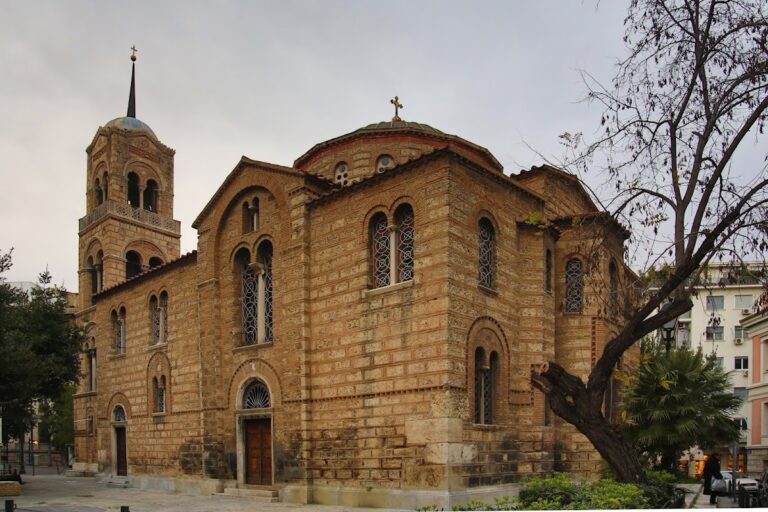
Saints Isidoroi is a small, single-aisled basilica built directly against a cut rock face inside a large cave. A single-aisled basilica has one principal lengthwise interior space rather than several parallel aisles. The church has a wooden roof and measures approximately 5.2 by 12.1 metres. The cave forms part of the physical setting, while a lower cavity in the steep ground below is associated with the reported refuge of an ascetic.
Main church and cave
The interior includes furnishings installed during the church’s renewed development after 1937, notably the iconostasis, lectern, bishop’s throne, and other decorative elements. In the eastern part, the exposed rock of Mount Lycabettus forms a visible part of the interior setting. A large icon of the Virgin of Prayers, also called the Virgin of the Rock or Isidoritis, is installed there and surrounded by many votive offerings.
Chapel of the Holy Cross
The Chapel of the Holy Cross stands on the southern side of the church and is entered from inside the main building. It is dedicated to Golgotha and the Holy Cross and was established there after numerous visions. Its southeastern side is formed by the rock of Mount Lycabettus, while a large cross occupies the western side.
Icons and devotional images
The chapel contains an icon of the Virgin of the Passion, also called the Immaculate Virgin, with a crown of thorns above its frame. It also holds an icon of the Bridegroom and the icon called “O Sweet Springtime,” which depicts the Virgin mourning Christ after his removal from the Cross.
Golgotha sanctuary
The chapel’s sanctuary is designed as a miniature representation of Golgotha, the hill associated with Christ’s crucifixion. Its Holy Table, the altar table of the sanctuary, consists of two stone slabs. Fragments said to be relics of Saint John the Baptist and Saint John Chrysostom are placed between them.
Because of the restricted space, the prothesis, where Eucharistic offerings are prepared, lies beneath the Holy Table. Beneath it is the Holy Hollow, which reportedly contains a piece of the rock of Golgotha with a section of the True Wood placed upon it. In Orthodox tradition, the True Wood is wood believed to derive from the Cross of Christ. The hollow is said to exude myrrh, a fragrant substance used in Orthodox religious practice and associated with miraculous relics or icons.
Cross and stations
At the rear of the chapel, the skull of an ascetic found at the site is arranged in the form of the skull of Adam. On the western side, the large cross is accompanied by stations representing Christ’s route from the Praetorium to Golgotha.
A case at the base of the cross contains three stones. They are traditionally identified as one from the place associated with the Lord’s Prayer, one from Golgotha, and one from the Holy Sepulchre, the tomb associated with Christ’s burial and resurrection. People who attribute healing to the site leave crutches, walking sticks, and shoes beside the chapel as commemorations.
Crosses and relics
A wooden cross is preserved in a cross-shaped case. It is not identified as the True Wood. Scientific examination reportedly found that it consists of three inseparably joined types of wood: pine, cypress, and cedar. The cross is venerated as an Orthodox pilgrimage object.
A reliquary contains part of the relic of Saint Demetrius the Myrrh-streaming, an early Christian martyr venerated in the Orthodox tradition. An icon of Saint Nectarios stands on a pier separating the northern aisle from the main aisle, and a small portion of his relic is kept at its lower part.
Nearby sites