Holy Forty Martyrs Church: A Royal Bulgarian Orthodox Church in Veliko Tarnovo


Site at a Glance
- Rating
- 4.7
- Popularity
- Low
- Country
- Bulgaria
- Primary era
- Medieval
- External website
- Open
- Eras represented
- Medieval, Modern
- Civilizations
- First Bulgarian Empire, Ottoman, Second Bulgarian Empire
- Site type
- Religious
- Remains
- Church
On this page12 sections
History
Holy Forty Martyrs Church is a Bulgarian Eastern Orthodox church in Veliko Tarnovo, Bulgaria, built under the Second Bulgarian Empire, the medieval Bulgarian state that existed from 1185 to 1396. Construction began in 1230 on the order of Tsar Ivan Asen II, during a period of territorial expansion and royal patronage. The church was founded and painted in honour of his victory at Klokotnitsa over Theodore Komnenos, ruler of the Byzantine-ruled Despotate of Epirus, on 9 March 1230, the feast of the Forty Martyrs of Sebaste.
Royal foundation and medieval monastery
The church stood at the foot of Tsarevets, within the fortified medieval city between Tsarevets and Trapezitsa and near the left bank of the Yantra River. It formed the principal church of the Great Lavra, a major royal monastery closely connected with the Bulgarian rulers and court. A smaller chapel dedicated to the Mother of God probably occupied the site before Ivan Asen II ordered the new building.
During the thirteenth and fourteenth centuries, the church served the monastery and the royal community of Tarnovo, then the political and cultural centre of the Bulgarian state. The monastery complex developed through several building phases beginning in the eleventh century, and part of its cemetery existed before Ivan Asen II’s foundation. The church was restored during the first half of the fourteenth century and later enlarged with western structures and galleries.
Conquest, conversion, and return to Orthodox use
After the Ottoman conquest of Tarnovo in 1393, the former royal church was converted into a mosque. It probably continued to serve its Christian community until the first half of the eighteenth century, but the conversion led to the destruction of its murals, icons, and iconostasis, the screen separating the sanctuary from the main body of an Orthodox church. The building was altered again in 1853.
After Bulgaria’s liberation in 1878, the building returned to Orthodox use. Its later history also includes two national events. On 18 May 1888, Prime Minister Stefan Stambolov married Polikseni Kostaki Stanchova there. On 22 September 1908, Prince Ferdinand I proclaimed Bulgaria’s independence in the church.
Excavation, royal burials, and reconstruction
Interest in the building began while it was still functioning as a mosque. In the 1850s, Petar Beron and Christo Daskalov attempted to investigate it, and Georgi Sava Rakowski visited the church and copied the inscription on Asen’s Column. Excavations took place in 1906 and 1914 after the building suffered severe damage in the 1913 earthquake. Systematic research began in 1969, followed by work from 1992 to 2007 that cleared, studied, and strengthened the church and its surrounding complex.
In October 1972, excavators uncovered a royal burial belonging to a richly equipped man about 1.9 metres tall. The identification with Tsar Kaloyan was connected with a 61.1-gram gold signet ring bearing a heraldic leopard and the inscription “Kaloyan’s ring.” A seal found in 1981 with the same emblem supported the interpretation of the leopard as an insignia of the Asen dynasty. Kaloyan’s remains were ceremonially reburied in the church on 19 April 2007.
The church contains burials associated with the Bulgarian royal family, rulers, aristocracy, and Saint Sava of Serbia. Named burials include Kaloyan, Ivan Asen II, Anna Maria of Hungary, Irene Komnene, Anna or Anisia, Irene Doukaina Laskarina, and Saint Sava. Sava, a Serbian Orthodox archbishop and major Serbian saint, died during a visit to Tarnovo on 14 January 1235 or 1236. He was initially buried in the church, and his relics were transferred to Serbia on 6 May 1237. Symbolic graves commemorate Khan Kubrat, Khan Asparuh, Tsar Ivaylo, Tsar George I Terter, and Tsar Michael III Shishman Asen.
Holy Forty Martyrs Church was declared a national antiquity in 1927. It received recognition as an architectural and construction monument of culture of national importance in 1964 and as an artistic monument of culture of national importance in 1979. Extensive reconstruction during the 2000s restored the building and brought its appearance closer to its medieval form. Its dedication recalls the Forty Martyrs of Sebaste, Christian soldiers traditionally believed to have been martyred during the Roman imperial period, whose feast is celebrated in the Orthodox Church on 9 March.
Remains
Church plan and monastery setting
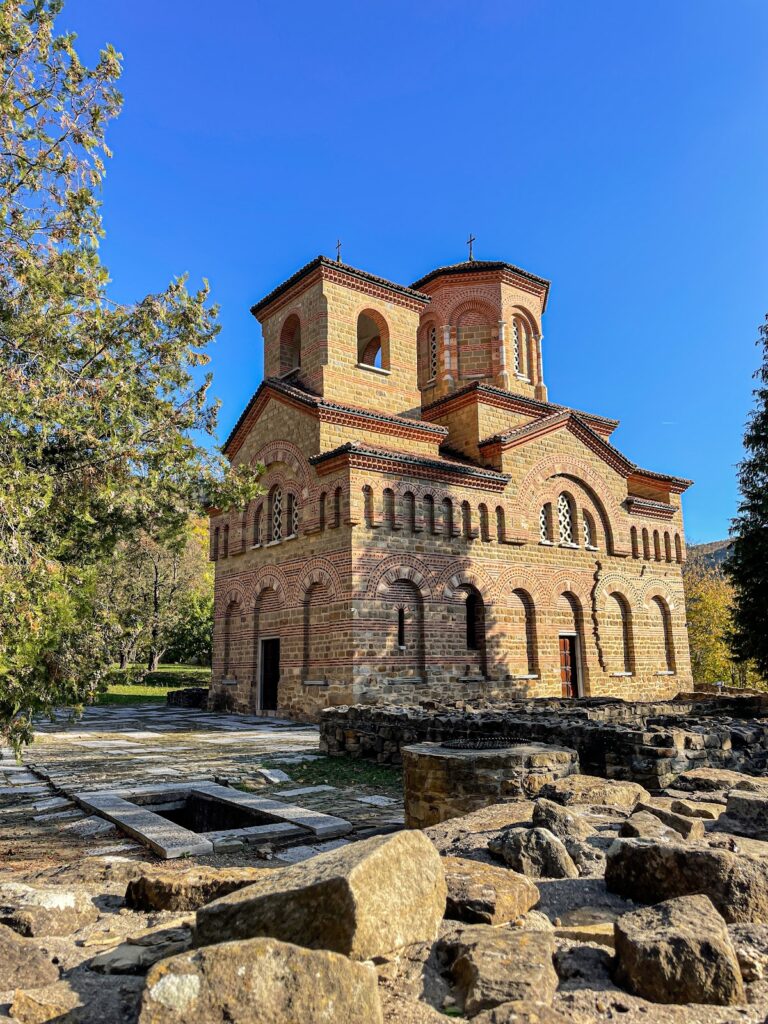
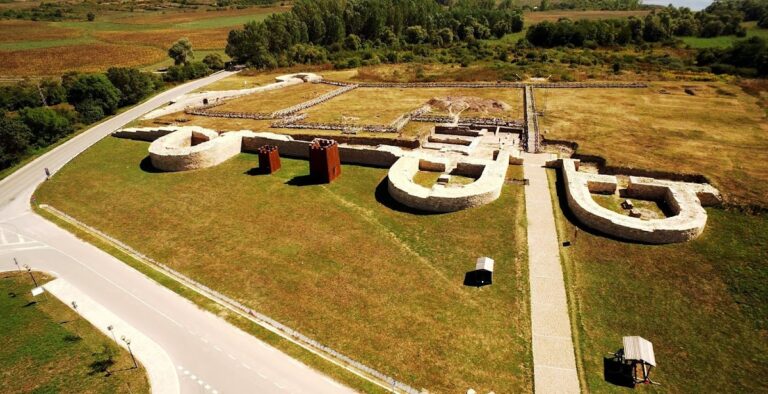
The original church was an elongated, three-aisled basilica, a longitudinal church plan, measuring approximately 14.65 by 11.7 metres. Six columns stood in two rows, and the eastern end had three semicircular apses, or rounded sanctuary ends. A narrow narthex, an entrance hall, occupied the west. The church was associated with Byzantine architecture and the Tarnovo Artistic School, and its surviving fabric permits the reconstruction of this original architectural concept.
A route through the fortress wall once connected the church’s area with the royal palace. Later building campaigns changed the first design through the addition of western structures, an exonarthex, meaning an outer entrance space, and galleries along the northern and southern sides. The western addition has been described as an ossuary and mausoleum. Part of its exterior decoration survives in the form of traditional arches and small coloured ceramic plates set into the masonry.
Murals and painted decoration
Surviving mural painting is concentrated mainly in the northern half of the west side of the narthex. Scenes of Saint Elizabeth the Nursing with the infant John and Saint Anne the Nursing appear above two entrances, one leading into the church and the other from the narthex into the main building. These paintings probably date from the second half of the thirteenth century, while the interior was probably painted around 1230.
The western wall also carried a pictorial calendar, of which four registers for May, August, and November survive. These fragments provide part of the remaining painted programme associated with the medieval church and its western entrance space.
Historic inscribed columns
Asen’s Column
Asen’s Column is a marble victory column bearing a thirteen-line inscription in Old Bulgarian. The text records Ivan Asen II’s foundation and complete decoration of the church in 1230. It attributes his victory to the Forty Martyrs, describes the defeat and capture of Theodore Komnenos, and recounts the expansion of Ivan Asen II’s rule.
Omurtag’s Column
Omurtag’s Column carries an inscription in Ancient Greek concerning the construction of a glorious residence on the Danube and a mound measured between two royal residences. It calls on later generations to remember its builder. The inscription is generally dated before 822, although the original location and the identity of the Danubian residence remain uncertain.
Rodosto boundary column
A boundary column brought from the fortress of Rodosto on the Sea of Marmara was incorporated into the church upside down, with its inscription at the lower end. The surviving text reads “Fortress of Rodosto.” Its presence, together with the other inscribed columns, assembled references to the political traditions of the First and Second Bulgarian Empires. Omurtag and Krum were early medieval Bulgarian khans associated with the inscriptions and their historical setting.
Burials and archaeological remains
The royal burial uncovered in 1972 contained rich warrior equipment decorated with complex embroidery, gold thread, and pearls. The large gold signet ring with the heraldic leopard and the inscription “Kaloyan’s ring” formed the principal object associated with the burial. Numerous Latin imitations were also recovered in connection with the investigation of the burial and the monastery.
The church and its associated monastery preserve archaeological remains of a complex fortification system and a necropolis. Together with the royal and aristocratic burials, these remains reflect the church’s place within the fortified royal centre of medieval Tarnovo.
Nearby sites