Neamț Monastery: A Medieval Orthodox Monastic and Cultural Center in Romania


Site at a Glance
- Rating
- 4.7
- Popularity
- Medium
- Country
- Romania
- Primary era
- Medieval
- External website
- Open
- Eras represented
- Medieval, Modern
- Civilizations
- Principality of Moldavia
- Site type
- Religious
- Remains
- Monastery
On this page16 sections
History
Neamț Monastery is an active Romanian Orthodox monastery near Târgu Neamț in Romania, developed by Moldavian rulers and Orthodox monks during the medieval period. Its principal church was completed in 1497, and the monastery became one of Moldavia’s oldest and largest religious, cultural, and educational centers. Known also as Neamț Lavra, a lavra is a major Orthodox monastic establishment associated with an influential community of monks. The monastery is affiliated with the Iași Archdiocese.
Early foundation and Moldavian patronage
Monastic activity at Neamț is attributed by one tradition to the twelfth century. The foundation itself has been dated variously to 1367, to the fourteenth or fifteenth century, or to no later than 1407. One foundation tradition names three disciples of Nicodemus of Tismana, Sophronius, Pimen, and Silouan. Nicodemus was a Serbian-educated Orthodox monk and founder active in medieval Wallachia. Another tradition attributes the monastery’s foundation to Voivode Peter I Mușat, a medieval ruler of Moldavia.
Peter I Mușat is credited with building the monastery’s first stone church during the fourteenth century. An earlier wooden building, traditionally called the White Church, was believed to have been built by monks about a century before the present church. During the reign of Alexander I the Good, this wooden church was replaced by a stone church, and a bell tower was built. Alexander also strengthened the monastery’s resources. On 31 August 1429, he donated Lake Zagorna on the Dniester and an apiary. On 23 December 1430, he added three mills below the lake and estates at Chițcani, Copanca, and Zagorna.
Stephen III the Great confirmed the monastery’s lands in 1500, while Petru IV Rareș confirmed them in 1527. Stephen had already built the monastery’s principal church in 1497, dedicating it to the Ascension of the Lord. Its construction was associated with his victory over John I Albert of Poland. Stephen also gave valuable objects to the monastery, and the church later served as an architectural model for many Moldavian churches.
Manuscripts, schools, and the medieval library
During the fifteenth century, Neamț became a major center of manuscript production. Gavril Uric, Theodor Mărișescu, and other scribes and calligraphers worked there, and the monastery developed schools for scribes and deacons. Monks trained at Neamț frequently went on to become Moldavian bishops and metropolitans, extending the monastery’s religious influence beyond its own community.
The medieval library brought together manuscripts made locally and imported from elsewhere. Its holdings included Romanian, Church Slavonic, and Greek works. Gavril Uric’s first known manuscript, dated 1429, is now preserved in the Bodleian Library at Oxford, while other manuscripts produced at Neamț are held by the Romanian Academy, the National Archives of the Republic of Moldova, and other institutional collections. By 1859, the library contained 1,671 manuscripts in several languages.
Paisius Velichkovsky and monastic renewal
In the early eighteenth century, the incorporation of southern Moldavia into the Ottoman Empire deprived Neamț of revenues and weakened its connections with the surrounding population. In 1790, the monastery was placed under joint administration with Secu Monastery. A major spiritual renewal followed the arrival of Paisius Velichkovsky, who lived at Neamț from 1779. Paisius was an Orthodox monk and reformer whose teaching helped renew Eastern Orthodox monasticism.
Paisius gathered monks who wished to follow the traditions of early Orthodox monasticism. He established a spiritual school, introduced parallel services in Romanian and Church Slavonic, and compiled a communal monastic rule. His community included Moldavians, Russians, Ukrainians, Bulgarians, Serbs, Greeks, Romanians, Macedonians, and others. During his leadership, it numbered 1,100 monks from 23 nationalities.
Paisius and his disciples translated Greek ascetic writings into Church Slavonic, including the Philokalia, The Ladder of Divine Ascent, and the works of Isaac the Syrian. Pilgrims from Moldavia, Wallachia, and Slavic lands came to Neamț for the Ascension feast, and Paisius received them throughout the day and night. He died in 1794. In the late eighteenth and early nineteenth centuries, his disciple Gregory the Dascăl worked at the monastery. Gregory later became a metropolitan, translated spiritual works from Greek into Romanian, wrote a life of Paisius, and compiled a twelve-volume Lives of the Saints.
Printing, estates, and nineteenth-century change
A printing press began producing books at Neamț in 1806, and the publishing operation was established in 1808. Metropolitan Veniamin Costachi established a press there in 1807. The operation issued liturgical, ascetic, instructional, historical, secular, and spiritual works in Romanian, Russian, and Greek. After a short interruption in the 1920s, printing resumed in 1922.
When eastern Moldavia, or Bessarabia, became part of the Russian Empire in 1812, Russian authorities returned estates that had formerly belonged to the monasteries. Neamț recovered properties and villages in Bessarabia, improving its finances and renewing its links with local inhabitants. From 1856, Hieromonk Theophan administered the Bessarabian estates and sought to recover the properties of Chițcani and Copanca. He also worked to establish a new male monastery there for monks arriving from Moldavia.
During the Ottoman attack of 1821, the Neamț Icon of the Mother of God was discovered as a wonder-working icon. A church dedicated to Saint John of Suceava, a hospital, and later a skete were established at the place of its discovery. A skete is a smaller monastic settlement linked to a larger monastery.
In 1848, during the Hungarian campaign, General Alexander Lüders visited Neamț as commander-in-chief. Acting for Emperor Nicholas I, he brought ten pairs of priestly vestments, presented Archimandrite Neonil with the Order of Saint Anna, Second Class, and conveyed the emperor’s contribution toward constructing a hospital.
After Alexandru Ioan Cuza came to power in 1859, the secular government subordinated the Church and secularized monastic estates. A government commission supported by military personnel arrived at Neamț on 2 July 1859. It created an administrative committee of monks and took control of provisions, servants, the hospital, and the monastic school.
In October 1859, the government ordered services in Church Slavonic to cease. Archimandrite Gerasim refused, defending the order established by Paisius. Officials removed Slavonic service books from the cathedral and placed them in the monastery tower, while monks who protested were arrested. Gerasim was expelled and temporarily replaced by Hieromonk Isichius. The monks appealed to Metropolitan Sophronius of Moldavia and Suceava, who protested the commission’s actions. Gerasim and Sophronius were later imprisoned under military supervision, while Theophan appealed to Russian ecclesiastical authorities and the Patriarch of Constantinople. Hieromonk Timothy was then elected monastery superior.
Many monks left for Mount Athos and Bessarabia as a consequence of the persecution. In 1864, Archimandrite Andronic Popovici led 32 monks in founding Chițcani Monastery, also called the New Neamț Lavra. Neamț consequently became known as the Old Neamț Lavra.
Twentieth-century disruption and renewed activity
In 1934, Neamț and its two sketes had about 800 inhabitants. The complex included a theological seminary, the Metropolitanate of Moldavia’s printing press, and a large library. After the communist takeover in Romania following the Second World War, the monastic population fell from 500 in 1948 to 30 after the 1956 decree that forced monks under the age of 70 to work. The sketes were closed, and monks began returning only after the 1964 decree. During the communist period, Neamț’s press was the only church publishing house producing books and calendars for the Romanian Orthodox Church.
In 1948, 25 Romanian Greek-Catholic clergy, including the future bishops Ioan Cherteș and Tit Liviu Chinezu, were detained and imprisoned at Neamț. They were transferred in February 1949 to Căldărușani Monastery near Bucharest.
Since 2003, Neamț has operated a cultural and pilgrimage center. In 2007, 63 monks lived at the monastery and another 50 lived at its sketes. The monastery was associated with eight sketes in the surrounding mountains, forests, and villages, while a nearby seminary had 400 students, including 150 monks. The principal feast is the Ascension of the Lord, celebrated on the Thursday of the fortieth day after Easter. Other commemorations honor the Neamț Icon of the Mother of God, Paisius Velichkovsky, and Stephen the Great.
Neamț Monastery is a Romanian historic monument, with the designation dated 1 March 1991, and it has been placed on Romania’s tentative list for UNESCO World Heritage.
Remains
The monastic complex is organized around two churches, two small Orthodox chapels, a bell tower, a theological seminary, a museum of ecclesiastical art, a printing press, a large library, and a circular baptistery in front of the monastery. A hospital stands nearby beside the church of Saint John of Suceava. The wider monastic foundation includes eight associated sketes in nearby mountains, forests, and villages, together with properties such as the memorial house-museum of Metropolitan Vissarion Puiu and the museum dedicated to the writer Mihail Sadoveanu near Vovidenia Skete.
The principal church
Church of the Ascension
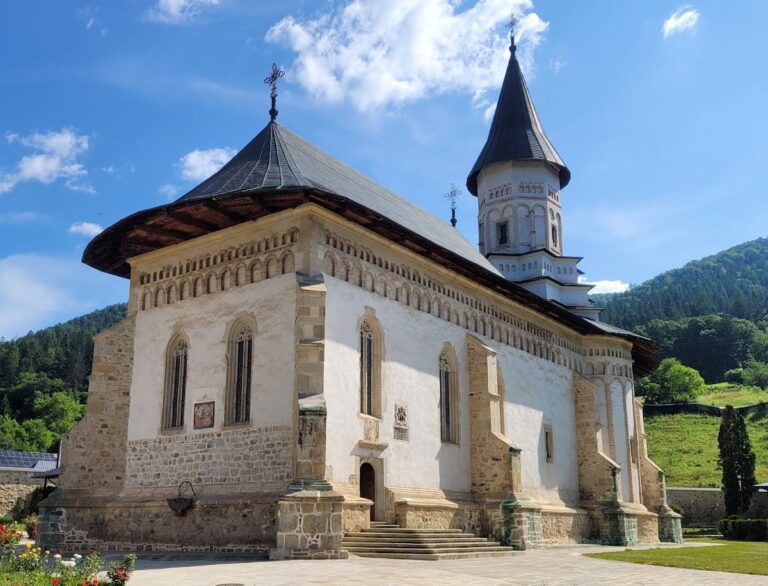
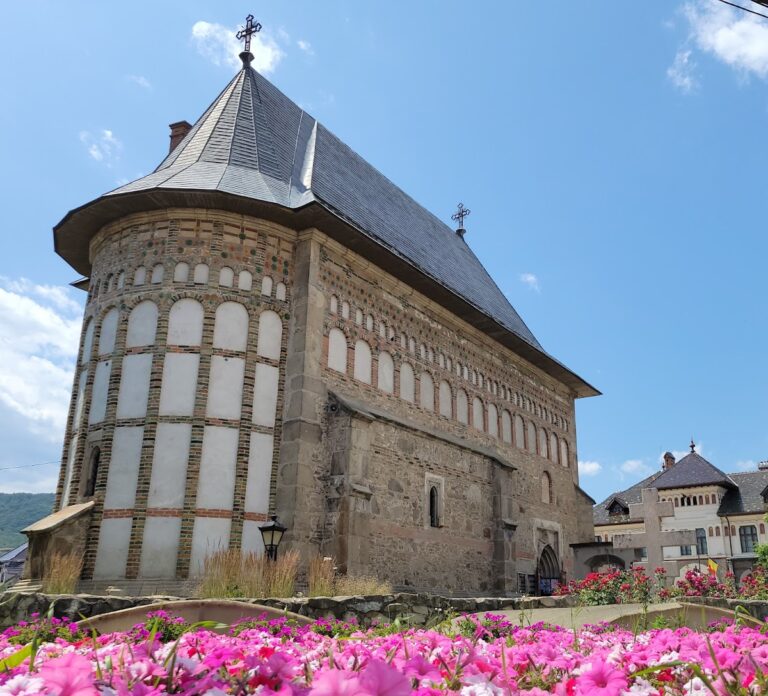
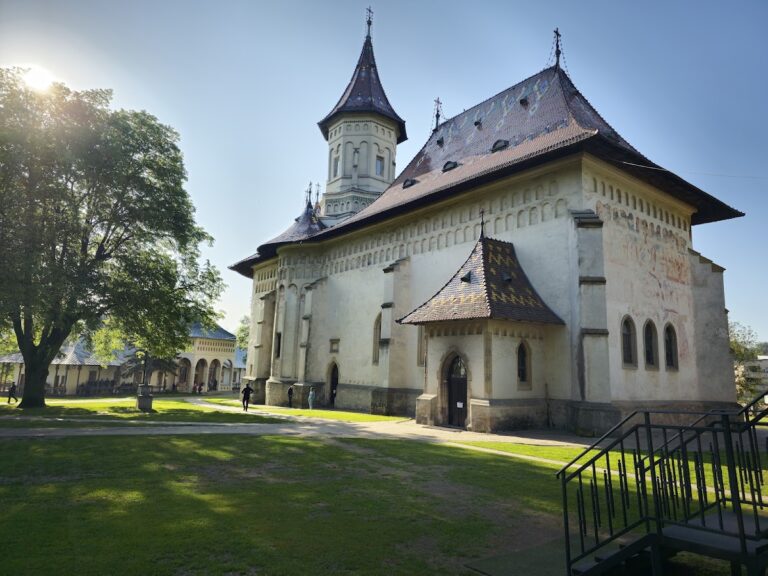
The principal church, built under Stephen III the Great and completed in 1497, is dedicated to the Ascension of the Lord. A porch stands before the entrance, and a tomb chamber lies between the entrance hall, or pronaos, and the nave. Stephen II, the son of Alexander I the Good and uncle of Stephen the Great, is buried in this funerary chamber.
The church has a rectangular pronaos covered by two spherical vaults. Its large rectangular nave has two side apses, rounded inside and pentagonal outside. Four oblique arches form their bases and rest on four large arches. A central spire rises above the building, while nine massive buttresses support the walls to the level of the vaults. The octagonal spire has four windows and is decorated with chamfered disks and niches.
Its facades combine Moldavian, Byzantine, and Gothic elements. Glazed ceramics, bricks, and colored disks in green, yellow, and brown provide the Byzantine features, while the buttresses and the frames around the doors and windows show Gothic influence. Paintings in the main apse, nave, and tomb area date from the final years of Stephen the Great’s reign. The porch and pronaos were painted during the period of Petru Rareș.
Other churches and sacred features
Church of Saint George
The second church in the complex is dedicated to Saint George and is incorporated into the enclosure wall. The monastery also preserves the altarpiece from the former fortress church of Neamț and Nicolae Grigorescu’s painting The Flight into Egypt.
Church of Saint John of Suceava
The church dedicated to Saint John of Suceava stands at the place where the Neamț Icon of the Mother of God was discovered during the events of 1821. The icon is kept in this church. The monastery’s sacred objects also include the Romanian Icon of the Savior, the head of Saint Simeon of the Wondrous Mountain, an icon of George the Victorious, and portions of the relics of Paisius Velichkovsky. An icon of the Virgin Mary painted in Palestine in 665 is preserved in one of the monastery churches.
Baptistery, bell tower, and burial features
The circular baptistery stands in front of the monastery, where water consecration takes place during the principal feast. The bell tower, built during the period of Alexander I the Good, survives from that phase of the complex. An entrance passage beneath the tower is decorated with frescoes.
In 1986, the remains of an unidentified saint were found in the pronaos when the pavement was removed. A charnel house in the crypt of the cemetery church is also among the monastery’s sacred features.
Library, printing heritage, and associated settlements
Books and manuscripts
The library contains more than 22,000 handwritten and printed books, chiefly dating from the seventeenth and eighteenth centuries. Its holdings include fourteenth-century manuscripts, sixteenth-century printed editions, and some of the earliest books printed in Romania. Illuminated and calligraphic works form part of the monastery’s manuscript and artistic heritage. Manuscripts created at Neamț are also preserved in museums and institutional collections beyond the monastery, including Gavril Uric’s first known manuscript in Oxford.
Sketes and related properties
The associated sketes include Brăniște, founded in 1582; Pokrovsky, founded in 1714; the Skete of the Old Icon of the Mother of God; Vovidenia, established between 1849 and 1857; and the Skete of the New Icon of the Mother of God, founded in 1941. Other associated sketes at Băiceni and Cărbuna were founded in 1998 and 2001. The monastery’s vineyards lie about 60 kilometers away and cover seven hectares.
Repeated destructive devastations and fires have affected the complex. Restoration work carried out afterward altered or destroyed portions of the original painted decoration, while the surviving churches, tower, chapels, collections, and associated settlements preserve the monastery’s long religious and cultural history.
Nearby sites