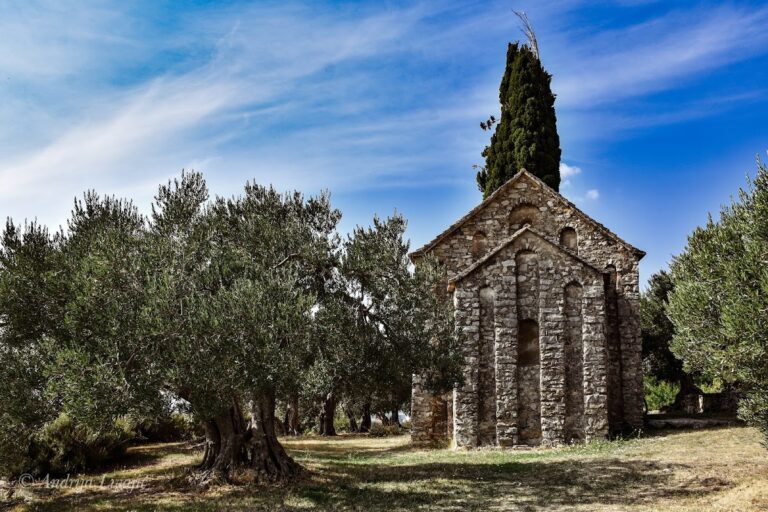
Dragović Monastery: A Serbian Orthodox Monastic Center in Croatia


Site at a Glance
- Rating
- 4.8
- Popularity
- Low
- Country
- Croatia
- Primary era
- Modern
- External website
- Open
- Eras represented
- Early Modern, Modern
- Civilizations
- Serbian
- Site type
- Religious
- Remains
- Monastery
On this page17 sections
History
Dragović monastery is a Serbian Orthodox monastery in Croatia, located at Koljane near Vrlika. It belongs to the Eparchy of Dalmatia and is regarded as one of the three historic Serbian spiritual centers in Dalmatia, together with Krka and Krupa monasteries. Its foundation date is uncertain, although reliable historical evidence places its establishment before the restoration of the Serbian Patriarchate of Peć in 1557, probably by the end of the sixteenth century.
Origins and early history
A tradition first recorded from 1811 onward, and later associated especially with Nikodim Milaš, places the monastery’s construction in 1395. According to this account, Serbs migrated from Bosnia to Dalmatia six years after the Battle of Kosovo and after the death of Bosnian King Tvrtko I. Archaeological evidence for a late-medieval foundation has not been confirmed, so this tradition remains distinct from the more cautious dating suggested by the historical evidence.
The monastery’s name is traditionally connected either with Drago, who was said to have moved from Bosnia to the Cetina region with his brothers Dobro and Vuk, or with the Dragović stream near the former monastery site. A bridge associated with Vuk once stood over the Cetina but is now submerged beneath Peruća Lake. The nearby village of Dabar preserves another name associated with this tradition.
Dragović was plundered and deserted during a Turkish campaign in 1480. It suffered further devastation in 1537 during the Ottoman campaign against the fortified town of Klis. After approximately two decades of abandonment, the monastery was restored in 1590, although famine soon forced the monks to leave again. Following another period of roughly seventy years, Bishop Nikodim Busović obtained Venetian authorization to rebuild the monastery in 1694.
Venetian rule and monastic renewal
The monastery was abandoned once more in 1698 because of Turkish attacks. The Treaty of Karlowitz in 1699 brought the Cetina region under Venetian rule, enabling the monks to return. Busović later resigned as bishop after difficult relations with Greek Catholic and Roman Catholic authorities, and he died at Dragović.
In 1585, five Dragović monks, Pajsije, Eustatije, Stefan, Gerasim, and Dionisije, moved into the territory of the Buda bishopric and founded Grabovac Monastery. Their departure forms part of the wider institutional history of Dragović and its monastic community.
Dragović’s superiors included Busović, Teofil, Savatije Ljubibratić, Teofil Jugović, Arsenije Nikolić, Vikentije Stojisavljević, and Jerotej Kovačević. The succession continued through the nineteenth and twentieth centuries, including Ilarion Torbica, who served from 1854 to 1892, Silvester Bogovac, Parentije Miokovac, Sevastijan Jović, Naum Milković, and Ruvim Štrbac. Danilo Jokić was recorded as administrator in 1976.
Relocation in the eighteenth and twentieth centuries
The original site stood on unstable, damp ground beside the Cetina. At the request of hieromonk Vikentije Stojisavljević, and with Venetian authorization, the monastery began moving in 1777 to Vinogradi. Prior Jerotej Kovačević supervised the completion of the new foundation. The monastery and its new church were consecrated on 20 August 1867.
A second relocation became necessary during the construction of the Peruća hydroelectric project and its artificial lake in the 1950s. The former monastery, church, cemetery, and estate were submerged, while several thousand Serbian Orthodox inhabitants of the fertile Cetina valley were displaced, mainly to Serbia. The monastery was rebuilt on a hill above the left bank of the Cetina, near the old Gradina fortification, and its new premises were consecrated in 1959.
Bishop Simeon of Gornji Karlovac administered the monastery during this relocation, with substantial assistance from Marko Plavša, the archpriest and parish priest of Split. Flooding also destroyed the monastery’s agricultural estate, leaving the community dependent on donations from worshippers, including displaced former parishioners, many of whom had settled in Srem.
War, destruction, and reconstruction
During the Croatian War of Independence, the monastery was looted repeatedly between 1991 and 1993. It was abandoned in 1995, after which the church and monastic premises were devastated and desecrated. The buildings were reportedly used as a stable before reconstruction began in the early twenty-first century.
Bishop Fotije authorized Father Đorđe Knežević to begin the rebuilding. On 15 September 2004, an episcopal decree installed a new brotherhood and appointed hieromonk Varsonufije Rašković as superior. On the same day, during the feast of the Nativity of the Theotokos, the first Hierarchical Divine Liturgy was celebrated in the reconstructed church. An annual Orthodox gathering is associated with the monastery on the Sunday before that feast.
Dragović played an important part in the religious and communal life of Orthodox Serbs in Dalmatia. Its abbots and superiors served on ecclesiastical and political bodies, while some monks participated in uprisings and wars connected with the survival and rights of the local Serbian population. A chronicle written by Archimandrite Gerasim Petranović in 1859 preserves foundation and naming traditions. The monastery also corresponded with Vuk Karadžić, who donated fifty forints, and Nikodim Milaš spent time there as a monk in 1873.
Remains
The present monastery stands on a hill near Peruća Lake, close to the old Gradina fortification and about 20 kilometers from Knin. The hill of Kosa lies to the northeast. The earlier monastery stood downstream along the Cetina in the former fertile valley, but ground movement associated with the creation of the hydroelectric reservoir contributed to the flooding of that site. The present complex preserves material transferred from the earlier church alongside buildings constructed during the second relocation.
The former monastery and transferred elements
Old church
The former church was a modest building enclosed on all sides by monastery structures. It had two entrances and four windows, with a bell tower above the western portal. The tower used a preslica, a bell support shaped like a small open gable or upright plate, and carried a small bell dated 1720. A stone plaque above the western entrance recorded restoration during the tenure of Abbot Vikentije in 1749. The plaque is now incorporated into the base of the holy table in the present church.
Altar and Saint Petka chapel
A marble plaque above the window of the old altar apse recorded restoration of the altar under Abbot Leontije in 1771. The altar table itself bore the date 1779. Above the choir, beneath the bell tower, stood a chapel dedicated to Saint Paraskeva, also called Saint Petka, a widely venerated Orthodox saint. The chapel was later transferred to the north side of the present church.
Roman stonework
Earlier stone elements were incorporated into the old church and monastery buildings. Among them were a block from an ancient altar dedicated to Silvanus, a Roman woodland god, and a stone representation of two lions. These Roman monuments were preserved in the monastery treasury.
Present church and monastic buildings
Church and bell tower
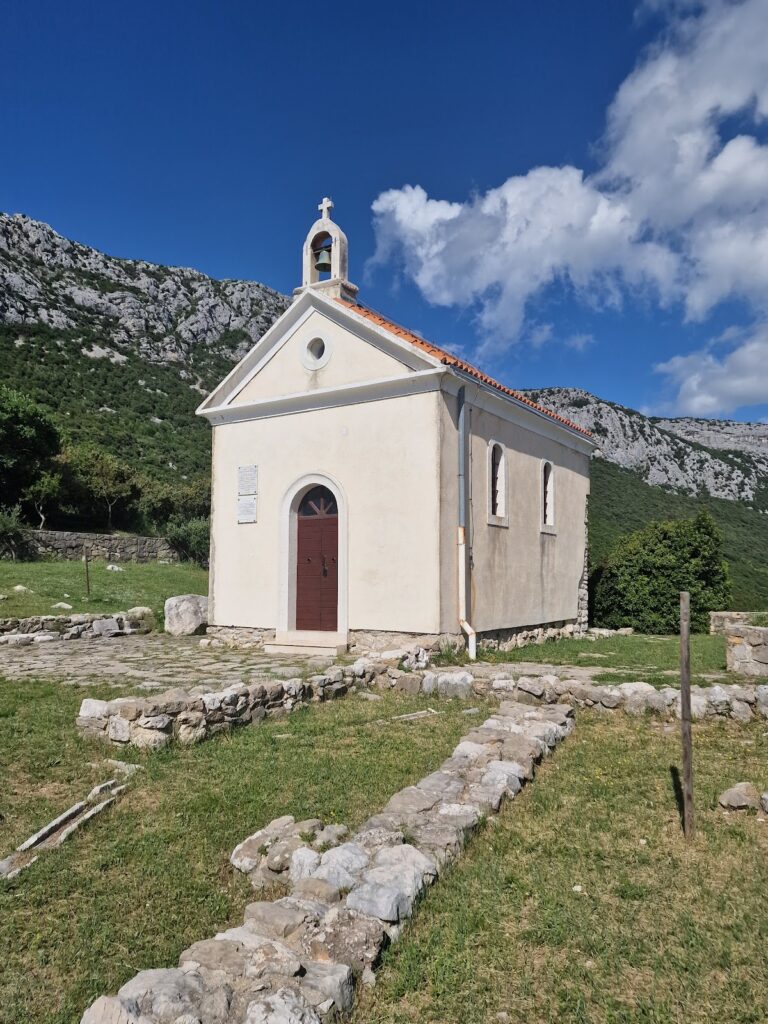
The present church was built in 1958 as part of the second relocation. It is a single-nave building constructed from dressed stone taken from the old church, with architectural affinities to other churches in the region. A rectangular bell tower with Romanesque features stands beside the western portal. The transferred chapel of Saint Petka is on the north side, while a monastery residence built of dressed stone stands on the south side.
Iconostasis
The iconostasis largely follows the arrangement of its predecessor. Its principal icons show the Archangel Michael, the Virgin and Child, Christ as Hierarch, and Saint John the Baptist, with the royal doors between them. The doors contain the Annunciation and images of Solomon, David, Daniel, and Isaiah, while the deacon’s doors depict the Archangels Michael and Gabriel. Above the screen is the Crucifixion, with the Virgin and the Apostle John beneath it.
Three paintings above the earlier principal icons date from the late seventeenth century: the Prayer in the Garden of Gethsemane, the Last Supper, and the Nativity of the Virgin. They are mature works by a Zograf, an Orthodox icon painter, and retain elements of the Serbian medieval icon-painting tradition. On the present iconostasis, the Last Supper is above the royal doors, while the other two works are placed in the altar.
The icons have silver coverings. An inscription on the Archangel Michael names Vuko Sudarević as its painter in 1767 and gives the date 1783 in connection with Dragović. The Virgin and Child bears the inscription “Venice, 1775.” That icon and the image of Christ were silver-clad in Venice during the tenure of Abbot Gerasim Adamović.
Other icons
A large Virgin and Child icon measuring 61 by 97 centimeters hangs above the right choir stall, while a companion image of the Archangel Michael, with the same dimensions, hangs above the left. Both are attributed on stylistic grounds to the second half of the seventeenth century and are among the oldest paintings associated with Dragović.
The nave contains further nineteenth-century icons painted on canvas. The altar includes mostly eighteenth-century works, among them a 23-by-29-centimeter Virgin and Child inscribed with the name Partenije Đurić; three 30-by-45-centimeter images of the Apostle Andrew and the Evangelists Luke and John attributed to the same artist; a 32-by-39.5-centimeter icon of Saints George and Demetrius; and a 25.5-by-32-centimeter Zograf icon of Emperor Constantine and Empress Helena.
Treasury and memorials
Ecclesiastical objects
Until 1995, the monastery held a library of more than one thousand titles and a valuable treasury. Its holdings included manuscripts and books dating from the fourteenth through the eighteenth centuries, works in Greek, Latin, Italian, Russian, and Church Slavonic, rare antimensia, silver liturgical objects, and other ecclesiastical treasures. An antimension is a consecrated cloth bearing a Christian image and usually relics, on which the Eucharistic liturgy may be celebrated.
The treasury included an antimension of Patriarch Arsenije III Čarnojević from 1692, described as the first Serbian antimension printed from a copperplate, as well as works associated with Jerusalem Patriarch Dositej in 1701, Metropolitan Pavle Nenadović, and Bishop Venedikt Kraljević. A particularly rare antimension attributed to Hristofor Žefarović dates to approximately 1752. It depicts the Entombment of Christ with Jerusalem behind it and angels representing the Holy Trinity above. Its text is in Church Slavonic and Greek and includes the artist’s signature. Metropolitan Sava of Montenegro consecrated it in 1767, and the cloth was later exhibited at the Hristofor Žefarović Memorial Museum in Bođani Monastery.
Relics and graves
A small reliquary in the church contains relics identified variously as part of the remains of Saint George or Saint Gregory, described as a Serbian enlightener and archbishop associated with the medieval Nemanjić dynasty. It also contains a fragment of a vestment associated with Saint Spyridon, whose relics are connected with Corfu.
The old church had the grave of Archimandrite Stefan Dubajić near its entrance. A stone slab marked the grave with his name and the date of his death, 13 May 1816, and a copy of the inscription is preserved in the monastery library. A communal tomb northeast of the present church contains the remains of monks transferred from the cemetery submerged beneath Peruća Lake. Separate memorials mark hieromonk Lukijan Milković, Protosyncellus Ruvim Štrbac, and hieromonk Kasijan Arnautović.
Nearby sites