Laufen Castle: A Salzburg Archiepiscopal Fortress in Germany


Site at a Glance
- Rating
- 4.3
- Popularity
- Very Low
- Country
- Germany
- Primary era
- Early Modern
- Eras represented
- Medieval, Early Modern, Modern
- Civilizations
- Holy Roman Empire
- Site type
- Domestic
- Remains
- Castle
On this page8 sections
History
Laufen Castle is a former Salzburg archiepiscopal castle in Laufen, Germany. Its predecessor, described as a castellum ad Loffi, was associated with the episcopate of Bishop Virgil of Salzburg and is believed to have been built over Roman buildings. The complex acquired its present form through late Gothic alterations and major rebuilding between the sixteenth and eighteenth centuries.
Early fortress and medieval administration
Emperor Frederick Barbarossa, the Holy Roman Emperor Frederick I from 1155 to 1190, held a court and judicial assembly at the fortress on 29 March 1166. The stronghold was mentioned again in the thirteenth century. During the Middle Ages, it served first as the seat of the town judge and later as the residence of the Pfleger, a territorial administrator representing the Salzburg ruler in the local district.
Late Gothic and early modern rebuilding
Alterations and extensions in the late Gothic period took place between 1424 and 1426. Under Prince-Archbishop Wolf Dietrich von Raitenau, a new castle building was begun on the medieval remains in 1591. Johann Baptist Ninnguarda directed this work until 1606, and the master builder Egon Riedl continued it from 1606 to 1612, creating the complex’s final overall form. A further campaign under Prince-Archbishop Johann Ernst von Thun und Hohenstein lasted from 1697 to 1702 and included the demolition of the Great Tower. In the eighteenth century, the palace served as a prince-archiepiscopal hunting and summer residence. A prince-archbishop combined ecclesiastical leadership with secular territorial rule, allowing Salzburg’s rulers to use the castle for both administration and residence.
Division of Laufen and conversion to a prison
Political instability followed the decline of the Salzburg prince-archbishopric and the unfavorable course of the Battle of Hohenlinden. The Treaty of Munich, concluded between Bavaria and Austria on 14 April 1816, divided Laufen along the Salzach. The territory on the river’s left bank went to the Kingdom of Bavaria, while the right bank became part of the Austrian Empire. The river then formed a state border through the town, leaving both sections in a peripheral position.
The castle was converted into a prison in 1862. It was designed for 400 inmates and employed about 70 supervisory staff. Supplying the prison population became an important source of income for Laufen’s inhabitants. Under-occupancy led to the prison’s closure on 1 April 1932.
Military, wartime, and postwar uses
In 1933, the castle housed an SA sports school. The SA, or Sturmabteilung, was the paramilitary organization of the Nazi Party. A unit of the Reich Labour Service, a state labor organization of Nazi Germany, occupied the building in 1934, and the castle served as a barracks from 1935 to 1938.
During the Second World War, the castle became Oflag VII-C, an officers’ prisoner-of-war camp. Polish officers were initially held there, followed by English officers captured at Dunkirk in May 1940. In 1942, it became Ilag VII, an internment camp for civilians deported from the Channel Islands. The camp also held some American civilians caught in Europe after Germany declared war on the United States on 11 December 1941. American troops liberated the camp on 4 May 1945. The castle then briefly served as a Wehrmacht discharge camp before Hungarian occupants took over the building.
A Caritas residential and nursing home was established in the castle in 1946 and remained until 1966, when it moved to Glonn. A domestic-science school for girls also operated there during this period. After the castle stood vacant because Laufen could not finance its renewal, the Laufen architect Gottfried Lobmayr converted it into a residential and commercial building between 1970 and 1992. Since 1992, an owners’ association has held the property. The castle and its archaeological remains are protected as both a built monument and an archaeological monument. The protected archaeological area includes medieval and early-modern remains beneath the former castle, its predecessor buildings, and the former Church of Saint Peter.
Remains
Castle complex
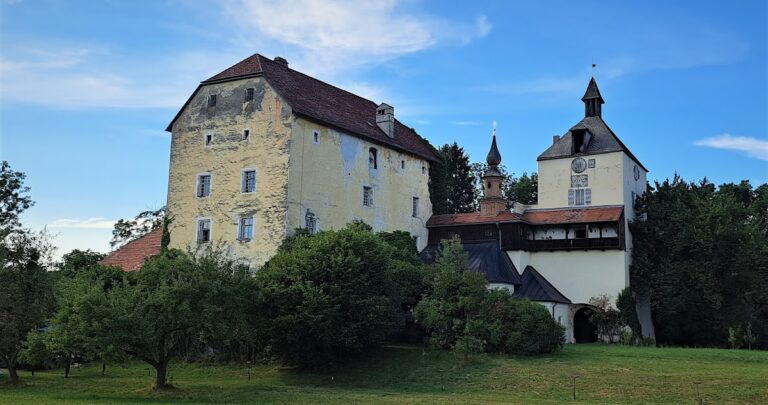
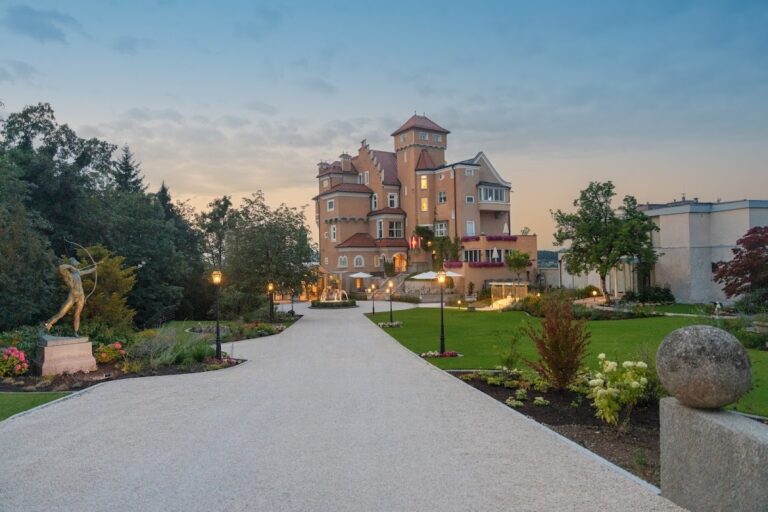
Laufen Castle is a massive, square-shaped, four-storey complex arranged around an inner courtyard. Three-storey extensions enlarge the main block, while a stair tower stands at the rear. The principal building is covered by a hipped roof, and a marble entrance portal is associated with the castle. The coat of arms of Archbishop Hieronymus von Colloredo, Salzburg’s last ruling prince-archbishop before the archbishopric’s secular principality was dissolved in 1803, is also associated with the complex.
Eastern building and retaining wall
An additional four-storey building with a hipped roof stands to the east of the main complex. Its associated high retaining wall dates from around 1800 and was erected under Prince-Archbishop Hieronymus von Colloredo. The castle overlooks the Salzach River. Following the conversion completed in 1992, the complex contains businesses, rental apartments, and two hospitality establishments.
Nearby sites