Kerch Fortress: A Nineteenth-Century Russian Imperial Fortification


Site at a Glance
- Rating
- 4.5
- Popularity
- Medium
- Country
- Ukraine
- Primary era
- Modern
- External website
- Open
- Eras represented
- Early Modern, Modern
- Civilizations
- Russian
- Site type
- Military
- Remains
- Fort
On this page15 sections
History
Kerch Fortress, also known as Fort Totleben, is a nineteenth-century Russian Imperial fortress in Ukraine, built to protect the empire’s southern frontier and control the narrowest part of the Kerch Strait at Cape Ak-Burun. Its construction began in 1856, after the Crimean War, and developed into a complex of coastal, land, and sea defenses.
Early batteries and the Crimean War
The first fortification on the strait was a battery established on the cape in 1771. The site was later known as Cape Pavlovsky. Rebuilt and strengthened several times, the battery mounted 20 guns during the Crimean War, fought from 1853 to 1856 between Russia and an alliance that included the Ottoman Empire, Britain, France, and Sardinia.
On 12 May 1855, Anglo-French-Turkish forces landed at Kamysh-Burun, south of Kerch. The battery could not withstand an attack from land, so its guns were disabled, its supplies destroyed, and its personnel withdrawn. French troops then established a fortified camp on the position and remained there until June 1856.
Imperial construction
The Treaty of Paris in 1856 ended the Crimean War and made the Black Sea neutral, restricting Russia from maintaining a fleet or military ports there. It did not prevent the fortification of the Kerch Strait. Engineer units surveyed the area in April 1856, and work began in August on the former French camp. A proposal to reinforce the older Turkish fortress of Yenikale was replaced in December by a plan centered on Cape Pavlovsky. Alexander II, emperor of Russia from 1855 to 1881, also ordered sea forts at the end of the Tuzla Spit and on the reef off Cape Ak-Burun.
Construction began in 1856. During the first year, the coastal batteries were roughly formed, two barracks and a powder magazine were built, and work started on a stone barrier across the strait between Tuzla Spit and Cape Pavlovsky. Colonel Anton Antonovich Nat initially supervised the project. In October 1859, military engineer Eduard Totleben became director of the Engineering Department of the Ministry of War and received Alexander II’s support for the works. Totleben was known for his role in the fortifications and defense of Sevastopol during the Crimean War.
Earthworks began at Cape Ak-Burun in 1860, while the stone barrier in the strait grew beyond three kilometers. During Alexander II’s first visit in 1861, he ordered two detached field forts, or lunettes, to be named the Minsk Lunette and Vilna Lunette. He designated the principal fort Fort Totleben and congratulated Nat on his promotion to major general. The Kerch fortifications received fortress status in 1867. Defensive construction was complete by Alexander II’s third visit in 1872, when he expressed satisfaction with the finishing of the coastal batteries.
First World War and interwar modernization
During the First World War, the fortifications were placed on a war footing after a German-Turkish naval attack on Russian Black Sea ports on 15 October 1914. A defensive minefield was laid at the entrance to the strait with local vessels after the German light cruiser Breslau was detected nearby.
Three permanent defensive installations were added in the 1930s. Coastal Battery BS-48 was built at Cape Ak-Burun, Anti-Boat Battery BS-9 stood at the cape’s tip, and the four-gun 69th Anti-Aircraft Battery occupied Bastion E of Fort Totleben. At the end of the decade, Fort Totleben became the Black Sea Fleet’s Main Aviation Store No. 51. It was renamed Store No. 590 in February and March 1942.
Second World War defense
At the beginning of the Second World War, the fortress housed services of the Kerch Naval Base and an aviation-ammunition store holding up to 4,000 tonnes of aerial bombs. In September 1941, all fortress guns were evacuated. The 69th Battery’s 75 mm Lender anti-aircraft guns went to Sevastopol, while the guns of Batteries 48 and 9 were taken to the Taman Peninsula. Batteries 48 and 9 later fired on German forces occupying Kerch in November 1941 and continued operating from Taman until August 1942. After their ammunition ran out, their crews destroyed the guns and later fought at Novorossiysk.
German forces first reached Kerch Fortress in November 1941. A small composite garrison under Captain of Quartermaster Service L. I. Gursky could not organize a full defense, and the fortress and its ammunition stores were abandoned after fighting on 11 and 12 November. Soviet forces retook the position on 31 December 1941 after the Kerch-Feodosia amphibious operation. The Germans had neither used nor removed the ammunition in the stores, which was recovered intact.
The Kerch Naval Base returned to the fortress, and Fort Totleben again housed Store No. 590. During the Kerch defensive operation, the fortress was prepared for battle between 10 and 13 May 1942. Its nineteenth-century Advanced Fortifications and Main Fortress Rampart became two defensive lines. Retreating units of the Crimean Front joined the naval-base forces, forming a composite garrison of about 5,000 men. The garrison included elements of the 72nd Cavalry, 156th Rifle, 404th Rifle, and 157th Rifle divisions, as well as a separate motorized detachment with five BA-10 armored vehicles and 45 mm guns. Its artillery consisted of five 76 mm field guns and two captured 105 mm guns.
Regimental Commissar V. A. Martynov assumed overall command on 14 May. German forces cut the fortress off from the main Soviet forces at Kerch and attacked from the Yuz-Oba Ridge with infantry and tanks. Fire from the captured guns on the Main Rampart disabled approximately seven or eight German tanks. That evening, the garrison counterattacked positions on Mount Mithridates, retook the mountain by 21:30, and temporarily restored contact with Soviet forces in the city.
The fortress stood on elevation 110.0 at the retranchement, a fortified interior line intended as a final defensive position. From there, its garrison observed and radioed targets in the German rear. Soviet heavy batteries on the Taman shore used these reports to shell German positions. The fire restricted daylight movement, forced German units onto routes north of the city, and reduced pressure on Soviet crossings to the Taman Peninsula. The garrison was ordered to hold until the main forces of the Crimean Front had been evacuated from the Yenikale-Opasnaya crossing area.
German forces recaptured the Bocharny Factory and Mount Mithridates on 15 May and renewed their attacks, including fighting around the Advanced Structure, locally called the Small Fortress. Regimental Commissar Monastyrsky restored the defensive line by personally stopping a disorderly withdrawal on the right flank.
The garrison began evacuating at 23:00 on 15 May and concentrated at Pavlovsky Bay. The evacuation coincided with the destruction of the ammunition stores in Fort Totleben, which then held about 4,000 tonnes of aerial bombs. During the night of 15 to 16 May, about 2,000 people were transported, leaving more than 2,200 personnel and the garrison’s serviceable weapons inside the fortress.
Captain I. S. Barabanov assumed command of the remaining troops, and the defense along the Main Rampart was restored by 07:00 on 16 May. At 16:00, Battalion Commissar D. S. Kalinin arrived from Taman with sailors and a radio station. German infantry and tanks attacked repeatedly from 16 to 18 May but failed to break through. Once the fortress had diverted German forces from the Yenikale-Opasnaya crossing area, the remaining garrison was ordered to evacuate.
About 2,200 defenders reached the Taman shore, while 37 men of the 17th Separate Machine-Gun Company of the Kerch Naval Base remained as a covering detachment under Junior Lieutenant Naumov. The German general assault on 19 May encountered a nearly empty fortress, but the covering group resisted until nightfall.
Postwar military use and preservation
After the Second World War, military stores containing Black Sea Fleet equipment and ammunition were returned to the fortress. In 1946, a Black Sea Fleet disciplinary battalion was established near the redan, a projecting V-shaped defensive work, in the southern part of Fort Totleben. It was formed on the basis of the 613th penal battalion.
In the mid-1970s, thousands of cubic meters of dredged mud from Genoese Harbour were dumped in shallow water near the fortress’s Mine Pier. The material contained objects dating from the fifth century BC onward. After the dissolution of the Soviet Union, military units were reduced. The disciplinary battalion was disbanded in 1993, the stores were later removed, and the territory was transferred in 2003 to the East Crimean Historical and Cultural Museum-Reserve.
The fortress is protected as a federal-level cultural heritage site of Russia and as a national-level cultural heritage monument of Ukraine. These designations recognize it as an example of nineteenth-century fortification. In August 2019, demining operations uncovered a Second World War ammunition store containing 1,700 fragmentation aerial bombs weighing 2.5 kilograms each and one 100-kilogram high-explosive aerial bomb. Russian emergency-service personnel rendered the ammunition safe.
Remains
Setting and overall layout
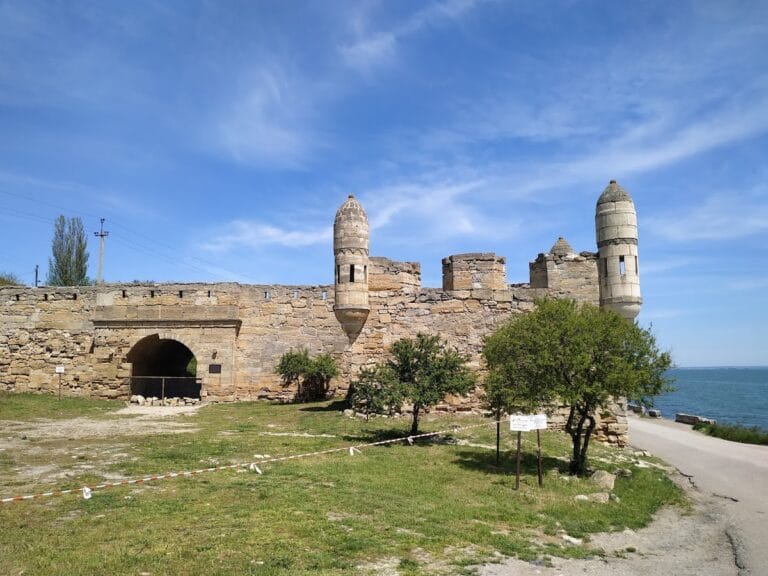
Kerch Fortress occupies Cape Ak-Burun, meaning “White Cape,” on the Kerch Strait at its narrowest point. Its stone defenses spread across the cape and adjacent terrain, with related positions extending into the strait. The complex includes coastal batteries, land defenses, sea fortifications, barracks, powder magazines, underground passages, artillery positions, caponiers, semi-caponiers, lunettes, a redan, gates, and the main fort. A caponier is a fortified work projecting into or flanking a ditch, while a semi-caponier is a smaller or partly projecting flanking work.
The early works included two barracks, a powder magazine, coastal batteries, and a stone barrier more than three kilometers long between Tuzla Spit and Cape Pavlovsky. Planned sea defenses occupied the end of the Tuzla Spit and the reef off Cape Ak-Burun. The fortress’s highest point is elevation 110.0. Its retranchement overlooks much of the fortress and nearly all of Kerch, while Cape Ak-Burun overlooks Kerch Bay and Pavlovsky Bay.
Principal fortifications
Fort Totleben and the inner defenses
Fort Totleben forms the main fort of the complex. The Minsk and Vilna lunettes are detached field fortifications with projecting angles. The Advanced Fortifications, the Main Fortress Rampart, the Small Fortress, and Bastion E form other named parts of the defensive system. The Vilna route passes through Caponier No. 6, the Vilna Lunette Barracks, and Semi-Caponier No. 8, an area involved in intense fighting during 1942. Other surviving defensive works include Caponiers Nos. 12 and 13, the Central Gate, the Ak-Burun Gate, the “Blue Gates,” and a covered-path redoubt, an enclosed fortification intended for independent defense, described as unique in southern Russia.
Coastal and anti-aircraft batteries
The coastal-defense complex includes the so-called French Barracks, the positions of the principal fortress artillery, and the pre-war positions of Coastal Battery 48 at Cape Ak-Burun. BS-48 had four 152 mm Canet guns. BS-9, the Anti-Boat Battery at the cape’s tip, had four 75 mm Canet guns. The four-gun 69th Anti-Aircraft Battery occupied Bastion E of Fort Totleben and used 75 mm Lender anti-aircraft guns during the Second World War.
Subterranean and archaeological remains
Underground installations
Passages beneath the fortress include underground galleries, specialized ammunition workshops, and other subterranean installations. Some of these spaces remain little studied. The grounds also contain cleared areas and archaeological or military remains, and further underground spaces and routes continue to be cleared and investigated. The fortress is generally in good condition but is partly destroyed.
Mine Pier deposit
Shallow water near the Mine Pier contains dredged material brought from Genoese Harbour in the mid-1970s. This deposit includes archaeological objects dating from the fifth century BC onward, providing material evidence from periods extending well before the nineteenth-century fortress.
Second World War ammunition cache
The ammunition store uncovered in 2019 contained 1,700 2.5-kilogram fragmentation aerial bombs and one 100-kilogram high-explosive aerial bomb. The entire cache was subsequently neutralized.