Burg Castle: A Medieval Fortress and Early-Modern Castle in Switzerland


Site at a Glance
- Rating
- 4.2
- Popularity
- Very Low
- Country
- Switzerland
- Primary era
- Early Modern
- External website
- Open
- Eras represented
- Medieval, Early Modern
- Civilizations
- Holy Roman Empire
- Site type
- Military
- Remains
- Castle
On this page7 sections
History
Burg Castle, also known as Burg Biederthal, is a preserved hill castle in Switzerland, above the village of Burg im Leimental. Its oldest surviving parts date from the middle of the thirteenth century, and the present castle was built around 1250 as a medieval fortress. Its origins remain uncertain, since a reference to Biederthal Castle in the twelfth century probably concerns the ruins of Alt-Biederthal elsewhere on the same rocky ridge.
Medieval Lords and Episcopal Control
The castle was initially Habsburg property. The Habsburgs were a major European ruling dynasty whose possessions included territories in the region of present-day Switzerland. Ownership later passed to a branch of the Ratolsdorf family, whose estates lay in the hinterland of the Blauen area. Under the Lords of Biederthal, a Ratolsdorf lineage, the castle identified as Biederthal Castle was established around 1250.
In 1269, the Bishop of Basel acquired the castle. As the ecclesiastical ruler of the Prince-Bishopric of Basel, the bishop could also exercise territorial and feudal authority. He first granted the property as a fief, meaning property held from a superior lord in return for service and loyalty, to the Lords of Biederthal. This arrangement continued until 1392, when the Lords of Wessenberg received the fortress as their fief.
Transformation into an Early-Modern Castle
From the sixteenth through the eighteenth century, the Wessenberg family remodeled the medieval fortress into an early-modern castle. The early-modern period, between the Middle Ages and the modern era, brought a substantial change in the character of the complex, which developed beyond its original fortified function.
In 1810, the castle was sold to private owners. It has remained privately owned and is not open to the public. Burg Castle is classified as a Swiss cultural property of national significance.
Remains
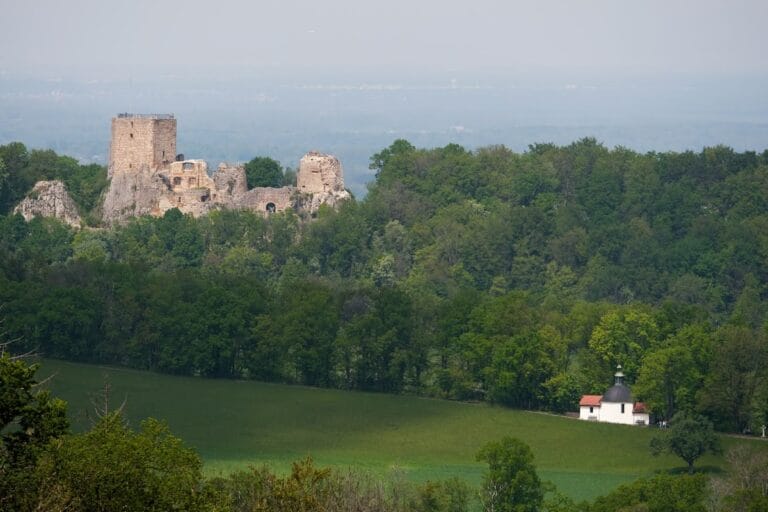
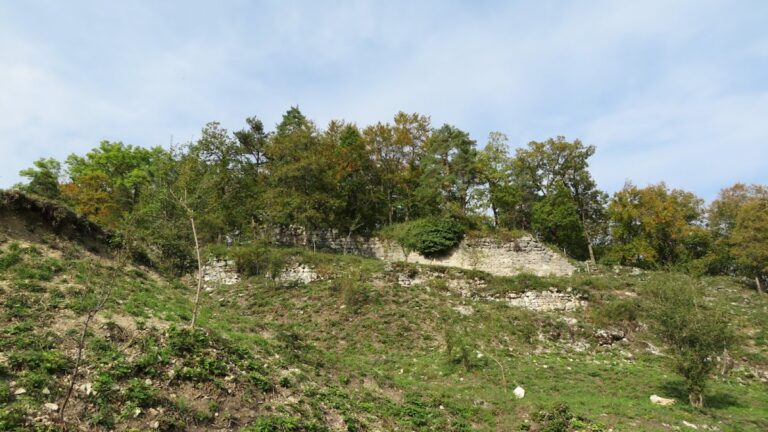
The surviving complex occupies the eastern spur of the Schönenberg rocky ridge above Burg im Leimental. A spur castle is a fortified site built on a projecting ridge, using the elevated terrain to strengthen its position. Burg Castle and its associated chapel form an extensive building complex that dominates the village. The medieval fortress was later remodeled into an early-modern castle, leaving the site with both a medieval origin and a later residential character.
Building Complex
Castle
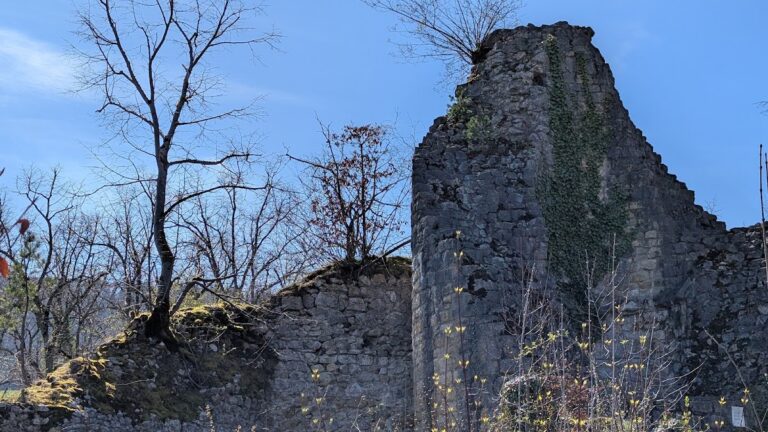
The preserved castle stands on the eastern ridge spur as the principal element of the complex. Its oldest parts belong to the middle of the thirteenth century, while its present form also reflects the remodeling carried out between the sixteenth and eighteenth centuries. The structure therefore combines the surviving fabric of a medieval fortress with the later form of an early-modern castle.
Chapel
An associated chapel forms part of the castle complex. Together with the castle, it occupies the rocky ridge above the village and contributes to the extent of the surviving hilltop building group.
Nearby sites