Duomo di Naro: A Norman Cathedral in Italy


Site at a Glance
- Rating
- 4.1
- Popularity
- Very Low
- Country
- Italy
- Primary era
- Medieval
- External website
- Open
- Eras represented
- Medieval, Early Modern
- Civilizations
- Kingdom of Sicily, Norman, Spanish
- Site type
- Religious
- Remains
- Cathedral
On this page6 sections
History
The Duomo di Naro is a Norman cathedral in Italy, built in 1089 by Roger Hauteville shortly after the Norman conquest of Naro in 1086. Roger Hauteville, also known as Roger I of Sicily, led the Norman conquest of Sicily in the late eleventh century. The church stood over an earlier Arab mosque and was dedicated to the Assumption of the Virgin Mary.
From Norman church to cathedral
In 1174, Walter Offmill, Archbishop of Palermo, raised the church to the status of Mother Church. In the same year, the Orthodox rite was abandoned at the Church of Saint Nicholas of Bari. On the second Sunday of May 1266, the church was consecrated to the Annunciation of the Virgin. The ceremony took place in the presence of Cardinal Rodolfo, Bishop of Albano and papal legate of Pope Clement IV, as well as the archbishops of Palermo and Bari and the bishops of Agrigento, Mazara, and Patti.
King Martin the Younger, the fourteenth-century king of Sicily, granted the church the title of cathedral toward the end of the fourteenth century. Its religious role continued into the early modern period. In 1700, nobles and priests founded the Confraternity of the Blessed Sacrament at the church. This formally organized religious association, whose members shared devotional and charitable duties, remained active until the middle of the nineteenth century.
Chapels, renewal, and later decline
In 1565, Bernardo Lucchesi Palli of Campofranco added the main chapel, dedicated to Madonna della Catena, formerly the patron of Naro. The chapel incorporated an earlier Arab tower and contained a statue by a member of the Gagini family, a prominent dynasty of Sicilian Renaissance sculptors. The statue was later transferred to the Mother Church.
A comprehensive restoration began in 1771 under Antonio Lanza, Bishop of Agrigento, and was entrusted to Gaetano and Giuseppe Bennica. The work lasted seventeen years. In 1788, the Palermitan stucco artists Emanuele Ruisi and his son Domenico painted several frescoes, while the Narese artists Ignazio Citillo and Amedeo Vella decorated the church with arabesques. These interventions formed part of the building’s Baroque renewal.
The church has been closed to worship since 1867 and is now deconsecrated. In 1889, the former church was used as a cemetery for victims of cholera, after which most of the artworks preserved inside were moved to other churches. The building is designated a national monument. Although it underwent restoration in the early twenty-first century, a landslide that struck Naro’s inhabited center on 4 February 2005 severely destabilized it. Shoring now supports the structure, which is inaccessible to the public.
Remains
Plan and exterior structure
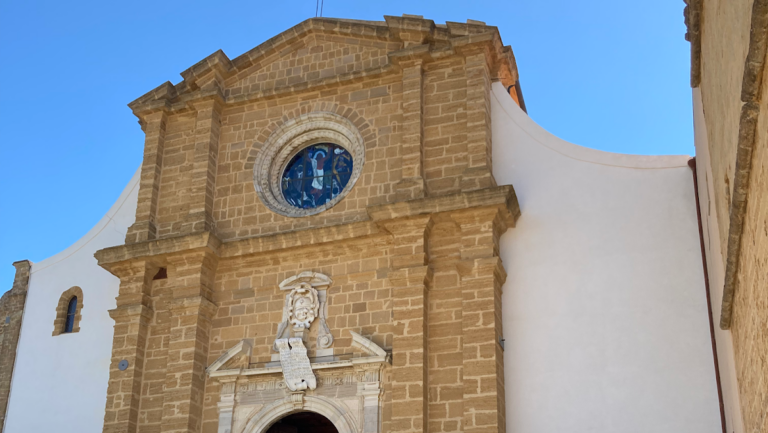
The church stands at the top of a long staircase rising from Via Dante, formerly called Via dei Monasteri and once the principal road through the city. Its plan forms a Latin cross, with a long central axis crossed by a shorter transept, a single nave, and a dome at the crossing. Later lateral additions are asymmetrical. The building measures approximately 50.60 metres in length and 9.50 metres in width and is constructed almost entirely of tuff, a porous volcanic stone widely used in Mediterranean building.
Columns attached to the nave walls carry cornices, from which transverse ribs extend across the space. Made from blocks of tuff, these ribs reinforce the barrel-vaulted roof, a continuous curved ceiling. The entrance portal belongs to the Chiaramonte period, a phase of Sicilian medieval architecture associated with the Chiaramonte family. Its pointed arch rests on fourteen small columns and is richly formed with zigzags and palmettes.
Interior decoration and surviving artworks
The interior was completely renewed during the Baroque period. Elements of the earlier Corinthian ornament survive chiefly in the cornice, columns, and capitals. The Corinthian order is recognized by capitals decorated with acanthus leaves. The church’s former vault carried an extensive fresco cycle by Domenico Provenzani, a painter associated with the building’s monumental decoration. Its subjects included the Assumption of Mary, Aaron with incense, David with the harp, Moses with the Tablets of the Law, Joshua stopping the sun, and Judith liberating the people of Bethulia. The vault has since collapsed.
A fifteenth-century fresco of the Assumption of Mary with the twelve Apostles, once kept inside the church, is now preserved in the municipal library. Together with the surviving medieval portal, the Baroque interior work, and the integrated earlier structures, the building reflects Norman, Gothic, Arab, and Byzantine architectural traditions.
Nearby sites