Brașov Fortress: A Historic Hilltop Defensive Stronghold in Romania


Site at a Glance
- Rating
- 4.4
- Popularity
- Very Low
- Country
- Romania
- Primary era
- Early Modern
- External website
- Open
- Eras represented
- Early Modern, Modern
- Civilizations
- Habsburg, Hungarian, Ottoman, Principality of Transylvania
- Site type
- Military
- Remains
- Fort
On this page12 sections
History
Brașov Fortress is a historic defensive complex in Romania, built on a 64-meter-high hill north of Brașov’s historic center to prevent an enemy from placing artillery there during a siege. Its development began in 1524, when the hill was known as Martinberg, with the construction of a horseshoe-shaped stone tower outside the city walls.
Construction and seventeenth-century strengthening
During the mid-sixteenth century, Giovanni Battista Castaldo, a military adviser to Emperor Ferdinand I, encouraged the strengthening of Transylvania’s towns and borders as the threat of Ottoman invasion increased. Between spring 1552 and late autumn 1553, the original tower was enclosed by defensive walls and three small towers. The design was probably prepared by the Italian architect Alessandro da Urbino, and a deep ditch was excavated around the outer defenses.
In 1611, during a civil war in Transylvania, an earthen rampart was added outside the fortress. Prince Gabriel Bathory besieged the stronghold but failed to capture it. A fire in October 1618 destroyed its wooden buildings, and reconstruction was completed in 1625.
A further rebuilding campaign began in April 1630. The towers were transformed into stronger bastions, projecting fortifications that allowed defenders to fire along the walls and approaches, while the entrance received additional protection. The northern bastion was finished by late September 1630, a second followed in spring 1631, and a third in August 1631. The architect was probably Johannes Siena. The outer walls and corner defenses were also expanded and reworked during 1630 and 1631.
Habsburg rule and changing military importance
After Transylvania came under Habsburg control in 1688, the Habsburgs, the ruling dynasty of the Austrian monarchy, made the fortress the principal defensive center in place of Brașov’s older city fortress. Most of the guns were transferred there, and a garrison was established inside. The authorities also cleared vineyards and orchards from the hill so that attacking troops could not use them as cover.
Brașov’s inhabitants later rebelled against Austrian rule, captured the fortress, and imprisoned Mayor Michael Filstich and other officials. Imperial troops soon forced the rebels to capitulate, although Vienna decided not to impose a contribution on the city. In August 1690, the Kuruc leader Imre Thököly besieged the fortress but abandoned an assault after negotiations with Brașov’s inhabitants. The possible demolition of the central horseshoe tower was discussed in 1699, but the tower was preserved.
By the beginning of the eighteenth century, the fortress and Brașov’s city defenses were regarded as obsolete and unable to provide serious protection in wartime. The fortifications were repaired during the Russo-Austro-Turkish War, but a major rebuilding project was prevented by insufficient funds. Modernization began in 1773 on the initiative of Emperor Joseph II, with priority given to the safety of the garrison. After the Austro-Turkish War, the fortress was converted into a prison, initially for Turkish prisoners of war.
From military stronghold to prison and public site
By the beginning of the nineteenth century, Brașov Fortress had lost its original military purpose. It continued to represent Habsburg authority in the region and was intended to discourage unrest and support for independence. During the Revolution of 1848–1849, a period of political and national uprisings across Europe, approximately 200 Hungarian insurgents occupied the fortress after Russian forces entered Transylvania at the request of the Habsburgs.
The insurgents held the fortress for two days and surrendered on 22 June 1849 after running out of ammunition and receiving no expected relief from Hungary. Although they negotiated an agreement with the Russian command, Austrian forces captured them soon afterward. Some were imprisoned, while others were sent to serve in the Austrian army. The fortress was repaired in the 1850s. During the late nineteenth century, it became a fashionable destination, and a popular restaurant was established there.
After the First World War, Transylvania became part of independent Romania, and the fortress returned to use as a prison. In 1919, Romanian authorities interned approximately 600 officers of the Szekler Division, a Hungarian military formation associated with Transylvania’s Szekler population during the revolutionary period. In 1932, Brașov’s municipal authorities formally presented the fortress to King Carol II of Romania.
Following the Second World War and Romania’s communist takeover in 1948, the fortress became a prison used by the Securitate, the communist secret police and internal-security apparatus. From 1954 to 1975, it housed the city archive. Repairs were undertaken in the late 1970s, and the gates opened to tourists in 1981. A medieval-style restaurant was installed inside, while paved paths and lamps were added around the complex.
After the fall of communism, the fortress was acquired by the Aro Palace joint-stock company. From 2015, a legal dispute between the company’s owners and Romanian authorities over its return to state ownership resulted in the suspension of tourist access and the closure of the restaurant, after which the buildings deteriorated. A memorial plaque honoring the Hungarian freedom fighters who defended the fortress in 1849 was installed on the wall in 2014. The site is identified as a tourist site and museum and has undergone restoration. Its last use for its original military purpose was in 1849.
Remains
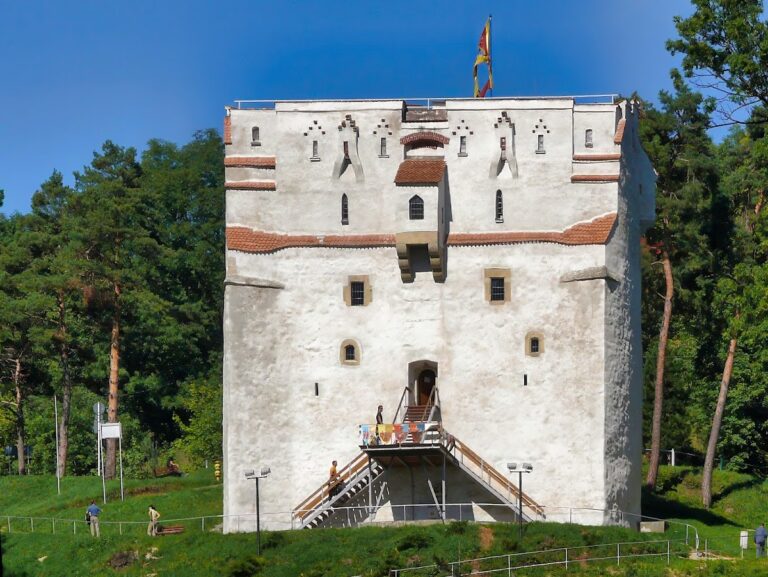
Brașov Fortress occupies a compact, slightly irregular rectangular complex measuring approximately 150 by 170 meters. Four substantial bastions strengthen its corners, projecting about 15 to 20 meters beyond the walls. The defensive system developed around the central horseshoe-shaped tower, with later walls, towers, a ditch, an earthen rampart, and rebuilt corner defenses forming the surviving layout.
Central tower and entrance defenses
Horseshoe tower
The central horseshoe-shaped stone tower dates from 1524 and later contained storage facilities. A well was dug in front of it, originally reaching 25 meters below ground before being deepened to 81 meters in 1631. During repairs in the 1850s, a large water-storage cistern was built in place of the well. A fountain now stands in front of the tower.
Southern gate
The fortress has a single entrance on its southern side. A drawbridge, a movable bridge used to control access across the defensive ditch, formerly led to the gate. Decorative elements were added before Queen Caroline’s visit in 1817, and the entrance has since been known as Karolinentor. The date 1580 is displayed above it as the date associated with the completion of the external walls.
Bastions and garrison buildings
Northern bastion
The northern bastion carries two memorial plaques on its facade. One displays Brașov’s coat of arms, while the other bears a Latin inscription referring to the bastion’s construction and Mayor Christian Hircher’s active participation. The bastions were created through the rebuilding campaign of 1630 and 1631, when the earlier corner towers were converted into stronger projecting defenses.
Garrison buildings
Small buildings constructed for the Habsburg garrison stand against the inner walls. They included barracks, military stores, and the commandant’s house. Repeated rebuilding has made the arrangement of the earliest structures difficult to determine.
Outer setting and underground feature
A deep ditch surrounded the external defenses, and an earthen rampart added in 1611 formed another layer beyond them. By the beginning of the twentieth century, much of the area around the fortress had become park woodland, while luxury villas appeared on the slopes of the hill. An underground passage leading from the fortress toward Brașov has been reported, but its existence remains uncertain.
Nearby sites