Fort of Rosemont: A Nineteenth-Century Artillery Battery in Besançon


Site at a Glance
- Rating
- 4.5
- Popularity
- Very Low
- Country
- France
- Primary era
- Modern
- Eras represented
- Modern
- Civilizations
- French
- Site type
- Military
- Remains
- Fort
On this page9 sections
History
Construction during the Franco-Prussian War
The Fort of Rosemont, more precisely an artillery battery, is a nineteenth-century French military work on Rosemont Hill in Besançon, France. Built hastily in 1870 and 1871 during the Franco-Prussian War, it supported the positions at Planoise and Chaudanne and formed part of Besançon’s fortified defenses. Its construction responded to the possibility of an enemy attack rather than to a fully developed strategic plan.
Besançon was blockaded during the war but held out until the armistice, and no battle took place in the city. The battery was intended to coordinate fire between the forts of Planoise and Chaudanne, helping to form a defensive barrier south of Besançon. Its guns also covered the roads and railways toward Dole and Dijon, the railway at Franois leading toward Lons-le-Saunier, the Doubs valley, and the road to Lyon.
Reorganization and later additions
After 1870, Rosemont was retained within the defensive reorganization associated with General Raymond Adolphe Séré de Rivières. This system was a French network of forts, batteries, and defensive barriers developed after the Franco-Prussian War to protect strategic cities and routes. Only limited improvements were made at Rosemont. A masonry reduit, a small defensive building for protected shelter or final resistance, was added in 1874, while a powder magazine for gunpowder and ammunition was completed about 50 metres downhill in 1880.
Abandonment and the name Fort Verne
The battery never saw combat, including during the First World War or the Second World War. Its exact decommissioning date is uncertain, although it was probably abandoned after the First World War. The position later became known as Fort Verne, commemorating a general of the French Revolution who was born at Saint-Vit and died during the Battle of the Bridge of Arcole in 1796.
After demilitarization, the fortification deteriorated. In the 2000s, seasonal goat grazing cleared vegetation around the surviving reduit and powder magazine. The remains have since suffered vandalism, including graffiti, fire traces, and accumulated rubbish. Barriers and grilles have been installed around parts of the site, while both buildings have been partly cleaned.
Remains
Layout and defensive works
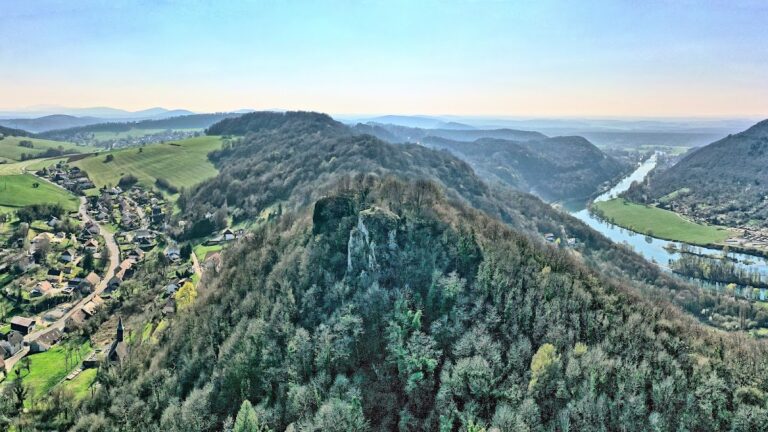
The battery occupies the summit of Rosemont Hill at an elevation of 465 metres, within dense forest. Its position was reached by pedestrian paths, including a former strategic road approximately 2,100 metres long that carried weapons, ammunition, and provisions to the work. The fortification combined a small rectangular masonry reduit with a separate powder magazine, making it one of the smallest fortified works in Besançon.
A rocky ditch about 210 metres long surrounded the battery. It had no masonry escarp or counterscarp, and its circular arrangement followed the rounded form of the hilltop, as did the close-defence path around the position. Surviving sections of these defenses are heavily degraded. The battery held emplacements for six artillery pieces, with one near the reduit and five associated with the powder magazine. The latter group also included small shelters and ammunition-storage areas.
Reduit
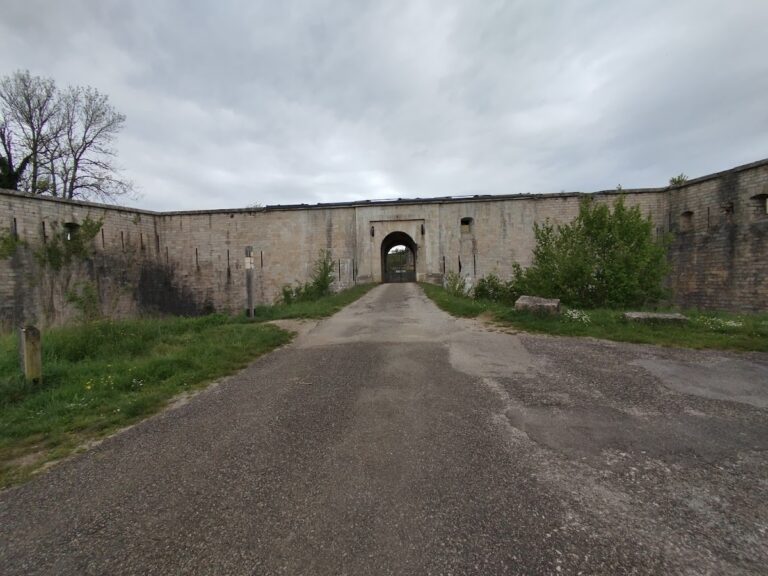
The reduit is a small rectangular masonry building protected on one side by an earth embankment. Its interior remains in relatively good condition, together with two entrances and several loopholes, narrow openings for defensive fire. A barrier encloses the building, while grilles block its entrances and windows. The surrounding battery area shows pronounced structural deterioration, with graffiti, traces of fire, and rubbish among the surviving fabric.
Powder magazine
The powder magazine is a semi-buried structure set within a large earthen mound. Three openings framed by robust masonry served as personnel passages or ventilation apertures. Its chronology is uncertain: construction is dated to 1880, while its inauguration is dated to 1889. The structure is now secured by metal grilles. Together with the reduit, it preserves the two principal buildings of the battery and illustrates the compact arrangement of this defensive position.
Hilltop setting
A viewpoint north of the fort overlooks the Planoise district and its surroundings. The summit setting, the rounded ditch, and the surviving buildings express the way the battery was fitted to the shape of Rosemont Hill while directing its artillery toward the approaches south of Besançon.
Nearby sites