Fort d’Hauteville: A Séré de Rivières Fort Protecting Dijon
Site at a Glance
- Rating
- 4.2
- Popularity
- Very Low
- Country
- France
- Primary era
- Modern
- External website
- Open
- Eras represented
- Modern
- Civilizations
- French
- Site type
- Military
- Remains
- Fort
On this page7 sections
History
Fort d’Hauteville is a French fortification at Hauteville-lès-Dijon, above Dijon, built between 1877 and 1880 as part of the Séré de Rivières system. This network of forts and defensive works was constructed after the Franco-Prussian War to protect France’s borders and strategic centers. Fort d’Hauteville formed part of the fortified belt around the Dijon stronghold and was regarded as one of its essential elements.
The Dijon defensive belt
After France’s defeat in 1870–1871, Dijon was chosen with Langres, Besançon, Reims, Laon, and La Fère for the system’s second defensive line. This position stood behind the principal line centered on Verdun, Toul, Épinal, and Belfort. The Dijon belt was developed between 1875 and 1883 and included the forts of La Motte-Giron, Mont-Afrique, Hauteville, Asnières, Norges, Varois, Saint-Apollinaire, and Sennecey.
During the ministry of Georges Boulanger, the fort was briefly renamed Fort Carnot in 1887. In the First World War, it accommodated several French Army units, including the 7th Territorial Artillery Regiment.
Internment and later history
In 1942, Fort d’Hauteville became an extension of Dijon Prison. Jews, members of the Resistance, and common-law prisoners were interned there. Prison registers record 3,821 detainees, who were later transported to Drancy, a detention and transit camp near Paris, before deportation to Nazi extermination camps.
Fort d’Hauteville has been protected as a French historic monument since the order of 17 March 2006. The municipality of Hauteville-lès-Dijon purchased it from the Ministry of Defence on 31 August 2010. Since 2025, the fort has housed the Choillot Museum.
Remains
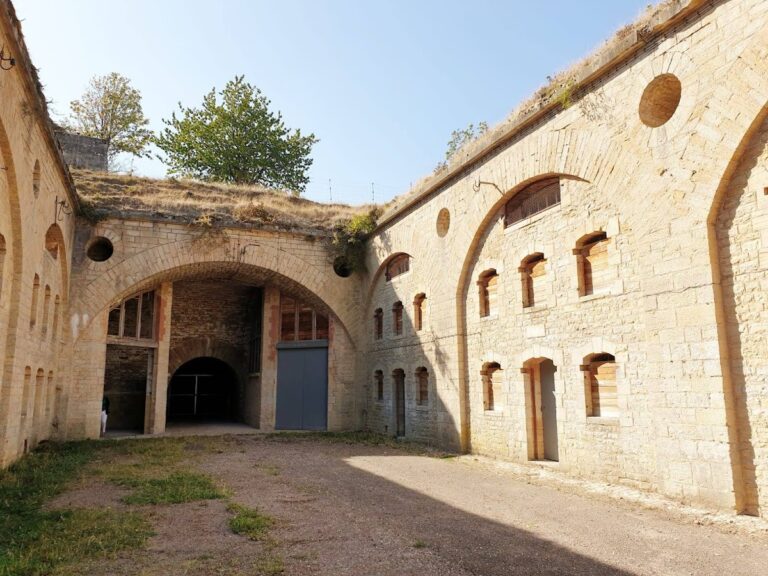
Fort d’Hauteville is a central-mass fortification, meaning that its principal buildings and defensive functions were grouped around a central core. Its surviving military character reflects its place within the fortified belt of Dijon and the defensive planning of the late nineteenth century.
Fortification and armament
Central mass and garrison
The fort’s listed garrison capacity was 653 men. In 1914, its garrison numbered 135 men, showing the difference between the planned accommodation figure and the force assigned during the First World War.
Artillery defenses
The rampart armament comprised 22 cannons and eight mortars. A further ten pieces formed the flanking armament, weapons intended to fire along the sides of the surrounding defenses and protect approaches that frontal fire could not cover effectively.
A special-concrete modernization was proposed under the French military program of 1900, followed by a supplementary program in 1908. Neither program was implemented at Fort d’Hauteville, leaving its defensive arrangement without those planned alterations.
Nearby sites