Château d’Olivet: An Early Medieval Motte Castle in Normandy
Site at a Glance
- Rating
- 4.3
- Popularity
- Very Low
- Country
- France
- Primary era
- Medieval
- Eras represented
- Medieval
- Civilizations
- Norman
- Site type
- Military
- Remains
- Castle
On this page12 sections
History
Château d’Olivet is an early medieval motte castle in Grimbosq, France, founded in the first half of the eleventh century by Erneis Taisson, a Norman lord. A motte-and-bailey castle combined a raised earth mound carrying a fortified tower with enclosed areas for residences, workshops, and service buildings. Built from timber and earth, Château d’Olivet occupied a strategic position above the Orne and controlled a river crossing.
The Taisson family and the Norman conflicts
Erneis Taisson was the younger son of Raoul Taisson, who had received lands in Normandy from William, duke of Normandy. Erneis became involved in an open conflict with his elder brother, Raoul II Taisson, lord of nearby Mutrécy and of Thury-Harcourt.
In 1046, Raoul II joined the barons who rebelled against William the Conqueror, the Norman duke who became king of England in 1066. Wace says that Raoul II later returned to William’s side during the Battle of Val-ès-Dunes on 10 August 1047, a Norman conflict that helped William consolidate his authority in the duchy.
Abandonment and later lordship
Occupation of the castle ended during the twelfth century, although the southern bailey remained in use until its abandonment in the middle of the thirteenth century. In the fourteenth century, the Tournebu family raised the Olivet domain to baronial status. A barony was a territorial lordship whose holder possessed recognized feudal authority and status.
In 1606, a daughter of Pierre d’Harcourt married into the La Marzelière family. A member of that family subsequently held the title of castellan of Olivet. The castle itself had already been abandoned, but its symbolic importance continued into the seventeenth century.
Archaeology and protection
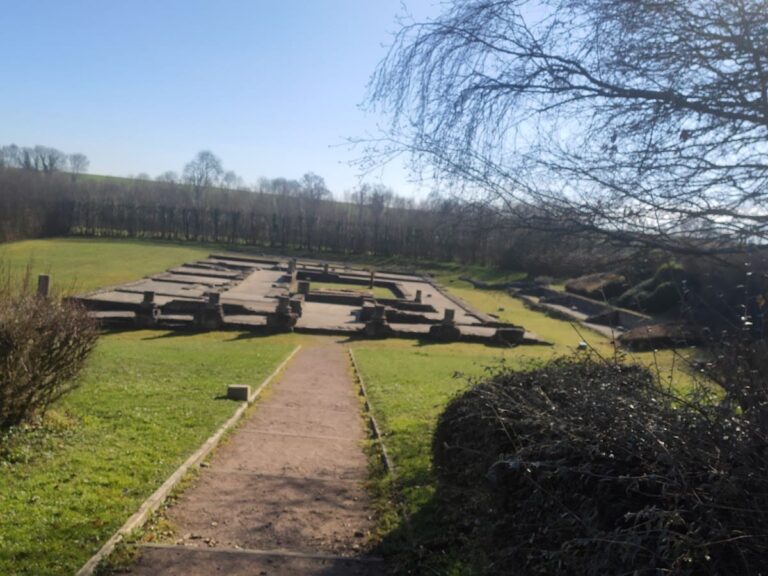
Michel de Boüard and Joseph Decaëns directed archaeological investigations at the site from 1975 to 1978. Later safeguarding work consolidated the dry-stone walls and positioned timber pieces to indicate the internal framework of the seigneurial residence.
The ruins have been protected as a registered French historic monument since an order of 21 July 1988. This recognition reflects the site’s archaeological value for the study of early medieval motte castles. Château d’Olivet is owned by the City of Caen.
Remains
The ruins occupy the end of a rocky spur in Grimbosq Forest, in the Cinglais, near the countryside of Mutrécy. The spur overlooks the Orne and stands at the meeting point of the Coupe-Gorge and Grande Vallée streams. Its position controlled a crossing of the river. The castle consisted of a central motte and two baileys enclosed by a ditch. The narrow northern bailey lay at the end of the spur, while the broader southern bailey formed the larger enclosed area.
The motte and northern bailey
The lookout tower
The narrow motte supported a lookout tower, or belfry. It formed the raised defensive centre of the castle and belonged to the timber-and-earth construction founded in the first half of the eleventh century.
The noble bailey
The northern bailey, described as the noble bailey, contained buildings standing on stone foundations. These included the seigneurial residence, a kitchen, and the chapel of Saint-André-d’Olivet. Timber elements now indicate the former positions of the residence’s internal framework, while the surviving walls remain in a consolidated ruinous condition.
The southern bailey and the wider landscape
The utilitarian bailey
The broader southern bailey served practical functions within the castle complex. It contained a forge and probably a stable, and it continued in use after occupation of the castle’s other areas had ended, until the middle of the thirteenth century.
Woodland clearance
Archaeological work revealed an effort to clear part of the surrounding forest for farmland intended for peasants from the neighboring village. Before this work, Grimbosq Forest and Cinglais Forest formed part of a larger woodland massif. The evidence connects the castle landscape with the management of land and resources around the settlement.
Objects and surviving fabric
Excavations recovered objects associated with the aristocratic occupants, including spurs, arrowheads, trictrac pieces, and glazed-pottery children’s rattles. Trictrac was a medieval and early-modern board game related to backgammon, so the pieces provide evidence of leisure activity among the castle’s aristocratic residents.
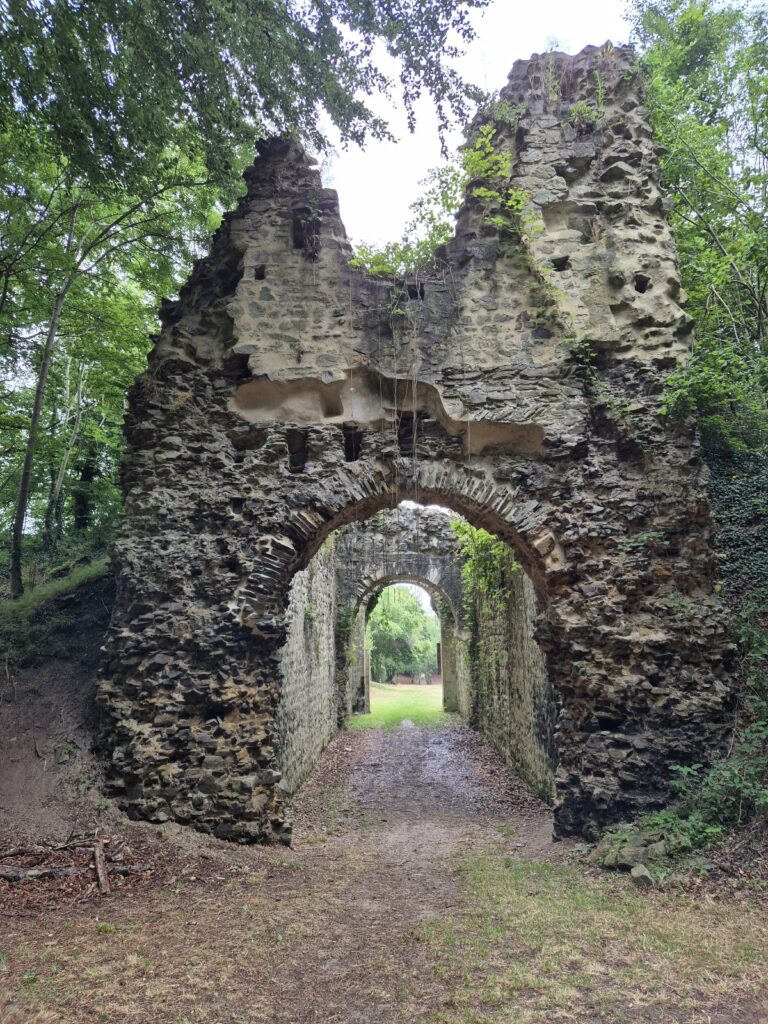
Château d’Olivet survives as ruins. Consolidated dry-stone walls preserve parts of the archaeological structure, and inserted timber pieces mark the former internal framework of the seigneurial residence.
Nearby sites