Theveste (Tebessa): A Roman City and Byzantine Fortress in Algeria


Site at a Glance
- Rating
- 3.5
- Popularity
- Very Low
- Country
- Algeria
- Primary era
- Classical
- Eras represented
- Classical, Medieval
- Civilizations
- Amazigh, Byzantine, Numidian, Phoenician, Roman
- Site type
- City
On this page16 sections
History
Theveste, also known as Tebessa, is an ancient city in Algeria, built as a Roman foundation in AD 75 near an older Berber settlement beside the Aurès Mountains. Its history reaches back to Paleolithic and Neolithic habitation, while its Roman development made it a military, commercial, civic, and Christian center in North Africa.
Early settlements and Carthaginian rule
The area was inhabited during the Paleolithic and Neolithic periods, as shown by objects recovered through excavation. An earlier Numidian and Berber settlement occupied the site before Phoenicians established a city there. Ancient Greek writers called it Theveste and also used the descriptive name “City of a Hundred Gates,” apparently because they confused it with Thebes in Egypt.
Carthaginians settled in the region around 880–820 BC and described the city as six days from Carthage. Theveste remained a major Berber center until Hanno the Great, a Carthaginian general and strategist, captured and occupied it around 247 BC. Massinissa, king of Numidia, controlled Theveste’s important agricultural center from 174 to 150 BC.
Roman foundation and expansion
Rome conquered the region in 146 BC, although an older city called Tbessa already existed there. Roman authority was consolidated after the submission of Jugurtha in 105 BC. Theveste lay near the southern limit of the territory occupied by the Musulames, a Berber people of Roman North Africa.
The Romans founded a new Theveste in AD 75 beside the older Berber village, apparently to control the mountainous region. During the first century AD, the Legio III Augusta, a Roman imperial legion responsible for military operations and territorial control in North Africa, was stationed there before transferring to Lambaesis. The city was probably elevated to colonial status under Trajan, who ruled from AD 98 to 117. A Roman colony was a settlement organized under Roman colonial law, with a formal civic structure and a close connection to Roman administration and citizenship.
Theveste flourished under the Roman emperors Hadrian and Septimius Severus. Its population was estimated at nearly 30,000 under Severus and at 50,000 under Hadrian. Under Severus, the city is described as having become a colony, with Roman citizenship granted to all its inhabitants. It developed into a strategic military and commercial center, an important diocesan seat, and a major center of Romanization in southern Algeria. Eight major roads converged there, linking it with Mascula, Timgad, and Lambaesis.
Christian communities and late antiquity
The Arch of Caracalla was erected in AD 214 in honor of Septimius Severus, the emperor’s father. A Christian basilica was later built at Theveste, which became an episcopal see, meaning the jurisdiction governed by a bishop. Donatism, a Christian schismatic movement that maintained separate churches and bishops in parts of North Africa, subsequently spread in the city.
Leucius, bishop of Theveste, attended the Council of Carthage in 256 and died as a martyr two years later. Maximilianus was martyred on 12 March 295, followed by Crispina on 5 December 304. By around AD 400, Crispina’s tomb in a cemetery outside the city had developed into an important pilgrimage complex.
The city’s bishops included Romulus, recorded in 349, Urbicus, recorded in 411, Felix, exiled by the Vandals in 484, and Palladius, known from an inscription. At the Conference of Carthage in 411, Urbicus represented the Catholic side and Persévérantius the Donatist side. Persévérantius had also attended the Maximianist council at Cabarsussi in 393. The Maximianists were a dissident branch of the Donatist movement. Felix was among the Catholic bishops of Numidia exiled by the Vandal king Huneric in 484.
A well-preserved burial and epitaph in the great basilica identify the bishop Palladius. The inscription states that he lived for 52 years and served as bishop for 12. His identity and date remain debated. He has been identified either with an exiled bishop of Idicra who died at Theveste after 484 or with a bishop whose epitaph dates from the sixth century. An inscription near Tébessa dated 9 January 550 names Faustinus, who has been attributed to Theveste.
During the fourth and fifth centuries, Theveste was also a center of Manichaeism, a religious movement founded by Mani that combined elements of Christianity, Zoroastrianism, and other traditions. A 26-leaf Latin codex written by Manichaeans was discovered in a cave near the city in June 1918.
Vandal, Byzantine, and Islamic periods
The Vandals captured and plundered Theveste in the fifth century without completely destroying it. In 496, Berber tribes led by Jaldas plundered and ruined the city, after which the Vandal king Thrasamund retook it. The city’s decline began during this period.
Around 530, the Byzantine governor and patricius Solomon recovered the region. The Byzantine Empire was the eastern Roman Empire, whose North African territories were reconquered during the reign of Emperor Justinian I. Theveste became part of a Byzantine province, was restored, and received new defensive walls in 535 after a Berber revolt led by Antalas. Solomon also commissioned a tomb at the city, which survives.
After the Muslim conquest of the Maghreb, Theveste became an Islamic city known as Tébessa and remained within the fortified Byzantine enclosure. The surrounding region appears to have remained peripheral to the principal episodes of the Arab conquest. Arab geographers from the ninth to the thirteenth centuries mentioned Tébessa intermittently as a madina, or city. Under the Hafsid ruler Abu Bakr, a local sheikh named Muhammad ibn Abdun controlled it.
Al-Bakri, a medieval Arab geographer, described Tébessa as ancient and noted its large stone blocks and visible pre-Islamic remains. The anonymous author of the Istibsar, a medieval Arabic geographical work, stated that two ancient temples and a building for spectacles could still be seen. Umayyad forces nearly destroyed the city, but a small settlement, probably first inhabited by a few surviving Christian Berbers, remained for centuries.
The diocese of Theveste is now a suppressed episcopal see and a titular see of the Catholic Church. A titular see is a former episcopal diocese retained in a bishop’s formal title although it no longer functions as a resident diocese. Theveste has been counted among the Church’s titular episcopal sees since the eighteenth century, and John Anthony Dooher became titular bishop on 12 October 2006.
Remains
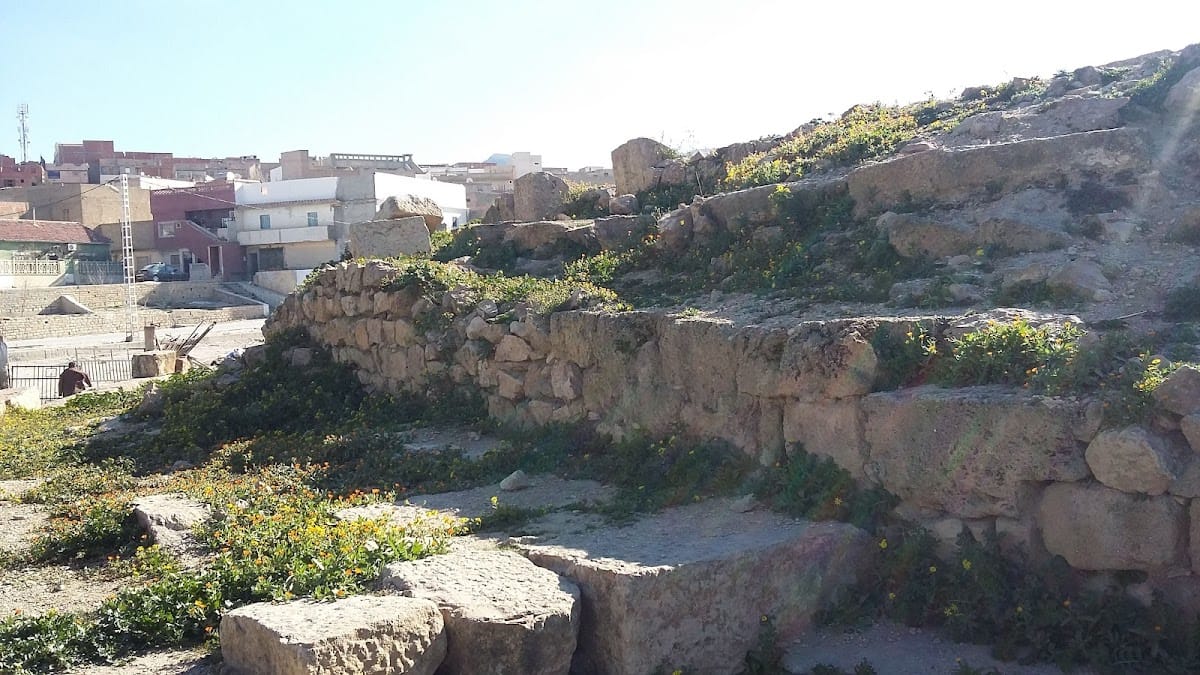
The surviving remains are concentrated around the Roman Forum and include civic, religious, military, and funerary structures. Roman monuments stand alongside the later Byzantine enceinte, or enclosed defensive circuit, while the Basilica of Saint Crispina occupies a separate complex north of the Arch of Caracalla and outside the old city.
Roman civic and religious monuments
Arch of Caracalla
The Arch of Caracalla is a Roman triumphal arch dated to AD 214. It stands on a square plan at the intersection of two roads and formed the northern entrance to the city. Its four façades are identical, giving the monument a consistent appearance on each side.
Temple of Minerva
The Temple of Minerva dates from the beginning of the third century AD. Mosaics decorate its walls, and coins, weapons, lamps, and other prehistoric objects are found inside the building. It forms part of the group of Roman remains situated around the Forum of Theveste.
Roman theatre and amphitheatre
The small Roman theatre was built when Theveste was refounded as a base for the Legio III Augusta. The amphitheatre dates from the fourth century AD and is divided into two sections. Together with the Forum and temple, these structures represent the civic and public buildings of the Roman city.
Roman aqueduct and Forum
A Roman aqueduct survives in partly functional form. The Forum of Theveste is among the visible remains of the Roman city and belongs to the principal archaeological group around which the ancient monuments are concentrated.
Christian and funerary complex
Basilica of Saint Crispina
The remains of the Basilica of Saint Crispina belong to a large Christian complex built at the end of the fourth century. Dedicated to the local martyr Crispina, it was one of the largest basilicas in Africa. The complex included chapels, baptismal fonts, catacombs, and gardens.
The basilica stood outside the old city, north of the Arch of Caracalla. Paths, monumental steps, stables, promenades, and numerous Roman buildings surrounded it. The burial and epitaph of Bishop Palladius were found in the great basilica, providing the inscription that gives his age and the length of his episcopate.
Tomb of Solomon
A tomb commissioned by the Byzantine governor Solomon remains extant. Its survival belongs to the sixth-century phase of restoration that followed Byzantine recovery of the region.
Byzantine fortifications
Solomon’s Walls
The sixth-century Byzantine enceinte, popularly called Solomon’s Walls, encloses the historic center. Thirteen square towers flank the fortifications, and four gates opened through the defensive circuit. One of these gates was formed by the Arch of Caracalla, linking the earlier Roman monument with the later Byzantine enclosure.
