Pac Palace: A Historic Aristocratic Residence in Vilnius


Site at a Glance
- Rating
- 4.7
- Popularity
- Very Low
- Country
- Lithuania
- Primary era
- Early Modern
- External website
- Open
- Eras represented
- Early Modern
- Civilizations
- Grand Duchy of Lithuania, Polish–Lithuanian Commonwealth
- Site type
- Domestic
- Remains
- Palace
On this page7 sections
History
Pac Palace is a historic residence in Vilnius, Lithuania, built at the end of the sixteenth century or around the turn of the sixteenth and seventeenth centuries in the city’s Old Town. It stands on the site of the earlier stone Pigulczyński house and later acquired a late-Baroque character, before extensive rebuilding gave it Classical features. Its successive owners included powerful aristocratic families of the former Grand Duchy of Lithuania and the Polish-Lithuanian Commonwealth.
Aristocratic ownership and rebuilding
In the late sixteenth century, the property was acquired by Hieronim Wołłowicz, General Starosta of Samogitia, a senior territorial administrator and the highest-ranking official in that Lithuanian region. During the first half of the seventeenth century, it passed to the Radziwiłł family and later to Kazimierz Leon Sapieha. By the middle of the seventeenth century, the palace belonged to the Pac family, whose members included Krzysztof Zygmunt Pac and Michał Kazimierz Pac.
The palace burned during the Russo-Polish War in 1655 and was rebuilt afterward. Later Pac owners included Piotr Michał Pac, General Starosta of Samogitia; Michał Kazimierz Pac, Grand Hetman of Lithuania, the Grand Duchy’s senior military commander; and Józef Franciszek Pac, Castellan of Samogitia. A second major fire damaged the building in 1748.
Józef Franciszek Pac and his son Michał Jan Pac, the last descendant of the formerly wealthy and influential Pac family, could not restore the palace after the 1748 fire. Michał Jan Pac was forced to emigrate for political reasons in 1771, and his possessions were placed under sequestration, meaning that the state took control of them or administered them for political or legal reasons.
The Sapieha palace
In 1783, Aleksander Michał Sapieha, Grand Chancellor of Lithuania, acquired the deteriorated and partly ruined building. A grand chancellor was a leading state official responsible for central government and diplomatic affairs. Sapieha extensively rebuilt and redecorated the palace, giving it the later form and Classical character that complemented its earlier Baroque origins. In 1793, ownership passed by inheritance to Franciszek Sapieha, General of Artillery.
Confiscation and changing public uses
After the November Uprising of 1830–1831, a Polish-Lithuanian insurrection against Russian rule, Russian authorities confiscated the palace from the Sapieha family because of its involvement in the uprising. They established the residence of the governor of the Lithuanian-Vilna Governorate in the building.
In the early twentieth century, the palace housed a Russian club. After reconstruction designed by Aleksandr Sonin, it accommodated the Russian Noble Assembly and the Russkij Mir restaurant from 1912. Before the First World War, its tenants also included a bookstore, an art gallery, and a wine shop. The Lithuanian Association Rūta occupied the building in 1918, and Christian labor unions made it their seat in 1919. Polish authorities and state institutions later used parts of the palace as well.
Institutional use and restoration
After the Second World War, the palace was assigned to communications workers. For a period it contained a long-distance telephone exchange and telegraph station, and it later served as the Culture House of Communication Workers. Apartments were also installed in the building. In 1959, Justinas Šeibokas and Bronislovas Krūminis rebuilt and partly restored the palace for its new institutional use. Further restoration continued from 1978 to 1991 under the Polish Monuments Restoration Laboratories, with additional work reported in the 1990s.
After Lithuania regained independence, Pac Palace became the property of the Lithuanian Post. Poland’s Ministry of Foreign Affairs purchased it on 27 July 2007 for use by the Embassy of Poland in Lithuania, the Polish Consulate General, and the Polish Institute in Vilnius. The sale was intended to help the Lithuanian Post repay its debts. In September 2007, Lithuania’s General Prosecutor’s Office announced an investigation into the circumstances of the transaction following a complaint by Lithuanian political figures and a member of the State Commission for National Heritage. After renovation and adaptation, the palace opened on 13 September 2018 as the headquarters of the Polish Embassy, its Consular Section, and the Polish Institute in Vilnius. It is a state-protected regional cultural-heritage monument listed in the Lithuanian Register of Cultural Values under code 760.
Remains
Layout and architectural character
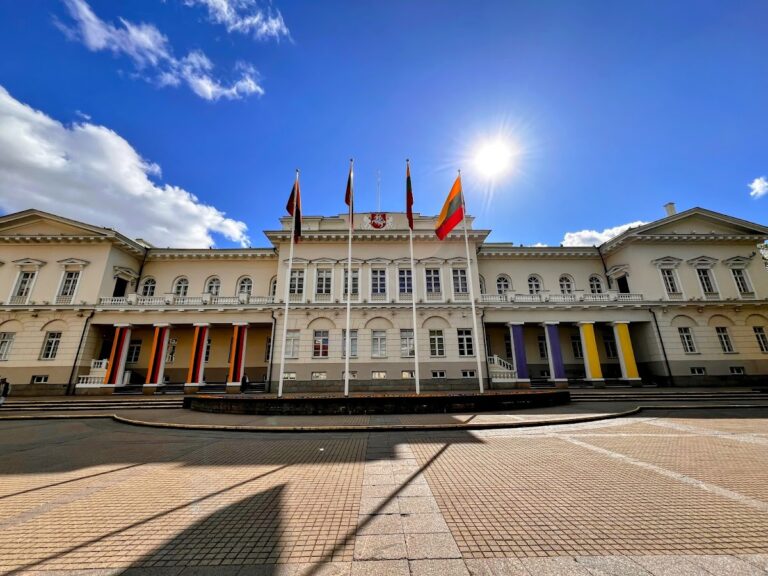
Pac Palace is a two-storey rectangular building organized around an inner courtyard. Its architectural character is late Baroque, a European style associated with elaborate movement and ornament, although the extensive eighteenth-century rebuilding introduced Classical elements derived from more restrained ancient Greek and Roman forms. The palace’s original Baroque decorations have not survived. The courtyard facade reaches the street frontage, and a gate once led directly through the building toward the street. Above this passage was a representative hall. The palace stands near Vilnius University within the historic Old Town, while its surviving form reflects the successive rebuilding and adaptation of the residence from an aristocratic palace into an institutional building.
Nearby sites