Fort Przyczółek Mostowy: A Historic Bridgehead Fort in Toruń, Poland


Site at a Glance
- Rating
- 4.1
- Popularity
- Very Low
- Country
- Poland
- Primary era
- Modern
- Eras represented
- Modern
- Civilizations
- German, Kingdom of Prussia
- Site type
- Military
- Remains
- Fort
On this page9 sections
History
Fort Przyczółek Mostowy is a fort in Toruń, Poland, built on the city’s left bank between 1824 and 1828. Located in the Stawki district, it was constructed to protect a wooden bridge and later helped safeguard Toruń Główny railway station. Part of the fort grounds was subsequently separated for the station’s construction.
Construction and nineteenth-century changes
The fort’s early history includes a monument to Franz Brusch von Neuberg, an Austrian colonel, erected on the grounds in 1827. Some accounts give 1825 as the monument’s date. In 1888, workers strengthened the fort’s upper covering with concrete and planted trees on its slopes.
Military and industrial reuse
During the 1920s, the fort housed a facility making military uniforms and a provisioning station for military transports. Early twentieth-century family houses built for officer personnel later accommodated the Lacpol Toruń processed-cheese factory, which operated there until closing in 2022.
Political inscriptions and heritage protection
In late 1981 or early 1982, inscriptions protesting Poland’s totalitarian communist authorities were placed on the fort wall. They were entered in the register of historic monuments in 2020. The fort is also listed in Toruń’s municipal heritage inventory as number 288.
Remains
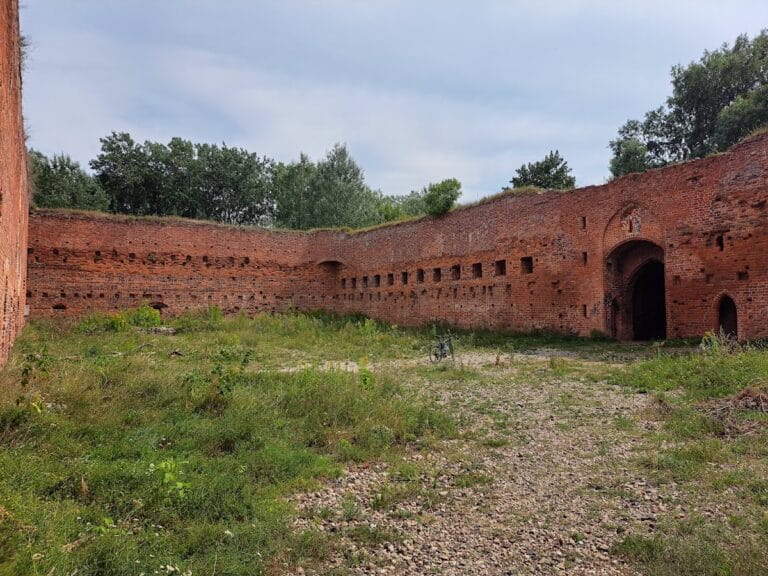
The surviving fortifications include a long defensive wall on the side facing Podgórska Street, together with the remains of the fort’s covered defensive layout. The grounds also retain buildings associated with its later military and industrial use, while the former moat and caponier lay in the area now occupied by Millennium Park.
Defensive works
Wall and loopholes
The oldest surviving part of the fort is the long wall beside Podgórska Street. It contains loopholes, narrow openings that allowed defenders to use weapons while remaining partly protected. The wall also bears the protest inscriptions dating from late 1981 or early 1982.
Moat and caponier
A deep moat once formed part of the fort’s defenses in the area of present-day Millennium Park. A caponier, a fortified structure positioned in or projecting into a ditch to direct defensive fire along the moat, was located there as well.
Covering and later buildings
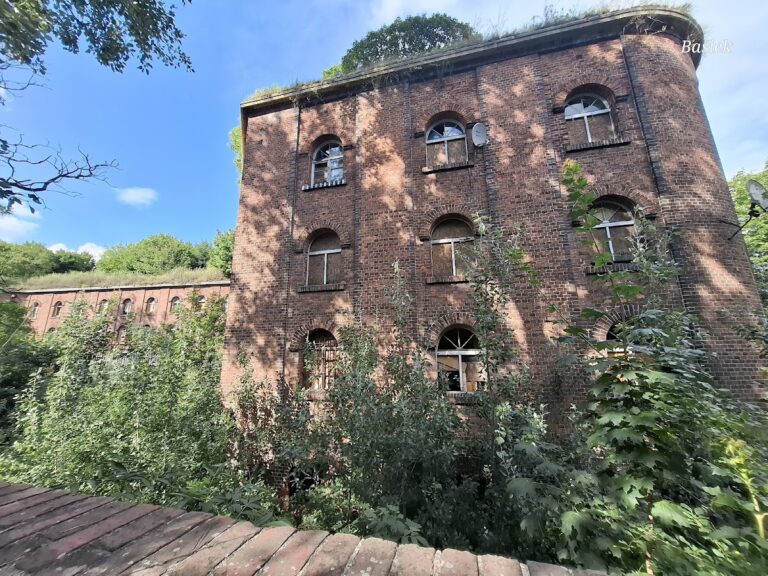
The fort had an upper covering that received a concrete reinforcement in 1888. Its grounds also included early twentieth-century family houses for officer personnel. These buildings were later used by the Lacpol Toruń processed-cheese factory.
Nearby sites