Montacute Castle: A Norman Motte-and-Bailey Stronghold


Site at a Glance
- Rating
- 4.5
- Popularity
- Low
- Country
- United Kingdom
- Primary era
- Early Modern
- External website
- Open
- Eras represented
- Medieval, Early Modern
- Civilizations
- British, Norman
- Site type
- Military
- Remains
- Castle
On this page7 sections
History
Montacute Castle in the United Kingdom was a Norman stronghold built after the Norman Conquest of England in 1066 for Robert of Mortain, a Norman nobleman and half-brother of William the Conqueror. It occupied a hill above the settlement of Bishopston and became the principal castle of Robert’s honour, a medieval territorial lordship of estates and dependent rights. The castle formed part of the new Norman political order in Somerset and overlooked routes important for movement across the region.
A Norman centre of power
Robert acquired the land from Athelney Abbey in exchange for the manor of Purse Caundle, a transaction regarded as costly for him. The settlement received the Norman name Mons Acutus, meaning “sharp hill,” and Bishopston later became known as Montacute. Robert also abandoned another Somerset castle that he had built at Castle Neroche, making Montacute the principal seat of his lordship.
The hill may also have been chosen for its political associations. Before the Battle of Hastings, Anglo-Saxons, the Germanic peoples and kingdoms that had dominated England before the Norman Conquest, reportedly discovered what they believed was a holy cross there. Harold Godwinson, the last crowned Anglo-Saxon king before the Conquest, is said to have carried it into battle, and the cross was used as a battle cry by the Anglo-Saxon army. This tradition gave the hill a meaning that reached beyond its defensive position.
Revolt, monastic ownership, and decline
In 1068, during a major Anglo-Saxon revolt against Norman rule, the castle was unsuccessfully besieged. Norman forces led by Geoffrey de Montbray, the bishop of Coutances, defeated the rebels. The episode demonstrated the castle’s role in the consolidation of Norman control, while its position also allowed it to oversee the Fosse Way, a major Roman road crossing Britain, and the Somerset Levels.
In 1102, William of Mortain, Robert’s son, gave the castle and its surrounding lands to the Cluniac order. This reforming Benedictine monastic network originated at Cluny in Burgundy, and its foundation at Montacute transformed the site’s institutional role. Montacute Priory was established there, while the castle gradually lost its military importance and declined. Its chapel, dedicated to Saint Michael, remained in use until at least 1315.
Destruction and modern protection
John Leland, an English antiquary who recorded historic and archaeological remains during the sixteenth century, described the castle as partly ruined in 1540. By then, the ruins were being quarried for building stone, a process that eventually led to the castle’s disappearance. The chapel was later rebuilt after the surrounding castle had been destroyed. Montacute Castle is now a Scheduled Monument, a legally protected archaeological or historic site in England. The National Trust owns the site, and English Heritage staff surveyed it for the National Trust in April 2000.
Remains
Montacute Castle occupied a hill above Montacute village, where the natural form of the ground was adapted into an oval motte and an inner bailey, with an outer bailey surrounding them. A motte-and-bailey castle combines a raised earthwork mound, usually carrying a keep, with enclosed courts used for buildings and activities. The arrangement created a fortified complex shaped by the hill’s contours. Its elevated position also gave the castle control over traffic on the Fosse Way and across the Somerset Levels, helping to obstruct military movement.
Earthworks and surrounding landscape
The castle’s principal physical organization consisted of the oval motte, the inner bailey, and the enclosing outer bailey. Local tradition holds that a wooden keep stood on the site first and was later replaced by a stone castle. Beside the castle and settlement, a medieval deer park was established for hunting, adding a managed landscape to the defensive and residential complex.
Chapel and later tower
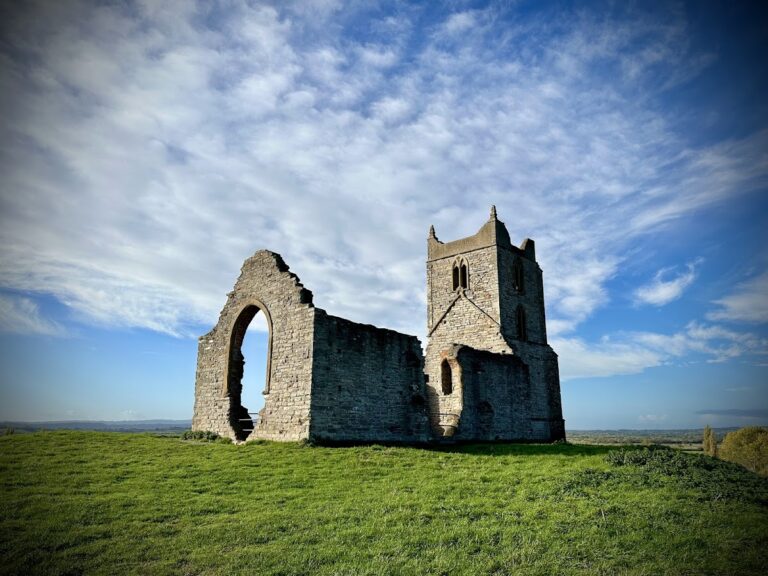
The castle chapel was dedicated to Saint Michael. After the castle’s destruction, the chapel was rebuilt, and the present St Michael’s Hill Tower, an eighteenth-century folly, occupies part of the former castle site and incorporates part of the chapel’s foundations. A folly is a mainly decorative building, often designed to resemble a ruin or another historical structure rather than to serve a practical purpose. The tower therefore preserves a physical connection with the chapel and the earlier castle through its position and reused foundations.