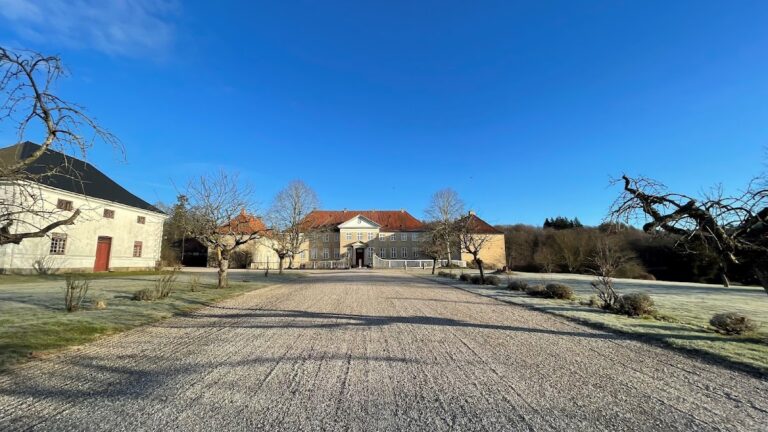
Løvenborg: A Danish Manor House and Estate


Site at a Glance
- Rating
- 4.5
- Popularity
- Low
- Country
- Denmark
- Primary era
- Early Modern
- External website
- Open
- Eras represented
- Early Modern
- Civilizations
- Danish
- Site type
- Domestic
- Remains
- Manor House
On this page7 sections
History
Løvenborg is a manor house and estate in Denmark whose complex was completed in the 1630s. Its history reaches back to the late twelfth century, when Bishop Absalon owned a village called Ennlige on the site. The property later became a large fief, an estate administered by a holder in return for service to a superior authority, and passed through ecclesiastical, royal, and noble ownership before becoming the centre of the Løven family’s barony.
From Ennlige to a royal fief
In 1199, Absalon presented Ennlige to Sorø Abbey, a major Cistercian monastery in Denmark. The abbey transferred the village to the Diocese of Roskilde in 1330, placing it under the jurisdiction of the bishop of Roskilde. At an unknown date, the village gave way to a manor bearing the same name. The estate became the seat of a relatively large fief.
During the Reformation, the sixteenth-century transformation that replaced Catholic ecclesiastical authority with Protestant church organization in Denmark, the Crown confiscated the property along with other possessions of the Catholic Church. It was then administered as a royal fief on behalf of the Crown.
The Barnekow and early noble estates
In 1547, the Crown sold Ellinge to the Pomeranian nobleman Hans Barnekow. At the same time, he was naturalized as a Danish nobleman and required to settle in Denmark and marry a Danish woman. He married Mette Oxe in 1550 and renamed the estate Birkholm.
After Hans Barnekow died, Mette Oxe remained at Birkholm. Their son Johan Barnekow inherited the estate in 1582. When Johan died in 1603, ownership passed to his brother Christian Barnekow. Christian’s widow, Margrethe Brahe Barnekow, administered Birkholm until their son Ove Barnekow was able to take control. After Ove’s death in 1629, his brother Hans Barnekow inherited the estate and sold it in 1630.
The purchaser was Malte Juul, who also owned Jessinggaard and Maltesholm. After his death, his widow Anne Juul, née Ramel, continued to live at Birkholm. Their only son died before her, so the estate passed to the husband of their youngest daughter, Mouritz Podebusk.
Seventeenth-century baronies
In 1676, Mouritz Podebusk established the Barony of Einsiedelsborg, but Birkholm was not incorporated into it. He sold Birkholm to Frederik Vittinghof Scheel, who established the Barony of Scheelenborg in 1680. After Scheel’s death, the estate went to his son-in-law, Baron Schack von Brockdorff.
Baron Schack von Brockdorff died in 1731, and Birkholm was sold at auction. His widow, Sophie Charlotte, bought it and transferred it to their son Frederik von Brockdorff. He pawned the estate in 1735, and it was sold at auction again in 1738.
The 1738 purchaser was Herman Leopoldus, a timber merchant and shipowner from Skien-Porsgrund in Norway. He had acquired Aggersvold at Hjembæk in 1737 and was ennobled in 1738 under the name Løvenskiold. He died in 1750. Birkholm later passed to Severin Løvenskiold, who inherited it together with Aggersvold and several Norwegian ironworks.
Creation of Løvenborg
Severin Løvenskiold had served in the Royal Life Guards and received the honorary Danish administrative and court title of konferensråd at the age of 24. In 1749, he married Magdalene Charlotte Hedevig Løvenskiold, née von Numsen, the daughter of the General War Commissioner.
In 1766, Severin created the stamhus of Løvenborg from Birkholm and Vognserup. A stamhus was an inherited landed estate subject to entail, which restricted its division or sale. The stamhus became a barony in 1773, giving the estate a higher-ranking entailed status associated with a baronial title.
Severin Løvenskiold died in 1776, after which his widow, Magdalene Charlotte Hedevig Løvenskiold, owned Løvenborg. The estate was reportedly used by Foreign Minister A. P. Bernstorff for secret negotiations connected with Crown Prince Frederick, later King Frederik VI of Denmark, and his seizure of power.
Reform, family inheritance, and decline of the barony
In 1789, Magdalene Charlotte Hedevig Løvenskiold transferred Løvenborg to her only son, Michael Herman Løvenskiold. He introduced contemporary agricultural reforms by selling the tenant farms to their copyholders. Copyholders were tenant farmers with hereditary or otherwise established rights to cultivate and occupy land in return for obligations to the estate owner. The process was completed in 1802.
Carl Løvenskiold, the eldest son of Carl Michael Herman Løvenskiold, inherited the barony in 1807. His son Herman Løvenskiold succeeded him in 1821 and lived quietly at the estate. Herman had a deep interest in music, and several of his compositions were published under the pseudonym Fridolin Carlsen.
After Herman Løvenskiold died in 1877, Løvenborg passed to his son Herman Frederik Løvenskiold. In 1878, a legal guardian placed the estate under administration because Løvenskiold was considered mentally ill. He objected several times without success and eventually moved to Vejle, where he supported himself as a plumber.
Herman Frederik Løvenskiold died in 1917, and the estate passed to his nephew Carl Løvenskiold. The barony was dissolved in 1921 under the Danish law of 1919 that abolished fiefs and entailed estates. That legislation ended the system preserving baronies as indivisible hereditary holdings. Part of Løvenborg’s land was sold in lots to pay the state fee, while Vognserup was sold in 1921.
After Carl Løvenskiold died in 1938, Løvenborg was sold to Count Christian Carl Ahlefeldt-Laurvig. The estate’s development from Ennlige and Birkholm into Løvenborg therefore spans medieval ecclesiastical administration, royal control after the Reformation, successive noble inheritances, agricultural reform, and the dismantling of the baronial system in the twentieth century.
Remains
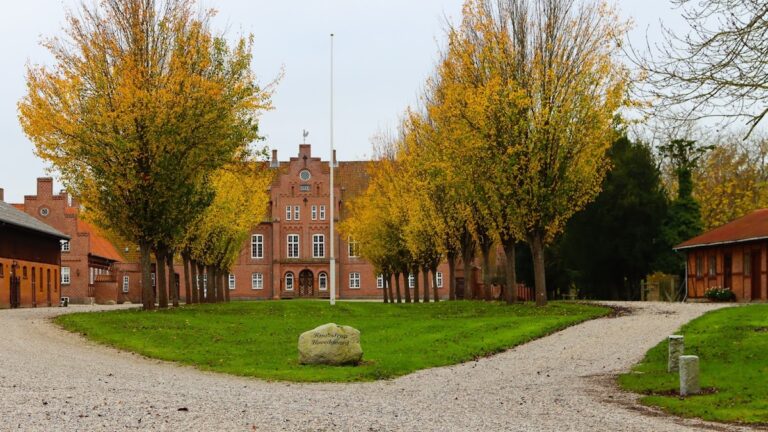
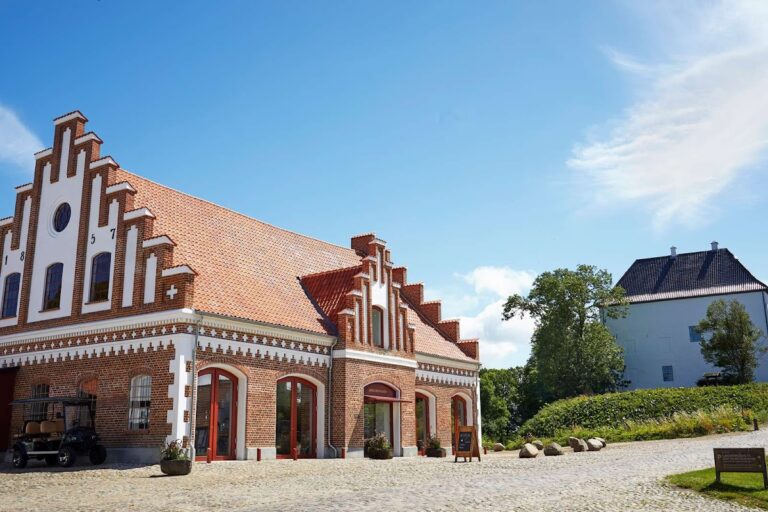
Løvenborg survives as a manor house and estate complex whose construction was completed in the 1630s. The site occupies the location of the earlier village of Ennlige, which was later replaced by a manor of the same name at an unknown date. The documented physical identity of the site is therefore tied to the transition from village settlement to manor estate, followed by the establishment of the complex associated with Birkholm and, from 1766, Løvenborg.