La Lanterne: A French Presidential Residence in Versailles


Site at a Glance
- Rating
- 4.1
- Popularity
- Low
- Country
- France
- Primary era
- Early Modern
- External website
- Open
- Eras represented
- Early Modern, Modern
- Civilizations
- French
- Site type
- Domestic
- Remains
- Elite Residence
On this page8 sections
History
La Lanterne is a former royal hunting lodge and state residence in Versailles, France, built in 1787 for the French court during the final years of the monarchy. Its builder was Philippe-Louis-Marc-Antoine de Noailles, prince de Poix, who served as captain of the royal hunts and governor of Versailles. The property stood beside the royal menagerie on land that Louis XV had granted to the prince’s father, the comte de Noailles.
Royal lodge and nineteenth-century uses
La Lanterne was created as a hunting retreat beside the menagerie. The identity of its architect and the workers who built it is unknown, since precise construction records have not survived. During the French Revolution, the property was alienated with the other buildings of Versailles. The Crown recovered it in 1818, during the Restoration, the period when the French monarchy was re-established after Napoleon’s fall, chiefly under Louis XVIII and Charles X.
Between 1847 and 1848, the building housed the director of the menagerie’s stud farm. From 1848, it became the home of the director of the Agronomic Institute, which replaced the stud farm. Two restoration campaigns took place during this phase. Beginning in 1872, La Lanterne was rented to a succession of private occupants, among them the American millionaire James Gordon Bennett Jr.
From republican residence to government retreat
During the Liberation of France in 1944, when the country was freed from German occupation and republican government was re-established, La Lanterne was formally added to the list of republican residences. Félix Gouin, vice-president of the Council, was its first tenant in this new role. David K. E. Bruce, the United States ambassador to France, lived there from 1949 to 1952, followed by André Le Troquer, president of the National Assembly, who remained its tenant until 1958.
In 1959, General Charles de Gaulle, the founder of the Fifth Republic and its first president, designated the former hunting lodge as an official holiday residence for the serving prime minister. Michel Debré used it regularly at weekends, while his wife followed renovation work. André Malraux lived at La Lanterne from 1962 to 1969 after an attack by the OAS, a clandestine French nationalist organization that opposed Algerian independence and used political violence, destroyed his apartment in Boulogne-Billancourt. Much of the interior decoration chosen by Louise de Vilmorin, Malraux’s companion, dates from this period.
Georges Pompidou preferred his own secondary residence at Orvilliers. Michel Rocard, prime minister from 1988 to 1991, renovated La Lanterne and commissioned its swimming pool and tennis court. He used the residence during his premiership and negotiated part of the Matignon Agreements there. These 1988 political agreements helped settle conflict in New Caledonia.
Presidential use
Lionel Jospin and his wife, the philosopher Sylviane Agacinski, regularly spent weekends at La Lanterne between 1997 and 2002, using the private apartments and playing tennis. Dominique de Villepin, prime minister from 2005 to 2007, commented on the residence’s extensive wine cellar.
From 1959 to 2007, La Lanterne was traditionally assigned as the prime minister’s secondary residence. In May 2007, shortly after winning the presidential election and before his inauguration, Nicolas Sarkozy stayed there with Cécilia Attias on 12 and 13 May at Dominique de Villepin’s invitation. He worked on forming the Fillon I government during that stay. After his civil marriage to Carla Bruni at the Élysée Palace, the official presidential residence, Sarkozy held his wedding dinner at La Lanterne on 3 February 2008.
Since 2007, the residence has been used by the president of the French Republic. François Hollande and Emmanuel Macron also used it privately. During Sarkozy’s presidency, the estate gained wider national prominence when flights over it were prohibited and some mapping services blurred its satellite imagery. Château de Souzy-la-Briche was made available to the prime minister in compensation for La Lanterne’s presidential use, although the prime minister did not stay there.
In 2012, Hollande retained La Lanterne as a presidential residence. Its legal assignment remained with Matignon, the office and official residence of the French prime minister, while a 2013 budget measure proposed transferring its administration to the Élysée domain. In December 2020, after contracting SARS-CoV-2, Emmanuel Macron stayed at La Lanterne in isolation for seven days while continuing his work.
Remains
Estate and principal building
La Lanterne occupies a four-hectare estate beside the Park of Versailles and the road between Versailles and Saint-Cyr-l’École. High walls and poplars enclose the grounds. A tree-lined lane runs from the gravel courtyard to the departmental road, about 200 metres away.
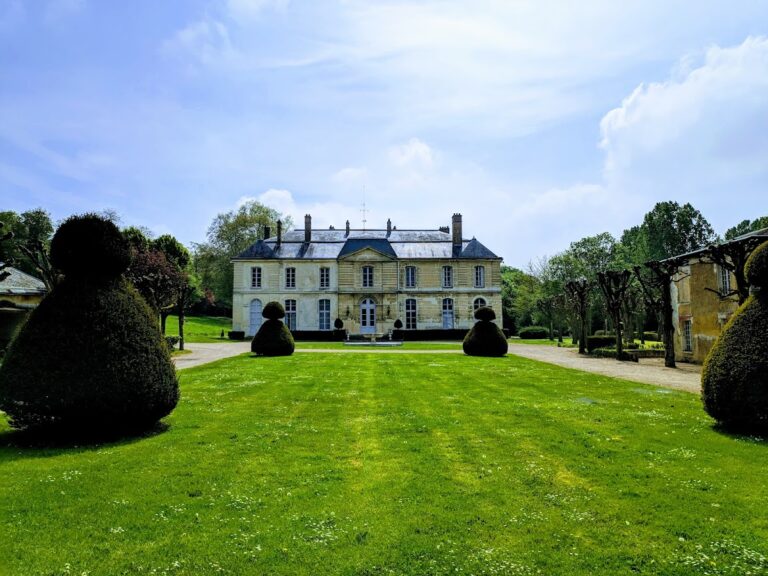
The principal building is a two-level, U-shaped structure. Its central section measures about 20 metres by 6 metres and is flanked by lower wings added later, which enclose the gravel-covered courtyard. One wing contains staff accommodation and the kitchen, while the other serves building-security services. Two studios were installed in the left wing during Nicolas Sarkozy’s presidency.
The original pavilion had a ground floor and an attic level. Its stucco-decorated facade contains seven bays, with six window bays arranged around a central doorway topped by a pediment. Thirty-six windows illuminate the building. On the ground floor are a large salon with a grand piano, a dining room, and an office. The upper floor contains five guest bedrooms, each with its own bathroom.
Garden and residential facilities
The estate includes a large garden, a swimming pool, a tennis court, and a wine cellar. The pool and tennis court were commissioned during Michel Rocard’s renovation of the residence. Together with the later wings and private apartments, these facilities reflect the building’s continuing use as a secluded government and presidential retreat.
Entrance grille and name
The entrance grille once separated the courtyard from the approach. It incorporates thirty-six herms, ornamental pillars or pilasters topped by carved busts in the classical tradition. Two of the herms are surmounted by deer heads, and two deer busts crown the entrance gate. The deer-headed herms were restored in 1942 and 1943, while the herms had already undergone restoration between 1785 and 1786. The pavilion received a complete restoration in 1994.
The name La Lanterne probably derives from the lantern turret that crowned the nearby former royal menagerie. It does not refer to the revolutionary refrain Ah! Ça ira, whose reference to lanterns concerned those in Paris.