Fort Delimara: A British Coastal-Defence Fort in Malta


Site at a Glance
- Rating
- 4
- Popularity
- Low
- Country
- Malta
- Primary era
- Modern
- External website
- Open
- Eras represented
- Modern
- Civilizations
- British
- Site type
- Military
- Remains
- Fort
On this page12 sections
History
Fort Delimara is a British colonial polygonal fort in Malta, built at Delimara Point near Marsaxlokk between 1876 and 1888 as part of the coastal defences of Marsaxlokk Harbour. A polygonal fort uses angular defensive lines rather than the older bastioned layout. The fort formed part of a wider system that also included Fort Tas-Silġ, Fort San Lucian, Fort Benghisa, and the Pinto and Ferretti batteries around Marsaxlokk Bay.
Construction and coastal defence
Construction began in 1876. The date 1881 above the main entrance refers to the completion of the gatehouse, not to the commissioning of the whole fort. The nearby Delimara Tower, a seventeenth-century watchtower built by the Knights Hospitaller in 1659, was demolished to clear the fort’s field of fire.
Fort Delimara’s artillery was modernized in 1887, again in 1913, and once more in 1938 and 1939. These changes kept the fort within Malta’s changing coastal-defence system, even after some of its original surface arrangements had become obsolete.
War, accident, and military decline
During the Second World War, the fort was used in operations against the laying of mines in the Mediterranean. It was also bombarded during the conflict. In March 1903, defective bombs stored at the fort before disposal exploded after local youths tampered with one of them. Four people were killed.
Most of the artillery was removed in 1956, when the British coastal-defence system was abolished and Fort Delimara’s strategic function ended. The site was then abandoned for a considerable period. The Government of Malta leased it to a local farmer in 1975, and it was used as a pig farm from 1982 until 2005.
Recent ownership and condition
Ownership passed to Heritage Malta on 11 August 2005. Heritage Malta is Malta’s government agency responsible for managing and conserving national museums, archaeological sites, and historic buildings. Plans to restore Fort Delimara and adapt it as a museum or visitor attraction have not materialized because of insufficient funds. The site remains under the agency’s responsibility, while coastal erosion and wave action continue to threaten its survival. Nearby development, including the Delimara Power Station and the Malta Freeport breakwater, has worsened these pressures.
Remains
Fort layout and landward defences
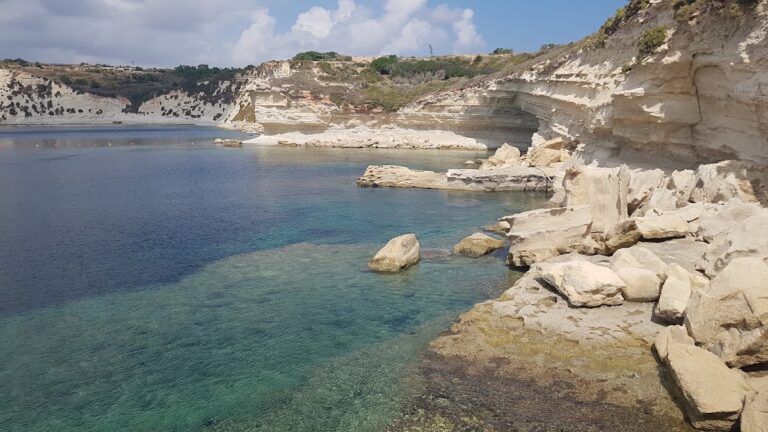
Fort Delimara occupies about 24,000 square metres and is built mainly from limestone and concrete. Most of the fort lies underground. Its surface plan is approximately hexagonal, with four sides formed by rock-cut ditches and the remaining sides following the gently curving vertical cliff at Delimara Point. Ventilation openings and access passages extend across the cliff face and onto the seaward side of the point.
Ditches and parapets
The ditches have revetted faces, meaning that parts of their slopes are supported by masonry. Their upper scarps are faced with earth and rubble, while a stone parapet with rifle loops runs along the top of the north scarp. A counterscarp battery at the northern end of the east ditch commands the north ditch and the gatehouse. A second battery probably stood at the southern end of the east ditch, where no caponiers, or covered firing positions projecting into a ditch, are visible.
Gatehouse and glacis
The gatehouse faces the landward end of Delimara Point and stands close to the seaward end of the north ditch. An asphalt road runs outside the ditch to the entrance. A square building above the gatehouse was probably added in the early twentieth century, when the fort continued to function as a military base after its surface defences had become obsolete.
The glacis, a gently sloping area outside a fort that exposed attackers to defensive fire, was probably reduced in front of the gatehouse to make road access easier. Its original rolling bridge was replaced by a permanent bridge. The road to Delimara Lighthouse cuts through the glacis along the east ditch, while the glacis beside the south ditch remains more intact.
Second World War pillbox
A pillbox, a small strongly protected concrete firing position, was built inside the Victorian fortification during the Second World War. It rises above the fort’s profile when viewed from the sea, adding a later defensive element to the nineteenth-century structure.
Seaward casemates and artillery
Casemate batteries
The seaward face is dominated by massive stone-and-concrete casemates, fortified chambers designed to shelter artillery or troops. They are arranged in pairs near the cliff top, covered with earth and rubble, and follow the natural curve of the cliff. Their arrangement allowed the combined fire of the battery to cover most of Marsaxlokk Harbour.
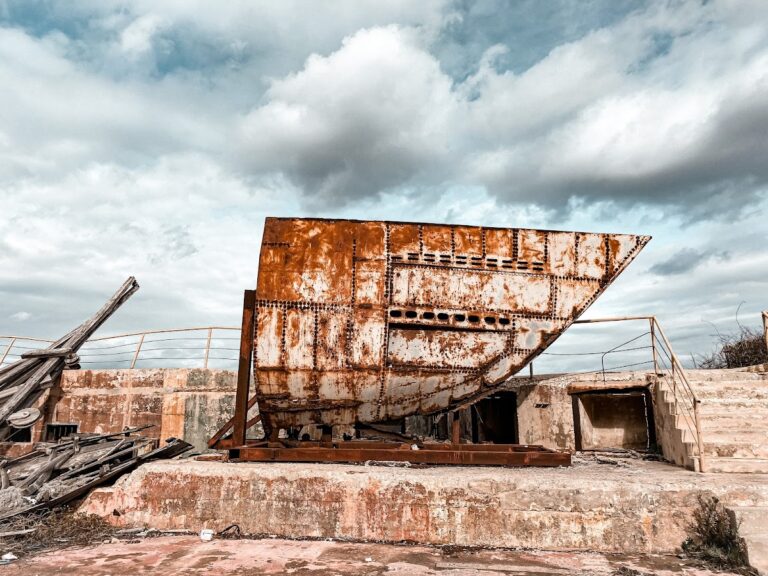
The casemates originally held fourteen Victorian 12.5-inch, 38-ton rifled muzzle-loading guns on dwarf carriages. These guns were loaded through the barrel and had internal grooves intended to improve the accuracy of their projectiles. Four of the original guns remain at the fort, despite its later agricultural use and the accumulation of modern debris.
Surviving fabric and deterioration
The limestone faces of the scarps and counterscarps have eroded substantially, in places to a depth of about one metre. Sections of revetting have collapsed into the ditches. Along the east ditch, where the road to Delimara Lighthouse passes above the counterscarp, a section about ten metres long has fallen into the ditch and threatens the stability of the road. Rubble from the collapse remains visible below.
The ditches are heavily overgrown and contain general rubbish. Although the external condition of the fort has been described as fair, the site is considered at risk of collapse, and parts of the nearby cliff have already fallen. Restoration has been estimated to require about ten years and millions of euros.
Nearby sites