Clarence House: A British Royal Residence in London


Site at a Glance
- Rating
- 4.5
- Popularity
- Low
- Country
- United Kingdom
- Primary era
- Modern
- External website
- Open
- Eras represented
- Modern
- Civilizations
- British
- Site type
- Domestic
- Remains
- Palace
On this page7 sections
History
Clarence House is a British royal residence in London, United Kingdom, built for the Duke of Clarence, the future King William IV, between 1825 and 1827 in the late Georgian and Regency period. It stands beside St James’s Palace and faces The Mall in the City of Westminster. Its history reflects the changing domestic and official needs of the British royal family from the reign of William IV to the present day.
Origins and the reign of William IV
Clarence House was constructed on the site of apartments built during the sixteenth-century reign of Henry VIII. William, who held the title Duke of Clarence before becoming king, preferred the new house to St James’s Palace, which he regarded as cramped and antiquated. After his accession in 1830, he continued to live at Clarence House instead of moving to Buckingham Palace. The architect John Nash, a leading designer of Georgian and Regency London, created a direct passage between the house and the State Apartments of St James’s Palace so that the king could conduct royal business.
William IV remained at Clarence House until his death in 1837. The residence then passed to his sister, Princess Augusta Sophia. After her death in 1840, it became the London home of Princess Victoria, Duchess of Kent, the mother of Queen Victoria and an influential presence during her daughter’s early life.
Royal residents and wartime use
In 1866 Clarence House became the London residence of Prince Alfred, Duke of Edinburgh. He lived there until his death in 1900, when the house passed to Prince Arthur, Duke of Connaught and Strathearn. Prince Arthur occupied it until his death in 1942.
Clarence House also had a temporary institutional use during the twentieth century. For a short period in the 1930s, it housed the library of the School of Oriental and African Studies, a University of London institution devoted to the study of Asia, Africa, and the Middle East. In 1939, after London universities were evacuated during the Second World War, the school moved temporarily to Cambridge.
The house was damaged during the Blitz, the sustained German aerial bombing campaign against Britain, especially London, in 1940 and 1941. Following Prince Arthur’s death in 1942, the Red Cross and the St John Ambulance Brigade used Clarence House as their headquarters for the rest of the Second World War.
Elizabeth, the Queen Mother, and the modern monarchy
After their marriage in 1947, Princess Elizabeth and Philip, Duke of Edinburgh, made Clarence House their home. Their daughter, Princess Anne, was born there in August 1950. When Princess Elizabeth became Queen Elizabeth II in 1952, she moved to Buckingham Palace in 1953. Her mother, Queen Elizabeth The Queen Mother, and her sister, Princess Margaret, then moved into Clarence House.
Princess Margaret left the residence for an apartment in Kensington Palace after her marriage in 1960. The Queen Mother continued to live at Clarence House until her death in March 2002. The building was then renovated and became the London residence of Charles, then Prince of Wales, and Camilla from 2003. It was also the official London residence of Prince William from 2003 until April 2011 and of Prince Harry from 2003 until March 2012. Both later moved their residences and offices to Kensington Palace.
Charles III has continued to use Clarence House as his London residence with Queen Camilla since becoming king in 2022. In June 2026, it was announced that they would remain there after the planned completion of renovations to Buckingham Palace in 2027. Buckingham Palace would continue to serve as the monarchy’s headquarters for official events. During Charles’s years as Prince of Wales, the name Clarence House was also used for his private office and press operation. The house is held by Charles III in right of the Crown and has been a Grade I listed building since 5 February 1970. In England, Grade I status is the highest level of statutory protection for buildings of exceptional architectural or historic interest.Remains
Building and setting
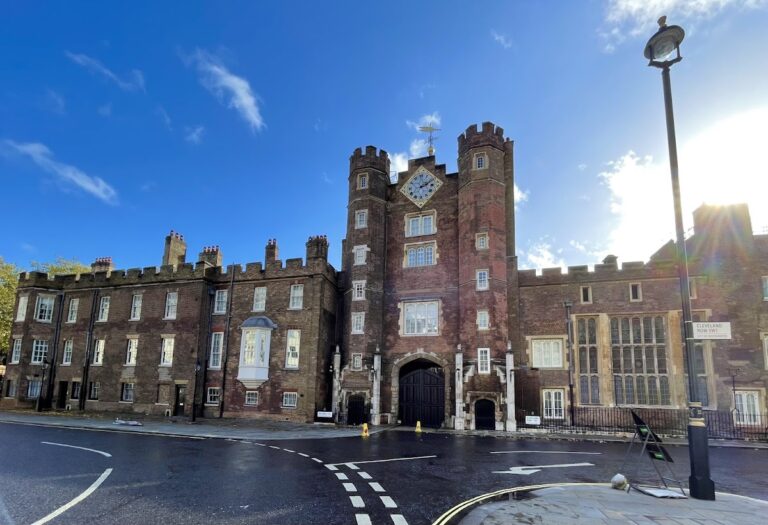
Clarence House is a four-storey building in the late Georgian or Regency style, an early nineteenth-century architectural and decorative tradition associated with the period around the regency of George, Prince of Wales. Its facade is covered with pale render. The house stands within the grounds of St James’s Palace, facing The Mall and open green space. It is beside Stable Yard road, with Lancaster House opposite, and adjoins St James’s Palace.
Extensive remodelling and reconstruction followed the bombing during the Second World War. These interventions left little of the original structure designed by John Nash. The present building therefore combines the site’s historic role and surviving setting with a fabric substantially altered after wartime damage.
Ground-floor rooms and collections
The ground-floor living rooms contain parts of the art collection assembled by Queen Elizabeth The Queen Mother. The collection includes porcelain and silverware, along with paintings by British artists including Graham Sutherland, Walter Sickert, Augustus John, and Edwin Landseer. It also contains works by Franz Xaver Winterhalter and Claude Monet, bringing together decorative objects and paintings associated with the royal household.